VULCANISM – ADVANCED PHYSICAL GEOGRAPHY
Vulcanicity or Vulcanism refers to the endogenic process where by molten materials are either intruded (forced to solidify within the earth crust) or extruded (ejected and solidified on outside of the earth’s surface). The materials intruded or extruded are solidified to form Igneous rocks common known as Vulcanic features.
The molten materials before reaching the earth’s surface are called Magma while after reaching on the earth’s surface they are called Lava.
THE DIFFERENCES BETWEEN VULCANICITY AND VOLCANICITY
1. Vulcanicity is a broad concept which include both intrusive and extrusive process, while volcanicity refers to extrusive process only where by the materials are ejected, cool and solidify on the earth surface.
2. The molten materials erupted outside the earth crust are called LAVA, while when the materials are still inside the crust are called MAGMA.
3. The volcanic process led to the formation of volcanic features, while Vulcanic process led to the formation of Vulcanic features.
4. Generally, the study of Vulcanicity refers as Vulcanology, while the study of Volcanicity is known as Volcanology.
THE NATURE OF MOLTEN MATERIALS
The molten materials (lava or magma) can be defined as any hot mobile materials originating below the earth surface capable of penetrating into or through the rock of the earth crust.
Most of the molten materials in reality liquid but they are combination of liquid, solid and gases materials.
PRINCIPLE KINDS OF MOLTEN MATERIALS (LAVA AND MAGMA)
There are two principal kinds of magma which differ based on chemical composition and viscosity.
What is the viscosity?
Viscosity is the tendency of molten materials to resist flow.
In general, the less viscous magma flows a greater distance occupies a large area than the highly viscous magma.
There are two (2) kinds of magma. These are: –
a) Basaltic / Basic magma:
Is the type of magma which contains less silica content but high metallic materials eg. Fe, Mg, etc. The silica content is less than 55%. This type of magma has high temperature about 9000C to 12000C and they erupt silently. This type of magma is less viscous thus capable to travelling a greater distance. They are very fluidly.
b) Granitic / Acidic magma:
It contains high silica content about 60% to 70% or above. The temperature of granitic magma is lower than 5000C, making it very thick and highly viscous. This magma does not travel at a greater distance but erupted violently.
VULCANIC LANDFORMS / FEATURES
There are several features (landforms) formed due to cooling and solidified of Vulcanic molten materials both intrusive and extrusive.
There are two kinds of features. These are: –
i. Intrusive Vulcanic features.
ii. Extrusive Vulcanic features.
INTRUSIVE VULCANIC FEATURES
These are Vulcanic features formed by intrusive vulcanicity where by molten materials cools and solidify within the earth crust.
The intrusive features can be divided into plutonic and hypabyssal features depending on their location within the earth crust. These features are the following;
1. Dyke
This is the discordant intrusive vulcanic feature which cut across the bending panes formed when magma solidified along the vertical faults. The dykes may be eroded to give rise the formation of trenches.
Example of dyke occurs in the south and west of Blantyre in Malawi, the Turkana ridges south of Lake Turkana, Kaap valley in S/Africa, Eastern Uganda in the Sukuli hills, etc.
2. Sill
These are horizontal sheets of solidified magma lying horizontally along the bending planes. Sills may extends for several kilometers and can be of any thickness. They are concordant or destroy the rock strata. Sills may cause water falls when overlying by the river bed. Sometime transgressive sills may occur when overlies one another.
Example of sill the Kinkon waterfalls in Guinea.


3. Laccolith
This is dome shaped intrusive vulcanic features formed through injection and solidified viscous magma which was unable to spread far and therefore accumulated in a large mass arching to overlying rock. When the laccolith may be exposed on the earth surface by denudation form upland.
Example of laccolith is Fonjary massif and Ambreny in Madagasca. Sometime subsidiary laccolith above one another like a cedar tree eg. of cedar tree laccolith occur in Henry mount in U.K, El Koub on Djaouf Hill in Algeria.
4. Lopolith
This is a very large saucer shaped intrusion of solidified magma forming a great shallow basin. The shape may be due to the increased weight of the materials leading to sinking movement. After denudation the edge of lopolith may give rise to the formation of resistant hills.
Example of lopolith is the Bushveld basin in S/Africa, the Great lopolith of Zimbabwe, the Banana Islands in the Atlantic Ocean (coast of Sierra Leone).


5. Phacolith
This is the lens shaped strip of igneous rock intrusion formed when magma solidified along the anticline and or syncline of the folded rock strata.
Example of Phacolith occur in Cordon hill in U.K. Phacolith are concordant intrusive features.
5. Batholith
This is a dome or very large mass of igneous rock which is formed by cooling and solidification of magma deeply in the heart of mountain range. They have a coarsegrained texture and, in most cases, they are granitic in composition. Normally they form surface features after the removal of the overlying materials through denudation. Batholiths have irregular shape with side walls that incline steeply against the host rock. A batholith forms the root of a mountain.
Similar to batholith but small in size are called Bosses. When both batholith and bosses undergo changes (metamorphosed) are called Xenolith.
Example of batholith include Nevada Batholith and Idaho Batholith in U.S.A, Aswan Granite Batholith in Egypt and Cape coast Batholith in Ghana.


6. Stock
This is similar to batholith but it is much smaller. It is amorphous and of indefinite depth, but it has a surface area of only a few square kilometers. Many stocks approximately are offshoots of batholith.

7. Ring dykes
This is the ring like intrusion of igneous rocks. It is formed when a circular block of the crustal rocks sinks into underlying magma, forcing molten rock to rise along the vertical cracks round the block. The magma cools and solidifies to form dykes round the block hence the name ring dyke. Eg. Chambe Hill in Malawi, Kudam Hills – Jose plateau in Nigeria.
EXTRUSIVE VULCANICITY / VOLCANICITY
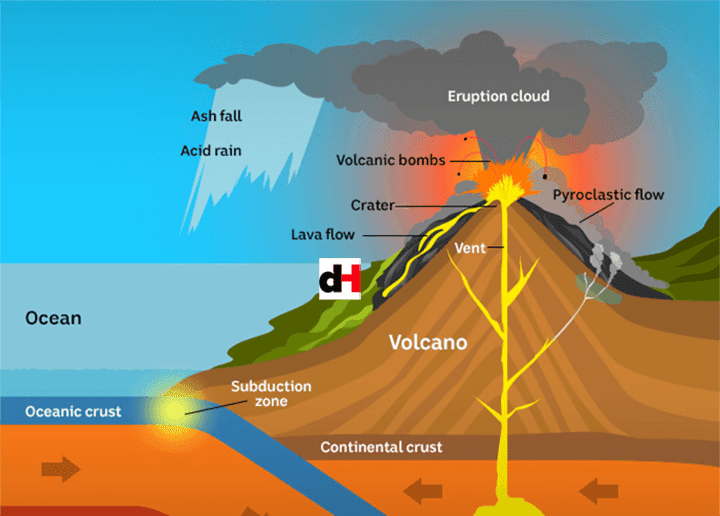
Volcanicity refers to the process where by molten materials called lava are ejected and solidified on to the earth surface.
The eruption of lava can be either silently or violently.
The silent (peaceful) eruption takes place through fissures, cracks, or faults and the type of lava ejected is usually basic in nature. This eruption is commonly referred as fissures eruption.
On the other hand, the violent eruption involves great force with ejection highly viscous lava. This eruption is called vent eruption, leading to the formation of cone like features.
The materials ejected are comprised of liquid, semi liquid, gaseous materials such as Sulphur, carbondioxide, etc. The materials are technically referred as Pyroclasts or Tephra.
VOLCANIC LANDFORMS / EXTRUSIVE VULCANIC FEATURES
There are different landforms associated with extrusive vulcanism (volcanism). These features divide into two groups. These are: –
- Major volcanic features.
- Minor volcanic features.
A: MAJOR VOLCANIC FEATURES
The major volcanic features are;
i. Explosive Crater
This is the shallow basin (depression) at the summit of a volcano surrounded by pyroclasts. It is formed when the vent or upper part of a volcano has been blown off after a vent eruption. Most of crater still become the site of opening of lava ejection from below the surface. Crater become a site of lake called crater lake. Example lake Oregon in U.S.A, lake Katwe in Uganda, lake Basotu in North East Singida, etc.
ii. Caldera
This is the very large depression at the summit of volcanic mountain.
It is formed due to either violent volcanic eruption where as blow off a larger area of the volcano top to form a bigger depression, or by subsidence of volcanic top as a result from continuous eruption which increase the weight of a volcano. When the caldera they become a site of water called caldera lake. Example lake Toba in Sumatra in Indonesia, etc.


iii. Lava plateau
It is an upland with general level summit made up with basic lava. It is formed when basic lava comes through cracks or fissures or faults to reach the surface. Example of lava plateau is Deccan plateau in India, Drakensberg plateau in S/Africa, etc.
iv. Ash and Cinder cone (Scoria cone)
This is a small symmetrical cone formed by violent eruption of lava where solid and ash materials accumulated around a vent. The cone is usually less than 150m high with fairly steep slopes. The slopes are concave in shape. Example of ash and cinder cone are Bitale mountain in South West Uganda, Paricutin mountain in Mexico, etc.

v. Composite cone (Strato volcano)
This is very large cone with alternate layers of pyroclasts and ash in strata. The composite cone are characterised by having secondary or parasitic cones attaching on the crater or on their slopes. Generally, most of the world great volcanoes are strato volcano. The strato volcanoes appear to have more than one crater. Example of strato volcano are Mount Etna and Vesuvius in Italy, mount Oldoinyolengai and Kilimanjaro in Tanzania, Mount Kenya, mount Longonot, mount Meru in Tanzania, mount Fujiyama, etc.

vi. Volcanic vent
This is a central opening exposed on the earth’s surface, underlying the summit crater of the volcano where volcanic materials are emitted. This opening, is usually circular or nearly circular shaped through which heated materials consisting of gases, water, liquid lava and fragments of rocks are ejected from the highly heated interior to the surface of the earth.

vii. Shield volcano (Basic lava cone)
This is very extensive cone with gentle sloping sides made up by basic lava. It is formed when the basic lava (less viscous) erupts and radiate from the vent in all direction.
The shield volcano has the following characteristics; It forms from fluid (less viscous) lava. It spread far distance from the vent. It is a gentle slope. It erupts silently because their lava is basic in nature (very fluidly).
Example of shield volcano include Mauna Loa and Mauna Kea mountains in Hawaiian in U.S.A, Afar triangle in Ethiopia, Nyamlagira in D.R.C, etc.

viii. Cumulo dome (Acidic lava cone)
This is the volcanic cone formed by eruption of very highly viscous lava forming steeper cone with invisible crater. Example; Ntumbi mountain in Mbeya – Tanzania,

ix. Plug dome (Volcanic plug)
This is the spinal volcano with a cylindrical summit made up by acidic lava. This forms a cylindrical plug or volcanic pipe that may completely block further eruption, sometime their vent blocked completely. Example the Atakor volcanic area of the Hoggar mountain in Algeria, etc.


B: MINOR VOLCANIC FEATURES
The minor volcanic features normally take place when volcanic eruption approach to the end. These are;
Solfatara:
It is a volcanic hole emitting Sulphur gases as dominant and water vapour. Other materials emitted by solfatara are hot muds. Solfataras are generally found in places with young volcanic activities. An example of solfatara is Naples Solfatara emissions in Italy.
Fumarole:
It is a volcano which emits steam, mud and several other gases than Sulphur. Examples of fumarole are found in the valley of Thousand Smokes in Alaska. Also, Kibo in Kilimanjaro can be put under this category, though it emits only gasses.
Mofette:
It is a volcano which emits carbon dioxide gas. Examples of Mofette are Kyejo in Rungwe, Southern Tanzania, Auvergne in France and Java in Indonesia.
Mud volcano:
Mud volcano is also known as mud dome. It is a landform formed from accumulated mud or slurries, water and gases erupted from the earth’s interior. Mud volcanoes do not produce lava and are not necessarily triggered by magmatic activity.
Hot spring:
It is a quiet outflow of superheated water from the ground. The outflowing hot water contains some mineral substances in solution or in suspension. Hot springs are common in Iceland as well as in some African countries such as Tanzania, Kenya and Ethiopia. Hot springs may be used to provide geothermal energy for different purposes especially for electricity generation.
Examples of hot springs are Amboni in Tanga and Nanyala in Songwe region, Tanzania.
Geyser:
This is a hot spring that throws out water into the air with great force and sometimes accompanied by steam. It occurs when heated water in the crustal rock is ejected explosively through a plumb-like narrow channel higher above surface. Examples of geysers are Allalobed and Dallol found in Afar region in Ethiopia.

THE CONDITIONS NECESSARY FOR OCCURANCE OF GEYSERS AND HOT SPRING
1. The presence of fracture in the crustal rock through which water can come out.
2. The presence of cavern that holds water in the ground.
3. Presence of very hot rock materials in the ground for the boiling the water that enters the rocks.
4. Presence of joints in the rocks that can allow water to get into the ground especially during the rainfall.
5. Presence of high hydrological pressure enough to forces water out of the ground.
ECONOMIC IMPORTANCE OF GEYSER AND HOT SPRING
i. The mud deposited by geyser gives rises to the formation of very fertile soils suitable for agriculture.
ii. In most cases geysers and hot springs contain medicinal water which can be used to treat human diseases.
iii. They may emerge as the source of streams.
iv. The features attract tourists, hence source of revenue.
v. They are site for chemical formed sedimentary rocks, through minerals precipitation.
CLASSIFICATION / TYPES / LIFE CYCLE OF VOLCANOES
There are various types of volcanoes according different criteria. These are: –
- Types of volcanoes based on the mode of eruption and shape of the volcano.
- Types of volcanoes based on the period of eruption.
A: TYPES OF VOLCANOES BASED ON THE MODE OF ERUTION AND SHAPE OF THE VOLCANO
Based on this category, the volcano can erupt either through vent (central) called central (vent) eruption or through the fissures called fissures eruption, as result of the following types of volcanoes. These are: –
i. Ash and cinder cones.
ii. Acidic lava cones (cumulo dome).
iii. Basic lava cone (shield volcano).
iv. Composite cones.
v. Crater.
vi. Caldera.
vii. Volcanic plug or neck.
viii. Fissure eruption eg. lava plateau.
ix. Minor volcanic forms like solfatara, fumarole,
Mofette, hot springs and geysers
B: TYPES OF VOLCANOES BASED ON THE PERIOD OF ERUPTION
According to the period of eruption (activities) there are three (3) types of volcanoes. These are: – [Life cycle of volcanoes are]
i. Active volcanoes.
These are volcanoes which erupt frequently in reality the volcanic activities never case and continues to erupt time to time. Most of active volcanoes occur along the plate tectonic margins where active plate motion triggers eruption processes. Example; Fujiyama mount in Japan, Nyiragongo in D.R.C.
A volcano said to be active only when it has erupted within 500 years.
ii. Dormant volcanoes.
It is also known as sleeping volcanoes. These are volcanoes which are not known to erupt (infrequent eruption) but expected to erupt again in the future. Example; Mount Kilimanjaro, Mount Meru, and Mount Kenya.
iii. Extinct volcanoes.
These volcanoes now are not expected to erupt again, therefore they are ceased to erupting for a very long time in history. Example; Mount Rungwe.
CAUSES OF VOLCANICITY
There are several causes of vulcanism. These are: –
1. Plate tectonic process (Plate movement):
Volcanic activities are closely related to plate tectonic processes and chiefly located along the edge of major plate margins. When plate move either divergent, convergent or transform can cause the up welling of the molten materials. The main areas of volcanic activities include Oceanic rifts, continental rifts, and subduction zones.
2. Hot spots cause:
Hot spots are the volcanoes that have not formed at a plate boundary, they are formed in the middle of the continents. Areas in the earth’s mantle that are hotter than the neighboring areas, forming melted rock that rise toward the crust. Example; Hawaiian Island are volcanic island that forming in the middle of Pacific plate far from its edge.
3. Isostatic cause:
The Isostatic adjustment can be causing the upwelling of molten materials from the ground.
4. Faulting cause:
When the block is displacement due to faulting it cause the upwelling of molten materials from the earth interior.
5. Global warming cause:
When the temperature increasing on the earth disturb the molten materials (convectional currents) due to increasing the heat within interior zones that cause the pressurize the molten materials to up welling.
THE ECONOMIC IMPORTANCE OF VOLCANIC ACTIVITIES
(CONSTRUCTIVE EFFECTS OF VULCANISM)
Volcanoes have enormous economic importance. These are;
1. Source of fertile soil:
Volcanic materials produce fertile soil that supports agriculture activities both cash and food crop production. Example Coffee growing in Kilimanjaro region depend on fertile soil, etc.
2. Source of mineral ore:
Volcanic activities result in the formation of precious stones and minerals, like gold from Geita in Tanzania, Mwadui dyke for diamond in Shinyanga in Tanzania, and silver from Kakamega, Kenya. Minerals bring foreign currency used for the development of country’s economy.
3. Source of Geothermal power:
Consistently, volcanic activities facilitate geothermal energy production because when magma rises close to the earth’s surface, it heats the groundwater to boiling point. When a well is drilled in these regions, hot water is pumped out as steam due to the extreme heat. The steam can then be used to drive turbines and produce electricity useful for different domestic, industrial and office activities. A good example is in Iceland where over 90% of homes are heated through geothermal energy. Another example Olkario in Kenya, Ethiopia, New Zealand, etc.
4. Source of hot water:
Hot springs are used for heating and supplying hot water in cold countries like Iceland and New Zealand during winter season.
4. Source of building materials:
Moreover, volcanic activities contribute towards provision of building materials, for instance, igneous rocks are used for building and construction of roads. Basalt, diabase and pumice are good examples.
5. Source of tourism:
Features that result from volcanic activities attract tourists such as crater, caldera, hot springs, etc. For example, the snow-capped Mount Kilimanjaro, Mount Oldonyo Lengai and the Ngorongoro caldera in Arusha attract tourists who bring in foreign currency and create employment opportunities among the citizens.
6. Source of rainfall:
Apart from that, volcanic mountains influence the formation of orographic rainfall. For example, the windward side of Mount Kilimanjaro receives adequate rainfall that supports agriculture activities.
7. Source of rivers:
Volcanic mountains form sources of rivers which can be harnessed through dams to produce electricity or for irrigation purposes. For example, the source of River Pangani is Mount Kilimanjaro whose water is used to generate hydro-electric energy at Hale and Nyumba ya Mungu Electrical Power Stations. Volcanic soils are fertile and suitable for agricultural production.
8. Source of Islands:
When volcanic cool and solidified within the oceanic plates cause to the formation of new land surface called Island. Example Hawaiian Island, Japanese Island, etc.
DESTRUCTIVE IMPACTS/ NEGATIVE EFFECTS OF VOLCANISM
1. Source of death to people:
When the volcano erupt near to the settlement can cause to killed a number of people.
For example in 1902 when mount Pelee erupt in Caribbean killed about 30,000 people.
2. Demage to properties:
The properties like crops, houses, infrastructure, etc are destroyed during the volcanic activities. iii. Source of mass wasting:
When volcanic erupt sometime cause mudflow due to heavy rains or melting of snow or flowing of lava which may be disastrous to the surrounding community.
3. Destroy agriculture;
The lava flow can also destroy agricultural land since the solidified lava hardens and makes it difficult for farmers to cultivate the land.
4. Source of pollution:
Moreover, volcanic eruptions may release poisonous gases such as Sulphur dioxide and carbon dioxide which may have adverse impacts to human beings as well as the atmosphere hence pollute air. Also, pollute noise for example, in 1883 when mount Krakatoa in Indonesia erupt with explosion heard 4000km away at Alice springs in Australia, Mount St. Helens in Washington on May 1980 when erupt heard to Vancouver 320km north in Canada.
5. Source of Tsunami:
During violent volcanic eruption near the coast or below the sea level, the possibility of formation of Tsunami waves and destroy coastal village, marine vessels, etc.
6. It hinders communication:
The surface of volcanoes and lava flow remain barren for long periods of time and the surface is extremely rough hence difficult to travel.
7. It causes earth quakes:
The violent volcanic eruption can cause earth quakes which can kill number of people and destroy infrastructure. Example the earth quake demage caused by eruption of mount Krakatoa 1883 in Indonesia.
8. Source of weather abnormalities:
Dense ashes in the atmosphere released by volcanic eruption can obscure penetration of sun rays to the earth surface, therefore leading to weather abnormalities.
GLOBAL DISTRIBUTION OF VOLCANOES
Basically, volcanic activities are not evenly distributed globally. It is revealed that almost 2/3 of volcanoes occur within the pacific ring of fire i.e areas surrounding the Pacific Ocean. Majority of activities corresponding to earth quakes belt along the plate tectonic boundaries where plate interacts and creates line of weakness through which materials up welling. In this case, there are the following volcanic zones in the world;
1. The pacific ring of fire:
This is the plate tectonic zone surrounding the Pacific Ocean. It includes sites of west coast of South America, North America, the Aleutian in the North Pacific Ocean, the Eastern lands of Eurasian linking Japanese volcanic sites and the South West of Pacific Ocean. These also volcanic site at middle of the Pacific Ocean marked by Isles like Hawaiian Island.
2. The Indian – Australian zones:
This is the lower plates tectonic zones running from Himalaya fold belts zones drown to the West Indian particularly Java and Indonesia. It also includes ocean plateau of Indian.
3. The Rift and Mid oceanic ridge zones:
These are among active basaltic volcanoes zones lying in the divergent plate zones of middle Atlantic Ocean, some parts of Southern Ocean, Indian Ocean and the Great East Africa rift valley. Example; Mountains Kilimanjaro, Elgon, Meru, Abyssinian, volcanoes in the North Africa, etc. This zone also includes areas along Rhine rift valley in Western Europe.
REVISION QUESTIONS: VULCANISM
1. Discuss the effects of volcanism to man and his surroundings.
2. Describe the life cycle of volcanoes
3. Describe the landforms associated with volcanicity.
4. Describe the constructive and destructive impacts of volcanism
5. People living in areas affected by volcanism benefits a lot by being occupants of those areas. Justify this statement with six points
6. Despite being dangerous, volcanism influences the development of the society. Justify this statement with six points
7. With the aid of diagram, explain six intrusive volcanic features.
8. Classify volcanoes
9. Briefly discuss the conditions that produce hot springs and geysers (Necta 2002)
10. Describe risks and prepatory measures associated with volcanic eruption that can be communicated to a community residing in close proximity to active volcanoes.
11. You have been assigned by your subject teacher to prepare a morning talk on socioeconomic siginicance of volcanoes. With examples, exaplain those significance.
CLICK HERE TO GET PDF FULL NOTES