TOPIC 2 CONGRUENCE – MATHEMATICS FORM TWO
Introduction
In fields like architecture, engineering and design, precise measurements and patterns are crucial.
Maintaining such patterns and measurements across objects and designs requires an understanding of the relationship between shapes and their properties.
In this chapter, you will learn about postulates, proofs and theorems on congruence as well as the congruence of triangles.
The competencies developed will enable you to solve problems such as determining the dimensions of sides of figures without taking actual measurements, designing and making objects of the same shapes and sizes such as worn-out parts.
Think
Without knowledge of congruence, industries would take longer time to produce objects of the same shape and size.
The Concept of Congruence
The term congruence is derived from the Latin word congruentia which means agree or fit together exactly. Engage in Activity 2.1 to explore the characteristics of objects from real life situations which fit together.
Activity 1: Exploring Congruence of Objects
Create a shape of your choice in Ms-Word, copy and paste it, then drag it on top of the original and observe.
Enlarge the original shape, overlap it with the copied shape, and note any changes.
Use real objects (e.g., coins or books) to repeat task 1 (or task 2 where necessary) and compare your observations.
In Activity 1, one may have noticed that same objects matched exactly on top of each other. This means that the objects have the same shape and size. Two or more objects with such characteristics are called congruent figures.
POSTULATES, THEOREMS AND PROOFS
Understanding postulates, theorems, and proofs is important for developing a solid foundation in mathematics. These concepts form the basis for logical reasoning and they are used to validate mathematical ideas.
Postulates
A postulate is a statement that is accepted as true without any proof. These statements are universally accepted, self-evident and can form the basis for further reasoning and making arguments. The following are examples of postulates.
A circle can be drawn with any centre and radius.
A straight line can be drawn from any point to any other point.
All right angles are equal to each other.
Theorems
A theorem is an argument that has been proved to be true based on past established results, definitions or postulates.
The following are examples of theorems.
The sum of interior angles of a triangle is 180 degrees.
In a right-angled triangle, the square of the length of the hypotenuse is equal to the sum of the squares of the lengths of the other two sides.
The sum of interior angles of a quadrilateral is 360°.
Proof
A proof is a series of logical statements that are based on definitions, previously established facts, and postulates that may be used to conclude the truth of a mathematical argument.
The following are common procedures when undertaking a proof.
Draw a clearly labelled diagram to represent a problem. Indicate all the information such as equal angles, parallel lines, and congruent segments.
Write down the given information based on the labels of the supporting figures.
State the argument which needs to be proved.
Where necessary, make additional constructions with dotted lines to make the proof clear.
In writing the proof.
Refer to the figures you have planned to use in the proof.
Provide arguments with reasons based on the given information or established facts.
Start with statements whose validity is given or are obvious.
The final statement is the conclusion about what was supposed to be proved.
Engage in Activity 2 to explore more about postulates, proofs, and theorems.
Activity 2: Exploring postulates, proofs, and theorems
Identify a list of postulates, proofs, and theorems from reliable sources and briefly explain why each is accepted as a postulate, proof or theorem.
Example 1
Prove that the sum of interior angles of a triangle is 180∘
Solution
Consider the triangle ABC as shown in the following figure.

Example 2

Example 3

Exercise 1


CONGRUENCE OF TRIANGLES
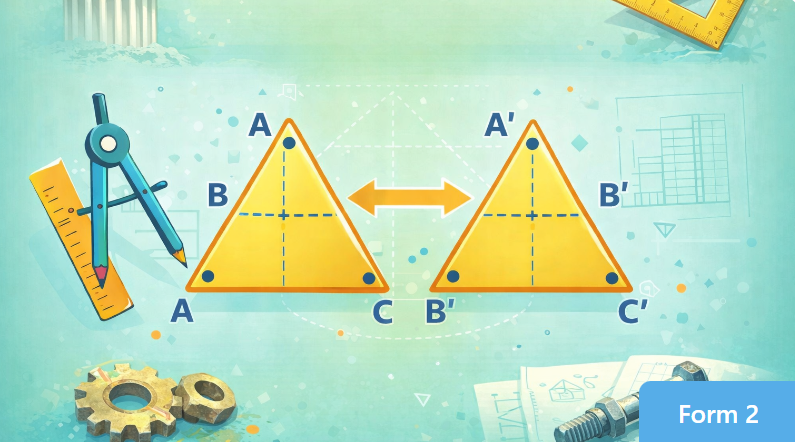
Two triangles ABC and PQR are said to be congruent if pairs of corresponding sides are equal and pairs of corresponding angles are equal. This fact is mathematically represented as
△ABC≅△PQR
. The symbol ≅ means “congruent to”. Consider the triangle in Figure below.

Conguerence of triangles

Pair of congruent triangles satifying SSS postulate.

Example 4

Example 5

EXERCISE 2


Side-Angle-Side (SAS) postulate
Two triangles are congruent if two pairs of their corresponding sides and the angles included between the two sides are equal. Figure below illustrates the postulate.

Pair of congruent triangles satisfying SAS postulate

Example 6

Example 7

Demonstrating non-congruence of triangles

EXERCISE 3


Angle-Angle-Side (AAS) postulate
Two triangles are congruent if the angles in any two pairs of corresponding angles are equal and the lengths of a pair of corresponding sides are equal. Figure 2.5 illustrates the postulate.

Two congruent figures by AAS postulate
The figure above shows that

Triangles satsfying ASA postulate

Example 8

Example 9

EXERCISE 4


Right angle-Hypotenuse-Side (RHS) postulate
Two right-angled triangles are congruent if their hypotenuses have equal length and a pair of the corresponding sides have equal length. Figure below illustrates the postulate

Two congruent right-angled triangles with RHS postulate
The Figure above shows that

Example 10

Example 11

EXERCISE 5


Chapter summary
1. Two figures are said to be congruent if they have exactly the same size and shape.
2. A postulate is a statement that is accepted without any proof.
3. A theorem is an argument that has been proven to be true based on past established results or definitions or postulates.
4. A proof is a series of logical statements that are based on definitions, previously established facts, and postulates that may be used to conclude the truth of mathematical arguments.
5. Two triangles are congruent if:
(a) The sides of triangle have equal lengths to the corresponding sides of the other triangle (SSS).
(b) The lengths of two sides and the included angle of one triangle are respectively equal to the lengths of two corresponding sides and the included angle of other triangle (SAS).
(c) (i) Two angles and the included side of one triangle are respectively equal to the corresponding two angles and the included side of the other triangle (ASA).
(ii) Two angles and non-included side of one triangle are respectively equal to the corresponding two angles and a non-included side of the other triangle (AAS).
6. Two right-angled triangles are congruent if their hypotenuses and a pair of sides have equal length (RHS).
Revision Exercise


TOPIC 2 CONGRUENCE – MATHEMATICS FORM TWO
CLICK HERE TO GET PDF NOTES