CHAPTER 1 STANDARD PRONUNCIATION – ENGLISH FORM FIVE
This chapter introduces Form Five students to the principles and practice of standard English pronunciation. Chapter One: Standard Pronunciation, English Form Five: Standard Pronunciation
Introduction to Standard Pronunciation, English Sounds and PronunciationM Vowels and Consonants, The English Sound System
It builds on foundational phonological skills acquired at Ordinary Level and extends them to meet the demands of Advanced Level academic and communicative contexts.
The chapter is organized into four main activities, each targeting a specific pronunciation sub-skill, followed by an integrated reading task, additional practice exercises and a chapter quiz.
Pronunciation is not merely about correctness — it is about intelligibility, confidence and communicative effectiveness. Students who develop strong pronunciation skills perform better in oral examinations, class presentations, debates, and future professional contexts such as job interviews and university studies.
OBJECTIVES
By the end of this chapter, students will be able to:
1. Articulate individual English consonant and vowel sounds clearly, accurately and consistently, including sounds that are challenging for Tanzanian learners.
2. Divide multi-syllabic words into correct syllable units and pronounce each syllable clearly and with appropriate length.
3. Identify the stressed syllable in multi-syllabic words and apply correct word stress when speaking and reading aloud.
4. Apply appropriate sentence stress, distinguishing between content words (which carry primary stress) and function words (which are typically unstressed and reduced in natural speech).
5. Describe objects, events and situations fluently, coherently and with intelligible pronunciation for at least one to two minutes without losing communicative clarity.
6. Identify grammatical function words, particularly prepositions, within written and spoken texts, and pronounce them correctly using natural weak forms in connected speech.
COMPETENCIES DEVELOPED
Phonological awareness: ability to perceive and produce sound distinctions in English.
Prosodic competence: awareness of rhythm, stress and intonation patterns in English utterances.
Communicative fluency: integrating pronunciation skills into spontaneous and prepared speech.
Self-monitoring: ability to assess and improve one’s own pronunciation through reflection and practice.
Collaborative learning: working with peers to give and receive pronunciation feedback.
TEACHING AND LEARNING RESOURCES
- English language dictionaries with phonemic transcriptions (e.g., Oxford Advanced Learner’s Dictionary).
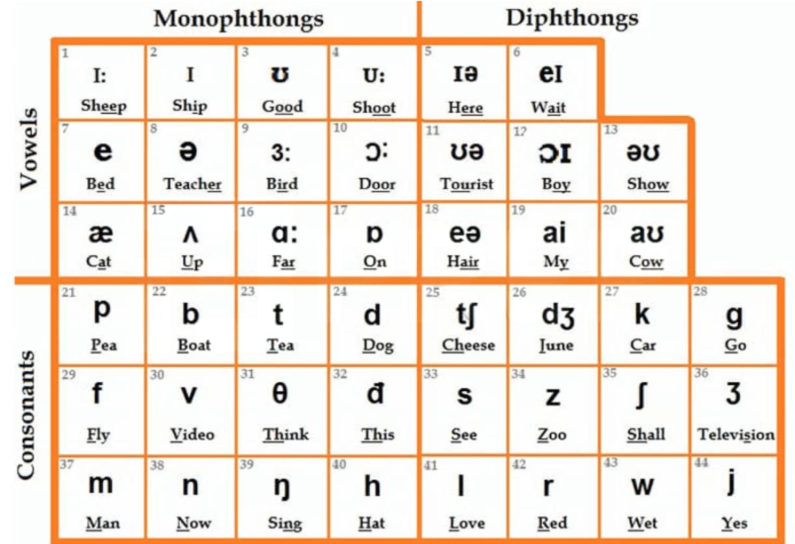
- Phonemic chart (British English IPA chart, displayed on the wall or projected).
- Audio recordings: BBC Learning English, Cambridge English, Oxford Online English.
- Smartphones, tablets, or a school language laboratory for recording and playback.
- Whiteboard and markers for demonstrating stress marking and syllable division.
- Printed copies of reading paragraphs and exercise worksheets for each student.
- Flashcards showing minimal pairs and stress patterns for pair and group activities.
INTRODUCTION
Why Standard Pronunciation is Important?
At Advanced Level, good pronunciation is a core academic and professional skill. It is not only necessary in the English classroom — it is increasingly important for university entrance interviews, national and international examinations, scholarship applications, formal presentations, debates and future employment. Employers, examiners and academic institutions expect candidates to communicate ideas clearly and confidently in spoken English.
For Tanzanian learners, English pronunciation presents specific challenges arising from differences between English phonology and Kiswahili (and other local languages). English has approximately 44 phonemes — including sounds that do not exist in
Kiswahili, such as the interdental fricatives /θ/ (as in “think”) and /ð/ (as in “this”), and distinctions such as vowel length (/ɪ/ in “ship” vs /iː/ in “sheep”) and voiced-voiceless contrasts (/f/ vs /v/; /p/ vs /b/). English also uses stress-timed rhythm, where stressed syllables occur at roughly regular intervals, while Kiswahili is syllable-timed, which causes learners to give equal weight to all syllables.
This chapter addresses these challenges systematically and gives students structured practice in all key pronunciation sub-skills.
Key Concepts Explained
Articulation
The physical production of speech sounds using the lips, teeth, tongue, alveolar ridge, hard and soft palate, and larynx.
Accurate articulation means each sound is produced clearly enough to be distinguished from similar sounds by a listener.
Phoneme
The smallest unit of sound that can change the meaning of a word. English has approximately 24 consonant phonemes and 20 vowel phonemes (in British Received Pronunciation).
Being able to hear and produce distinctions between phonemes is the foundation of intelligible pronunciation.
Syllable
A unit of spoken language consisting of a vowel sound (nucleus), usually accompanied by one or more consonants.
Every word can be broken into one or more syllables. For example: “cat” (1 syllable), “ta-ble” (2 syllables), “beau-ti-ful” (3 syllables).
Syllable division
The process of identifying where syllable boundaries fall in a word, which helps with correct pronunciation, especially of long or unfamiliar words.
Rules include: dividing between double consonants (hap-py), after a prefix or before a suffix (pre-dict, teach-er), and according to the VC/CV pattern in many words (student, num-ber).
Word stress
The emphasis placed on one syllable within a multi-syllabic word. In English, the stressed syllable is produced with greater volume, higher pitch and longer duration than unstressed syllables.
Incorrect word stress can make words unrecognizable even if the individual sounds are correct (e.g., stressing the wrong syllable in “photograph” or “economy”).
Sentence stress
In connected speech, content words (nouns, main verbs, adjectives, adverbs) carry primary stress while function words (articles, prepositions, auxiliaries, conjunctions, pronouns) are typically unstressed. Sentence stress creates the characteristic rhythm of English.
Weak forms and connected speech
In natural, fluent speech, function words are often reduced to their weak forms. For example, “to” is pronounced /tuː/ in isolation but /tə/ in connected speech (“going to school” → “going tə school”); “for” is /fɔː/ in isolation but /fə/ in sentences (“ready for us” → “ready fər us”). Understanding and using weak forms makes speech sound more natural and helps with listening comprehension.
Intonation
The rise and fall of pitch across an utterance. While detailed intonation study is beyond this chapter’s scope, students should be aware that falling intonation typically indicates statements and commands, while rising intonation may signal questions or uncertainty.
Teacher Tips for the Introduction Period
Open the lesson by playing a short audio clip (1–2 minutes) from BBC Learning English or a TED Talk. Ask students to identify what makes the speaker easy or difficult to understand. Guide the discussion toward articulation, rhythm, word stress and fluency.
Display the IPA phonemic chart and briefly review the 44 English sounds. Ask students to identify which sounds are most challenging for them and list them on the board.
Explain the difference between “accent” (which is acceptable and natural) and “intelligibility” (which is the main goal). The aim is not to sound like a native speaker but to communicate clearly enough to be understood in academic and professional settings.
Introduce key terms (articulation, syllable, word stress, sentence stress, weak forms) and ensure all students record definitions in their exercise books.
Learning Focus
Students will practise the accurate production of English consonant and vowel sounds, with particular attention to sounds commonly mispronounced by Tanzanian learners of English. These include:
- /θ/ (voiceless interdental fricative, as in “think, three, through”)
- /ð/ (voiced interdental fricative, as in “this, that, though”)
- /v/ (voiced labiodental fricative, as in “very, van, village”) — often confused with /b/ or /w/
- /f/ vs /v/ contrast (“fan” vs “van”)
- Vowel length pairs: /ɪ/ vs /iː/ (“ship” vs “sheep”), /ʊ/ vs /uː/ (“full” vs “fool”)
- Voiced vs voiceless final consonants (“bet” vs “bed”; “cap” vs “cab”)
Warm-up Activity (10 minutes)
Introduce the phonemic chart. Call out a phoneme and ask students to give a word that contains that sound. Alternatively, show the symbol and ask students to produce the sound, then a word.
Exercise 1: Minimal Pairs Practice
A minimal pair is two words that differ by only one phoneme. Practising minimal pairs trains learners to hear and produce small but meaning-changing sound differences.
Read each pair aloud, exaggerating the contrast first, then at natural speed:
Consonant contrasts:
- thin /θɪn/ — tin /tɪn/
- three /θriː/ — tree /triː/
- think /θɪŋk/ — sink /sɪŋk/
- then /ðen/ — den /den/
- this /ðɪs/ — dis (prefix)
- fan /fæn/ — van /væn/
- fine /faɪn/ — vine /vaɪn/
- ferry /ˈferi/ — very /ˈveri/
Vowel length contrasts:
- ship /ʃɪp/ — sheep /ʃiːp/
- live /lɪv/ — leave /liːv/
- sit /sɪt/ — seat /siːt/
- full /fʊl/ — fool /fuːl/ pull /pʊl/ — pool /puːl/
Voiced vs voiceless contrasts:
- bet /bet/ — bed /bed/
- cap /kæp/ — cab /kæb/
- half /hɑːf/ — have /hæv/
- safe /seɪf/ — save /seɪv/
Classroom technique: Say one word from each pair. Students hold up a card labelled A or B to indicate which word they heard. This develops both production and listening discrimination.
Exercise 2: Tongue Twisters
Tongue twisters isolate specific sounds and build articulatory speed and accuracy. Begin slowly, then gradually increase pace.
Tongue Twisters for /θ/ and /ð/:
“The thirty-three thieves thought that they thrilled the throne throughout Thursday.”
— Focus: /θ/ at the start of stressed syllables; /ð/ in function words (the, that, they, throughout).
Tongue Twisters for /s/ and /ʃ/:
“She sells seashells by the seashore. The shells she sells are surely seashells.”
— Focus: distinguishing /s/ from /ʃ/; smooth connected speech.
Tongue Twisters for /v/:
“Vivid violets have very vibrant violet veins.”
— Focus: /v/ — ensure students are not substituting /b/ or /w/ for /v/.
Tongue Twisters for /r/:
“Red lorry, yellow lorry, red lorry, yellow lorry.”
— Focus: clear /r/ and /l/ distinction; smooth rhythm.
Exercise 3: Sentence Practice
Read the following sentences aloud, focusing on clear articulation of every sound. Then read them again at natural pace:
- “We visited the village in the valley last Thursday.” (/v/, /ð/, /θ/)
- “The thin man thought through the thirty theories.” (/θ/, /ð/)
- “Very few voters voted for the favourite candidate.” (/v/, /f/)
- “She should show students how she shapes her speech.” (/ʃ/, /s/)
- “Philip felt perfectly comfortable in the philosophy lecture.” (/f/, /θ/)
Teacher Instructions
- Model each exercise first; then students repeat chorally; then in pairs; then individually.
- Give targeted feedback to individuals. Describe and demonstrate the tongue, lip and teeth positions for difficult sounds.
- Where possible, use a mirror to allow students to observe their own mouth positions.
- Reward effort and improvement, not just perfection.
Assessment of Activity 1.1
Observe and note: clarity of consonant contrasts (especially /θ/, /ð/, /v/, /f/), vowel length distinctions, voicing contrasts at word endings, and overall confidence in oral production. Record observations for formative assessment.
ACTIVITY 1.2: Articulating words with appropriate syllable divisions
Learning Focus
Students will learn to identify syllable boundaries in English words and use syllable awareness to improve the accuracy and clarity of their pronunciation, particularly for long, academic or unfamiliar words. Background Notes for the Teacher
Syllable division rules (simplified):
- Each syllable contains exactly one vowel sound (not necessarily one vowel letter).
- Between two consonants, the syllable break usually falls between them (VC-CV pattern): pen-cil, num-ber, hap-py.
- A single consonant between two vowels usually goes with the following vowel (VCV): stu-dent, fa-ther.
- Prefixes and suffixes usually form their own syllable: pre-dict, teach-er, un-fair, care-ful.
- Consonant clusters at the start of a root word stay together: e-qual (not eq-ual), agree (not ag-ree).
Exercise 1: Count and Divide Syllables
Count the number of syllables in each word and mark the syllable divisions with a hyphen.
Example set:
- education → ed-u-ca-tion (4 syllables)
- responsibility → re-spon-si-bil-i-ty (6 syllables)
- communication → com-mu-ni-ca-tion (5 syllables)
- information → in-for-ma-tion (4 syllables)
- examination → ex-am-i-na-tion (5 syllables)
- demonstration → dem-on-stra-tion (4 syllables)
- understanding → un-der-stand-ing (4 syllables)
- determination → de-ter-mi-na-tion (5 syllables)
- administration → ad-min-is-tra-tion (5 syllables)
- photosynthesis → pho-to-syn-the-sis (5 syllables)
- unbelievable → un-be-liev-a-ble (5 syllables)
- constitutional → con-sti-tu-tion-al (5 syllables)
Extended list for advanced practice:
- photographic → pho-to-graph-ic (4)
- psychological → psy-cho-log-i-cal (5)
international → in-ter-na-tion-al (5)
- socioeconomic → so-ci-o-ec-o-nom-ic (7)
- biodegradable → bi-o-deg-ra-da-ble (6)
Exercise 2: Syllable Articulation Drill
Read each word slowly, pausing between syllables, then again as a whole word at natural speed:
- con / sti / tu / tion / al → constitutional
- pho / to / graph / ic → photographic
- in / for / ma / tion → information
- de / vel / op / ment → development
- en / vi / ron / ment → environment
- gov / ern / ment → government
- im / por / tant → important
- ex / am / i / na / tion → examination
Exercise 3: Classroom Spelling-aloud with Syllable Boundaries
Ask students to take turns coming to the board, writing a word, dividing it into syllables, and reading it aloud. Class listens and confirms or corrects the division.
Exercise 4: Academic Word Vocabulary and Syllable Work
For each of the following academic words, students:
(a) divide into syllables
(b) count the syllables
(c) mark the main stress
(d) use the word in a sentence.
Analysis, hypothesis, paragraph, introduction, conclusion, experiment, laboratory, significant, approximately, contribute.
Teacher Tips
- Use clapping to help students feel syllable beats: students clap once per syllable as they say a word.
- Alternatively, place a hand under the chin — the chin drops once per syllable (because each syllable contains a vowel sound that opens the jaw).
Emphasise that syllable awareness helps with spelling as well as pronunciation.
ACTIVITY 1.3: Applying Word Stress in Speaking and in Reading Sentences Aloud
Focus: Correct word stress and natural rhythm in sentences.
Background and Purpose
Word stress is a fundamental feature of English pronunciation. In English, certain syllables within a word are pronounced more prominently than others — they are louder, longer, and higher in pitch. When a speaker misplaces stress on the wrong syllable, it can cause misunderstanding or make speech sound unnatural, even if the words themselves are correct.
This activity helps students develop an awareness of stress patterns, understand how stress can shift when the grammatical form of a word changes, and apply this knowledge in reading sentences aloud with natural rhythm and fluency.
Key Concepts to Remember:
- Primary stress (ˈ) falls on the most prominent syllable of a word.
- In English, stress is not fixed — it can shift depending on the word form (noun, verb, adjective).
- Sentences also have rhythm, which is created by the pattern of stressed and unstressed words. Content words (nouns, main verbs, adjectives, adverbs) are usually stressed, while function words (articles, prepositions, conjunctions, auxiliary verbs) are usually unstressed and reduced. __
Practice Exercises
Exercise 1: Mark the Stressed Syllable (ˈ)
Study the following word families carefully. Notice how the stress shifts as the word changes its grammatical form:
- ˈphotograph (noun) — phoˈtographer (noun — person) — photoˈgraphic (adjective)
→ Stress moves further right as the word becomes longer and more complex.
eˈconomy (noun) — ecoˈnomic (adjective) — ecoˈnomics (discipline) — eˈconomist
(noun — person)
→ The stress pattern shifts with each different form of the word.
Additional Word Families for Practice:
- ˈpolitics — poˈlitical — poˈlitician
- ˈnation — naˈtional — naˈtionality
- ˈsymbol — symˈbolic — symˈbolically
- ˈscience — sciˈentific — sciˈentist
- ˈdemocracy — demoˈcratic — ˈdemocrat
Task: Mark the stressed syllable in each word above using the symbol (ˈ) before the stressed syllable, then practise saying them aloud. Work with a partner and listen to each other carefully. __
Exercise 2: Read These Sentences with Correct Stress
In English sentences, the natural rhythm is created by stressing content words and reducing function words. Study the sentences below, paying attention to the marked stress and the overall rhythm:
1. The ˈgovernment has ˈannounced a new ˈpolicy on ˈeducation.
→ Key stressed words: government, announced, policy, education
→ Unstressed (reduced): the, has, a, on
ˈ2. Scientific ˈresearch requires ˈpatience and ˈdedication.
→ Key stressed words: scientific, research, patience, dedication
→ Unstressed: requires, and
Additional Sentences for Practice:
- The ˈteacher eˈxplained the ˈconcept of ˈsyllable ˈstress to the ˈstudents.
- ˈTechnology has ˈchanged the way we ˈcommunicate with each ˈother.
- It is ˈessential to ˈpractise your ˈpronunciation ˈevery ˈday.
- The ˈeconomic ˈgrowth of a ˈnation deˈpends on ˈeducation and ˈinnovation.
Reading Aloud Tips:
- Read each sentence slowly at first, then increase your speed gradually.
- Tap your finger or pencil on each stressed syllable to feel the rhythm.
- Do not stress every word — allow function words to be short and weak.
- Record yourself and compare your reading with a model if possible.
ACTIVITY 1.4: Describing Objects, Events and Situations (2 periods)
Focus: Integrating pronunciation skills into fluent, coherent description.
Background and Purpose
The ability to describe objects, events and situations clearly is a critical communication skill. Good description requires not only appropriate vocabulary and sentence structure, but also correct pronunciation, proper word stress, smooth linking of sounds, and natural rhythm. In this activity, students are expected to bring together all the pronunciation skills practised in this chapter — including syllable division, word stress, and weak forms of function words — and apply them in extended, connected speech.
Useful Language for Descriptions:
- Introducing: “What I would like to describe is…”, “The place/event I am going to talk about is…”
- Appearance/features: “It is characterized by…”, “One of its most notable features is…”
- Location: “It is situated…”, “It can be found…”, “It lies to the north/south of…”
- Effects/importance: “It has a significant impact on…”, “It plays a crucial role in…”
- Conclusion: “In summary…”, “Overall, I believe…”, “This experience taught me that…”
Practice Exercises: Describe the Following Orally (1–2 minutes each)
1. Your School Laboratory Consider including:
- Physical description: size, location within the school, layout, equipment present
(microscopes, Bunsen burners, beakers, charts, etc.) o How it is used: which subjects are taught there, types of experiments conducted o Its importance: how it contributes to learning and understanding of science
- Your personal experience: what you enjoy or find challenging about working in the lab
- Condition and suggestions: whether it is well-equipped or needs improvement, and what you would recommend
2. A Memorable School Event This Year Consider including:
o Name and purpose of the event (sports day, prize-giving ceremony, science fair, cultural day, etc.)
o When and where it took place o Who participated and how many students and staff were involved
o What happened: key activities, highlights, and moments that stood out o How you felt during and after the event
o What you learned or gained from the experience
o Why it was memorable and what impact it had on you or the school community
3. The Effects of Climate Change in Your Region
Consider including:
- Definition of climate change in simple terms
- Observable changes: rising temperatures, unpredictable rainfall, prolonged droughts, flooding o Specific effects on agriculture, water sources, forests, and wildlife in your region
- Effects on communities: food insecurity, displacement of people, disease outbreaks o What is being done locally to address climate change o What more should be done by individuals, communities, and the government
Pair Work Task:
One student describes while the partner listens actively and takes notes. After the description, the listener provides constructive feedback using the following checklist:
- Was the pronunciation of key words clear and accurate?
- Were stressed syllables correctly emphasized?
- Were function words (prepositions, articles, conjunctions) produced naturally and weakly?
- Was the description well-organized and easy to follow?
- Were there any words that were mispronounced or difficult to understand?
After feedback, partners switch roles and repeat the exercise.
SPECIAL READING PARAGRAPH: Identifying and Pronouncing Prepositions Correctly
Activity Purpose
Prepositions are among the most frequently used words in English, yet they are often mispronounced by learners who give them too much stress. In natural, fluent English, prepositions are typically unstressed and reduced in connected speech — this is called the “weak form.” Learning to pronounce prepositions correctly in context is essential for achieving a natural, rhythmic, and fluent speaking style.
Instructions for the Reading Activity:
Read the paragraph below aloud twice, following these guidelines:
- First reading: Focus on clear articulation, correct syllable division, and proper word stress on content words.
- Second reading: Pay special attention to all prepositions (in, on, at, to, for, with, by, from, of, etc.). Pronounce them naturally using their weak/reduced forms in connected speech.
Reading Paragraph
“Last year, our class went on an educational trip to the Serengeti National Park. We travelled by bus from Dar es Salaam early in the morning and arrived at the park gate in the afternoon. While we were in the park, we saw many wild animals grazing on the plains and drinking water from the river.
Our guide explained the importance of conservation to us and warned us about the dangers of poaching in the area. After spending two days with the wildlife, we returned to school with unforgettable memories and a deeper appreciation for the beauty and value of our natural heritage.”
Weak Forms of Common Prepositions in Connected Speech:
Preposition | Strong Form | Weak Form (Reduced) | Example in Context
—|—|—|— to | /tuː/ | /tə/ | “went to the park” → /wɛnt tə ðə pɑːk/ for | /fɔː/ | /fə/ | “appreciation for the” → /əˌpriːʃiˈeɪʃən fə ðə/ of | /ɒv/ | /əv/ | “importance of” → /ɪmˈpɔːtəns əv/ from | /frɒm/ | /frəm/ | “from the river” → /frəm ðə ˈrɪvə/ at | /æt/ | /ət/ | “arrived at the” → /əˈraɪvd ət ðə/ in | /ɪn/ | /ɪn/ (slightly reduced) | “early in the morning” → /ˈɜːli ɪn ðə ˈmɔːnɪŋ/ by | /baɪ/ | /bɪ/ (slightly reduced) | “travelled by bus” → /ˈtrævəld bɪ bʌs/ with | /wɪð/ | /wɪð/ (slightly reduced) | “returned with memories”
Follow-up Questions (Post-reading)
1. List all the prepositions used in the paragraph.
Answer: on, to, by, from, in, at, in, in, on, from, of, to, about, of, in, after, with, to, with, for, of
2. Read the paragraph again, deliberately stressing the prepositions (unnatural). How does it sound?
Expected response: It sounds robotic, unnatural, and overly mechanical. The rhythm of the language is disrupted, and the speech no longer sounds like fluent English. Stressing every preposition gives equal weight to both important and unimportant words, which destroys the natural flow of speech.
3. Now read it with natural weak forms (e.g., “to the” → /tə ðə/). Which version sounds more natural?
Expected response: The version with weak, reduced prepositions sounds significantly more natural, fluent and rhythmic. It sounds like the way a native or proficient English speaker would naturally read or speak.
4. Why are prepositions usually pronounced weakly in English sentences? Expected response: Prepositions are function words — they serve a grammatical role (showing relationships between words) rather than carrying the main meaning of a sentence.
In English, the stress and emphasis fall on content words (nouns, main verbs, adjectives, adverbs) because these carry the most important information. Function words, including prepositions, are reduced and weakened so that content words stand out clearly. This creates the characteristic rhythmic “stresstimed” pattern of English speech.
Practice Task:
Students work in pairs to create their own paragraph of 80–100 words containing at least 8 different prepositions. The paragraph should be on a topic of their choice (school life, their community, a recent experience, nature, etc.).
Once written, students read their paragraphs aloud to each other, focusing on natural pronunciation and weak forms of prepositions. The listening partner identifies all prepositions used and gives feedback on pronunciation.
Additional Practice Exercises (Whole Chapter Review)
Exercise 1: Recording Task (Homework)
Record yourself reading the Serengeti paragraph and one description from Activity 1.4 using your mobile phone or any available recording device.
After recording, listen carefully and assess your own performance using the following self-assessment checklist:
- Articulation: Were all sounds produced clearly and correctly?
- Syllable division: Did you divide multisyllabic words correctly?
- Word stress: Did you place stress on the correct syllable in each word?
- Sentence rhythm: Did stressed content words stand out clearly?
- Preposition pronunciation: Did you use natural weak forms for prepositions?
- Fluency: Was your reading smooth, or did you pause and hesitate frequently?
Write a short reflection (5–8 sentences) on what you did well and what you need to improve.
Exercise 2: Stress and Preposition Drill
Read the following sentences carefully, paying close attention to both word stress (on content words) and the weak/reduced pronunciation of prepositions and other function words:
- The ˈbook is on the ˈtable in the ˈlibrary.
→ /ðə ˈbʊk ɪz ɒn ðə ˈteɪbl ɪn ðə ˈlaɪbrəri/
- She ˈspoke to the ˈstudents aˈbout the imˈportance of ˈeducation.
→ /ʃi ˈspəʊk tə ðə ˈstjuːdənts əˈbaʊt ði ɪmˈpɔːtəns əv ˌedʒʊˈkeɪʃən/
Additional Drill Sentences:
- The ˈreport on the ˈeffects of ˈclimate ˈchange was ˈpresented by the ˈscientist.
- She ˈleft for ˈschool at ˈseven in the ˈmorning.
- The ˈletter from the ˈprincipal was ˈread to the ˈstudents in the ˈhall.
- He ˈworked with his ˈteam on the ˈproject for ˈthree ˈweeks. __
Exercise 3: Group Presentation
Each group of 4–5 students prepares and delivers a 2-minute oral presentation on one of the following topics:
- “A Typical Day in My Life”
- “My Future Career Plans”
- “The Importance of Education in Tanzania”
- “How Technology Has Changed Communication”
Assessment Focus: Groups will be assessed on:
- Clear and accurate articulation of all words
- Correct placement of word stress on content words
- Natural rhythm and fluency in connected speech
- Proper use of weak/reduced forms of prepositions and function words
- Confidence, organisation and clarity of ideas __
CHAPTER QUIZ (30 marks)
Section A: Multiple Choice (10 marks — 2 marks each)
1. How many syllables are in the word “responsibility”?
re-spon-si-bil-i-ty
A. 5 B. 6 ✓ C. 7 D. 4
2. Explanation: “responsibility” has 6 syllables: re / spon / si / bil / i / ty
In the word “photographic”, the main stress falls on: pho – to – graph – ic
A. pho B. to C. graph ✓ D. ic
Explanation: The correct pronunciation is pho-to-ˈgraph-ic; the primary stress falls on the third syllable “graph.”
3. Which of the following words has its stress on the FIRST syllable?
A. eˈconomy B. ˈphotograph ✓ C. photoˈgraphic D. ecoˈnomic
4. Which sentence demonstrates CORRECT sentence stress? A. The BOOK is ON the TABLE in THE library.
The ˈbook is on the ˈtable in the ˈlibrary. ✓
THE book IS on THE table IN the LIBRARY.
the book is on the table in the library.
CHAPTER 1 STANDARD PRONUNCIATION – ENGLISH FORM FIVE