PHYSICS OF THE ATOM
1.0 INTRODUCTION
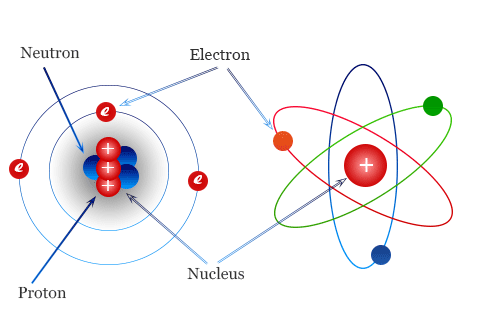
Physics of the atom is the branch of physics that deals with the structure, behaviour and properties of atoms and their nuclei.
The study of atomic physics has led to major developments in:
- Nuclear energy
- Medical diagnosis and treatment
- Lasers
- Communication
- Electronics
- Radiation protection
- Nuclear power generation
- Scientific research
- Industrial applications
This chapter covers four major areas:
- Quantum physics
- Atomic physics
- Lasers
- Nuclear physics
PART A: QUANTUM PHYSICS
2.0 INTRODUCTION TO QUANTUM PHYSICS
Quantum physics is the branch of physics that studies matter and radiation at atomic and subatomic scales.
Classical physics cannot adequately explain some phenomena involving very small particles and electromagnetic radiation.
Quantum physics introduced the idea that energy is exchanged in discrete amounts rather than always continuously.
These discrete amounts are called quanta.
2.1 Planck’s Quantum Theory
Max Planck proposed that electromagnetic radiation is emitted or absorbed in discrete packets of energy called quanta.
The energy of a quantum is:
E = hf
Where:
E = energy of the quantum in joules h = Planck’s constant f = frequency of radiation
Planck’s constant is approximately:
h = 6.63 × 10⁻³⁴ J s Therefore:
HIGHER FREQUENCY → HIGHER ENERGY PER PHOTON
Chapter 4: Physics of the Atom – Physics Form Six
READ FULL NOTES
DOWNLOAD PDF NOTES