EARTHQUAKE – ADVANCED PHYSICAL GEOGRAPHY
An earth quakes refers to the sudden vibration of the earth surface caused by rapid release of energy in the form of waves. OR
Is the shaking and trembling of the earth caused by sudden and rapid displacement of rocks beneath the earth surface.
The rock displacement produce energy in the form of waves called seismic waves which shake the ground.
The study of earth quakes is known as Seismology and the persons who deals in this study called Seismologist.
The instrument used to measure and record even the slightest earth tremor are called Seismographs or Seismometers.
The earth quakes waves are called Seismic waves.
CHARACTERISTICS OF SEISMIC WAVES
Generally, the seismic waves have the following characteristics;
i. The speed of the seismic waves is proportional to the density of the materials through which they travel. For instance, the denser the materials the faster the speed while less dense the materials the speed is low.
ii. Seismic waves are just like the sound waves or light waves. Hence, they also change direction under certain circumstance. In this case the waves reflected and refracted where there is difference in the rock density.
iii. The speed and effects of seismic waves are proportional to the distance on the earth surface. The effect and speed are very high near to the epicenter and decrease out ward.
iv. Some type of seismic waves can propagate on solid materials only while other type of seismic waves can propagate through both solid and liquid materials. The area on the earth’s surface not reached by seismic waves because of blockage is called shadow zones.
TYPES OF SEISMIC WAVES
There are two categories of seismic waves. These are;
- Body seismic waves.
- Surface seismic waves.
1: BODY SEISMIC WAVES
These are seismic waves which have sources and travels through the interior of the earth. These are two sub-types of body seismic waves. These are: –
Primary seismic waves (The P – Waves).
These are compressional seismic waves they can propagating longitudinally. They are very fast waves with short waves length. This wave can travel throughout the earth. The primary waves cause the rocks to moves back and forth in the direction to waves movement.

Secondary seismic waves (The S – Waves).
These waves are also known as shear waves or traverse waves. They travelling at right angle to the direction of waves movement. They are medium size waves which can not travels in liquid zones. These waves cannot reach parts of opposite sides. These waves cause crustal rocks to move from side i.e at right angle to the direction of waves movement.

2: SURFACE SEISMIC WAVES
These are waves travelling along the earth surface I.e through surface rocks of the earth. These waves are generally long waves and low speed type. There are two (2) sub-types. These are;
Love seismic waves (The L – Waves).
These are seismic waves which cause the rocks to move from side i.e right angle to direction of wave movement.

Rayleigh seismic waves (The R – Waves).
These are seismic waves which cause the surface rocks to moves up and down to the direction of waves movement.

NOTE:
Generally, the long waves are more destructive as they concentrate on the surface.
POINTS OF LOCATION OF EARTH QUAKES
FOCUS (HYPOCENTRE):
Is the place beneath the earth where earth quakes originated or has its origin. The focus which is very near to the earth’s surface is called shallow focus and that one a very deep below to the earth surface is called deep focus.
EPICENTRE:
Is the point of location on the surface directly vertically above the focus. The epicenter receives first and its place where massive destruction take place.


HOW TO DETECTING, MEASURING AND RECORDING EART QUAKES
Which instrument used to detect earth quakes?
The earth quakes are detected by using an instrument called seismograph (seismometer).
How to measuring and recording earth quakes?
The earth quakes speed and strength are commonly referred as the size of the earth quakes and is usually measure according to magnitude and intensity.
i. Intensity:
An intensity of earth quakes referred to how hard the quakes shakes the ground. It is determining the effects of earth quakes on the ground surface. Example; presence of faults, death of organisms, destruction of human properties like houses, etc.
The scale in seismometer which gives out intensity of earth quakes is called Mercalli scale. It is based on the detected catastrophic unit.
Generally, 1 to 3 unit means less and low effects, but 10 to 12 unit means massive damage with a lot of death. The Mercalli scale was developed in 1905 by an Italian Geophysicist named Giuseppe Mercalli.
ii. Magnitude:
This is the measure of on earth quakes based on the speed and amount of energy released during earth quakes. The Magnitude is measured on the scale unit in the seismometer ranging from 0 to 8 second or more. This scale in seismometer which gives out the Magnitude of the earth quakes is called Richter scale developed by French Geophysicist named Charles Richter in 1935.
CAUSES OF EARTH QUAKES
There are several causes of earth quakes and earth tremors. These are: –
Plate tectonic (movement) causes:
When the plate moves in convergent, divergent, or transform they cause rocks to gain energy which is released in the form of seismic waves. Eg. 2001 in Gujarat. This fact, account for the reason why the plate margins are the major earth quakes zones eg. in the Pacific ring of fire.
Vulcanic causes:
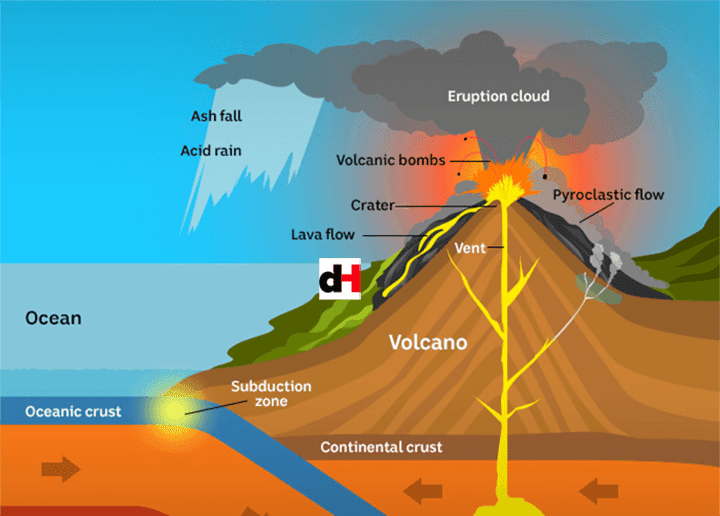
Violent vulcanism eruption can also cause the occurrence of earthquakes. This is due to the fact that magma moving under the influence of internal pressure of the earth’s interior erupts leading to shaking of the earth’s surface. Eg. in 1883 when mount Krakatoa in Indonesia erupted violently cause catastrophic earth quakes, and in 2008 when mount Oldoinyolengai in Tanzania erupted.
Isostatic causes:
This happens as the crust adjusts itself to changing pressure caused by weight exerted on the earth’s crust, hence the crust may move downwards or upwards. The movements then trigger the upper mantle which leads to earthquakes. Also, the isostatic disturbances which in turn generate shock waves that end up shaking the earth’s crust.
Human activities cause:
Furthermore, tremors can be influenced by human activities like the testing of nuclear bombs and other explosives in quarrying and mining that use dynamite. Other activities include moving of huge vehicle on the ground surface and storage of huge volume of water in big reservoir.
Mass movement causes:
Moreover, mass movements like landslides and rock fall can also cause minor tremors.
Falling of heavy objects (Meteors) from the space:
Falling of heavy objects from the atmosphere such as meteorites can lead to the shaking of the earth’s crust as a result of earth quakes or earth tremors.
Movement of animals:
When large number of animals moves on the ground surface, they can trigger occurrence of earth quakes and earth tremors.
FACTORS DETERMING (ACCELERATING) THE DEGREE OF DAMAGE CAUSED BY EARTH QUAKES
The degree of damage caused by an earth quakes depends on the following factors;
Structure of building materials (Architecture):
The damage is greater on building with weaker structure materials like stones and mud than those areas made by strong building structure like concreate and steel bars these resist the massive destruction.
Local geological conditions (nature of underlying rocks):
If the town or city rest on the weaker rock layer made by mud or shale, it will experience massive damage even by slight earth tremor eg. the Mexico earth quakes in 1986 was cause drastic demage due to the fact that the city is located on the weaker clay structure.
The strength of earth quakes magnitude:
Generally, the higher earth quakes speed the higher the demage and vice versa. In this case low magnitude earth quake cause very, little effects than the high-speed earth quakes.
Depth of focus:
When the earth quakes originated by the shallow focus (focus near the ground surface) can cause massive demage, than the earth quakes originated by deep focus (focus that located very far distance from the ground surface) can cause very little demage.
Distance from the epicenter:
Aras near to the epicenter experiences great demage as shock waves concentrate highly than area away from the epicenter.
Location of earth quakes:
An earth quakes that hits in a populated area is more likely to cause massive damage than the one that hits unpopulated area or the middle of the ocean.
Time of a day
When the earthquake takes place; i.e day time and night time, its effects differs as in a day time people can run away or minimize easily the impact of it than during night.
Level of technology
Developed countries can have low impacts of earthquake than less developed countries due to high level of science and technology on monitoring and detecting the earthquake occurrences.
CLASSIFICATION OF EARTH QUAKES
In generally, the earth quakes can be classified into three classes. These are: –
- Classification of earth quakes based on the causative factors.
- Classification of earth quakes based on the position of focus.
- Classification of earth quakes on basis the rate (magnitude) of human casualties
1: CLASSIFICATION OF EARTH QUAKES BASED ON THE CAUSATIVE FACTORS
In this category, there are two (2) sub classes. These are: –
- Natural factors (causes).
- Manmade causes.
A: EARTH QUAKES CAUSED BY NATURAL FACTORS (CAUSES)
These are earth quakes caused by natural factors (causes). These are: –
Vulcanic earth quakes:
This is an earth quake which occur due to the Vulcanic eruption. The intensity and magnitude of this earth quakes depend on the magnitude of Vulcanic eruption. Excellent example of volcanic earth quakes occurred in 1883 when mount Krakatoa in Indonesia erupted, also 1968 when Mount Etna in Italy erupted.
Tectonic earth quakes:
This is an earth quakes caused by the dislocation of the rocks blocks during faulting activities as plate move. These the most severe and dangerous earth quakes. Eg. in 1906 California earth quakes, also the 2001 Gujarat earth quakes.
Isostatic earth quakes:
These are earth quakes caused by sudden disturbance and adjustment process in the isostatic equilibrium for regional scale. This earth quakes are common along active zone of mountain building.
Plutonic earth quakes:
These are deep focus earth quakes which occur at great depth due to plates movement inside the earth crust.
B: EARTH QUAKES CAUSED BY MAN MADE FACTORS
These earth quakes are caused by human activities such as;
i. Minerals and oil extraction from underground.
ii. Using heavy explosive materials like testing of nuclear bomb eg. in 2017 North Korea.
iii. Also, dam construction with over weight of water reservoirs on the ground surface eg. 1931 in Greece due to construction of dam, also the Koyna earth quake in India in 1967 due to construction of large water reservoirs.
iv. Water pumping from underground.
2: CLASSIFICATION OF EARTH QUAKES BASED ON THE POSITION FROM FOCUS
In this category earth quakes can be divided into three (3) types in relation to the depth of focus.
These are: –
Shallow (moderate) focus earth quakes:
These are earth quakes with foci located very close to the ground surface. The depth ranging from 0m to 50km depth. The shallow foci earth quakes are common along the divergent plate boundaries.
Intermediate focus earth quakes:
These are earth quakes whose foci are located at intermediate depth below the earth’s surface ranging between 50km to 250km.
Deep focus earth quakes:
These are earth quakes with foci depth ranging from 250km to 700km below the ground surface.

3: CLASSIFICAION OF EARTH QUAKES BASED ON THE RATE (MAGNITUDE) TO HUMAN [CASUALITIES /EFFECTS]
Under this category there are three (3) types of earth quakes based on the impacts to human being. These are: –
Moderately hazardous earth quakes:
These earth quakes with very low or no impacts to human being eg. the number of deaths is below 50,000 people or insignificant. For example; Kobe in Japan 1995 about 5,378 people died, Luzon in Philippines 1990 about 1,621 people died, San Francisco in 1906 about 1,500 people died, Mexico City in Mexico 1985 about 9,500 people died, Iran 1990 about 50,000 people died, and Kamakura earth quake in Japan in 1293 the number of deaths is about 23024 peoples.
Highly hazardous earth quakes:
These earth quakes with high casualties where by the number of deaths ranging between 51,000 to 100,000 peoples, and destroy building are very high. Eg. Lisbon in Portugal 1755 about 70,000 people died, Chimbote in Peru 1970 about 66,000 people died during 1970 earth quake.
Mostly hazardous earth quakes:
These earth quakes accompanied with extensive casualties eg. very large death above 100,000 people and damage of properties very large. For example; 2005 Indonesia earth quake, 1976 Tangshan earth quake in China about 240,000 people died, Shensi in China 1556 about 830,000 peoples died, Tokyo in Japan 1923 about 143,000 people died, and Calcutta in India 1737 about 300,000 people died.
EFFECTS OF EARTHQUAKES
The following are the effects of earth quakes. These are: –
1. Earthquakes create joints and faults in the rocks eg. in Guatemala 1976 earthquake left a 320km fissure, in 1954 El Asnam in Algeria earthquake cause formation of cracks up to 3m deep, etc.
2. Moreover, when earthquakes occur in the ocean cause formation of very strong oceanic waves called Tsunamis. These waves are very high and when they reach the coast, they cause flooding. The Indian Ocean Tsunami of 26th December, 2004 caused over 200,000 deaths of people in Banda Aceh, Indonesia and other different countries along the Indian ocean including Tanzania.
3. Earthquakes cause parts of earth’s crust moved lateral or vertical. For instance, in San Francisco, in 1906, an earthquake caused horizontal displacement of rocks by 7 metres.
4. They can raise or lower coastal rocks. For example, in the Alaskan, earthquake of 1899 caused some coastal areas to raise by 16 metres.
5. It causes destruction of properties such as houses, hospitals, road, etc. as a result of demage of transport and communication network. Eg. Tanzania’s earth quake 2016 in Kagera destroy 1264 building, etc.
6. It causes loss of human life (deaths). For example, in 1556 about 830,000 people killed by earthquake in Shinshu town in China, in 1976 about 240,000 people died in Tangshan town also in China, in 1906 San Francisco an earthquake killed 700 people, in Tanzania earthquake which occurred in Bukoba District, in Kagera Region on 10th September, 2016, caused deaths of more than 20 people. Other example; Morocco in September 2023 more than 1000 peoples died due to earth quakes at Atlas Mountain region.
7. Earthquakes can also cause subsidence of the earth crust hence give rise to the formation of basin and rift valley, as well as part of the sea floor to rise. For example, the depth of the sea in some areas of the coast of Morocco decreased from 40m to 15m after the 1960 earthquake.
8. Earthquakes can also cause fire outbreaks due to the falling of electric poles, and volcanism. Ground shaking caused by earthquakes triggers off landslides and avalanches which destroy human settlements and can also cause human and animal deaths. Example 1906 and 1989 at San Francisco in U.S.A.
9. Earthquakes cause demolition of nuclear plants leading to release of lethal rays eg. 2011 in Japan at Fukushima.
10 .During occurrence of earthquakes cause stress and panic of people as a result of jump out through windows, etc. therefore people suffer psychological traumatic consequences for many years.
11. Earthquake can facilitate landslide and therefore accelerating land degradation eg. rockslide occur 1957 North West U.S.A due to occurrence of earthquakes as a result blocked of Madison river.
12. Earthquakes can destroy farms which can in turn culminate into the shortage of food hence famine.
PRECAUTION MEASURES OF EARTHQUAKES
Every person living in areas susceptible to earthquakes should be educated on precautions that they should take to minimize risk before, during and after an earthquake.
Precautions to be taken prior to earthquake incident:
i. People should be advised to stay away from high risk areas.
ii. People should not construct buildings in fault line zones.
iii. People should be advised to construct buildings and roads that can withstand earthquakes.
iv. Training and preparedness services should be available. For example, fire brigade units, ambulance and helicopter services should always be available.
v. People should be advised on what to do in the event of an earthquake.
vi. Emergency services should be organised to provide first aid, water, power and food to the victims.
vii. In addition, emergency communication plans should be put in place. viii. Remember telephone communication may not work.
Precaution to be taken during an earthquake incident:
i. If you are inside a house, move out and stay in an open place or slide under a table or bed and cover your head and body with heavy clothing to protect yourself from heavy and sharp objects such as glass.
ii. If you are outside, ensure that you stay away from buildings, trees, electric poles and electrical cables or anything else that might fall on you.
iii. Also, if you are in a moving vehicle, stop as quickly as safety permits and stay in the vehicle.
iv. Avoid stopping near or under tall buildings, trees and electrical poles since they may fall over you. Proceed cautiously once the earthquake has stopped.
v. Avoid using roads, bridges or humps that might have been damaged by the earthquake.
vi. Wait in your safe place until the shaking stops, then check if you are hut, then check the people around you to help.
vii. Move carefully and watch out for things that have fallen or Brocken, be ready for additional earthquake.
viii. Be on a lookout of fire.
ix. Use the stairs and not the elevator in the process of leaving a building after shaking.
x. If you are in the elevator stop the elevator at the nearest floor and get out immediately.
xi. In public building, follow the attendant’s instruction.
xii. Do not rush to the exit in train, hold on tightly to the strap or a hand nail.
Precaution to be taken in post-earthquake incident:
i. After an earthquake, you are advised to listen to media for latest emergency information.
ii. Stay away from damaged areas; return home only when authorities declare it is safe.
iii. Be aware of possible tsunami if you live in coastal areas; clean up spilled chemicals, bleaches, gasoline, or other flammable liquids immediately.
iv. Leave the area if it smells gas or fumes from other chemicals.
v. Inspect utilities. Check for gas leakages, damage to electrical systems and plumbing.
WAYS OF MINIMISING RISKS CAUSED BY EARTHQUAKE INCIDENCES
1. Houses should be constructed using light materials.
2. Tall buildings should be constructed on a strong, shock absorbed and reinforced foundation made of steel, rubber and concrete.
3. The height of buildings should depend on the recommendation of land survey authorities.
4. Education and preparedness plans should be in place to help to reduce deaths and injuries caused by earthquakes.
5. Civil engineers should erect buildings right from basement rocks. In case of vibrations, the rocks and the buildings will vibrate at the same frequency hence reduce damage.
6. It is also recommended to build tall houses resting on rollers. In case of an earthquakes, the rollers tend to protect the buildings.
7. To look historical records of earthquakes and conduct geologic field research that can indicate how recently a fault has moved.
8. To forecast (predict) occurrence of earth quakes by developing techniques which can detect the epicenter.
9. To avoid construction of building with heavy weight such as large dam and water reservoirs which disturb the isostatic balance.
10. To restrict building houses along the chief earth quakes zones, like along the plate margins.
11. To reduce tension in rock through saturation where the energy concentrated slowly is released as to avoid great shock.
12. To discourage the use of explosure such as dynamite in mining, etc.
EARTHQUAKES WARNING SIGNS
The following signs are observed before an earthquake’s occurrence. These are: –
Thermal indicator
A few months before the occurrence of an earthquake the average temperature of area keeps increasing and for the day of earthquakes the temperature recorded between 5 to 90C above the average temperature.
Water indicator
About one or three days before an earthquake there is a sudden rise of fall in water level in wells to one meter and sudden increase or decrease of water flow in rivers for 1 to 2 days before earthquake.
Seismoelectromagnetic indicator
Before the earthquake the surface temperature rises, this reduces the geomagnetic fields and adversely affects the propagation of the electromagnetic waves. This is experienced on the radio and television signals are affected. For mobile telephones stop functioning about 100 to 150 minutes before the quake.
Animal indicator
Between 10 to 20 hours before the occurrence of earthquake the entire animal kingdoms become highly restless. Birds not perch on trees, rodents like rats go into panic, and domesticated animals like cows, dogs struggle against being tied up and may turn on their owner.
Human indicator
Doctors and nurses have observed that some sensitive patients in hospitals become highly disturbed before earthquake. They exhibit a sudden rise in blood pressure, heart trouble, headache, migraine and respiratory disorders.
WORLD DISTRIBUTION OF EARTHQUAKES EARTH QUAKES
The earthquakes mostly occur into three places which are;
1. Convergent plate margins; Along the plate collision and subduction zones.
2. Divergent plate margins; Along the mid oceanic ridges and along the molten materials upwelling.
3. Oceanic trenches, island arch and young fold mountain ranges; These areas prone to earthquakes because they lie in areas of crustal instability and the volcanic activities frequently take place.
The examples of common regions for occurrence earthquakes are;
1. The circum-pacific belt, which includes the West Coast of North and South America, the Philippines, West Indies, the East Coast of Asia from the Aleutian Islands, through Japan to New Guinea.
2. Mid-oceanic ridge like the entire of the mid Atlantic Ocean; This is a range of submarine mountains from Iceland through the Azores, Ascension Island and Tristan de Cunha
3. The great African Rift valley; its runs along the red-sea and through East Africa to Beira (Mozambique’s). For Great East African Rift Valley, the areas which are vulnerable to earthquakes in Tanzania (Examples are Kagera Region in North-Western Tanzania and Rungwe in Southern Tanzania highlands).
4. They occur in the Alpine-Himalayan belt (the Mediterranean East Indies Belt) extending from West to East along the Mediterranean and Himalaya to join the circum-pacific belt near the New Guinea.
In generally; these zones are categorised as; the zones of young fold mountain, zone of faulting and fracturing, zones of active volcanoes, and along plate boundaries.

TSUNAMI
A tsunami is a series of ocean waves generated by any disturbance that displaces a large water mass.
The word Tsunami is a Japanese word means “harbor wave”.
CAUSES OF TSUNAMI
There are various causes of tsunami include the following;
1. Earthquakes: When earthquakes occur with 7.5 or above Richter scale, near or beneath the ocean floor, and with shallow depth focus cause the formation of Tsunami Eg. 2004 in Indonesia
2. Volcanic eruptions: Eg. in 1883 when mount Krakatoa violent erupt in Indonesia.
3. Submarine landslide: Eg. in 1958 in Lituya bay on Alaska’s southeast coast.
EFFECTS OF TSUNAMI
i. It causes the high rate of mortality. ii. It leads the illness and injuries. iii. It leads the spread of infection of diseases.
iv. Also, it leads to creates physiological traumas.
REVISION QUESTIONS: EARTH QUAKES
1. An earthquake is detrimental to human life and the environment. With vivid examples analyze five effects and four precautionary measures to be taken to reduce the impacts of earthquakes.
2. Earthquakes are the product of natural and cultural circumstances. Validate this statement with six points.
3. Assess eight factors that determine the destructiveness of earthquakes.
4. Describe six factors determining the degree of damage caused by earthquakes.
5. Classify earthquakes based on causative, focus and rate of casualties.
6. There are several signs that sometimes are observed before an earthquakes occurs. Describe six earthquake warning signs.
7. Using specific examples, explain the causes and effects of earthquakes.
8. Assume you are invited as a seismologist in Bukoba district, what are the necessary precautions will you advice the community to take in case they experience another phase of earthquakes? (give five points)
9. On 10th September, 2016 there was a natural disaster in Bukoba Tanzania (Kagera region); some people have been associated that with Spiritual issues. As a geographer, give a detailed explanation of the two causative and side effects of the referred disaster.
10. Using Indonsia Tsunami of 2004 as a case study, anticipate the effects that might be caused by such a phenomenon to people of East Africa and suggest possible measures to reduce the impact of a similar occurrence.
11. Discuss how earthquakes contribute to the deformation of different landforms.
CLICK HERE TO GET NOTES PDF