

Topic 1 Static Electricity – Physics Form Two
Introduction
Clothes containing nylon often crackle when they are taken off the body. Brushing a latex balloon against one’s face results in the balloon trying to stick to the face. This is due to static electricity, which results from an imbalance of electric charges within or on the surface of a material.
In this chapter, you will learn the concept of static electricity, the origin of charges, the fundamental law of static electricity and the detection of charges. You will also learn about conductors and insulators, capacitors, charge distribution along the surface of a conductor and lightning conductors. The competencies developed will enable you to recognise the effects and applications of static electricity in everyday life.
Think
Application of static electricity in daily life
Concept of static electricity
Have you ever noticed that a nylon garment crackles when taken off the body? Sometimes, tiny sparks are often experienced when undressing in the dark. The crackling sound is caused by small electric sparks caused by charge-discharge.
The charge is caused by friction between the nylon and your skin, giving rise to static electricity. Pens and combs made of certain plastic materials attract tiny pieces of paper after being rubbed on the hair or synthetic clothing.
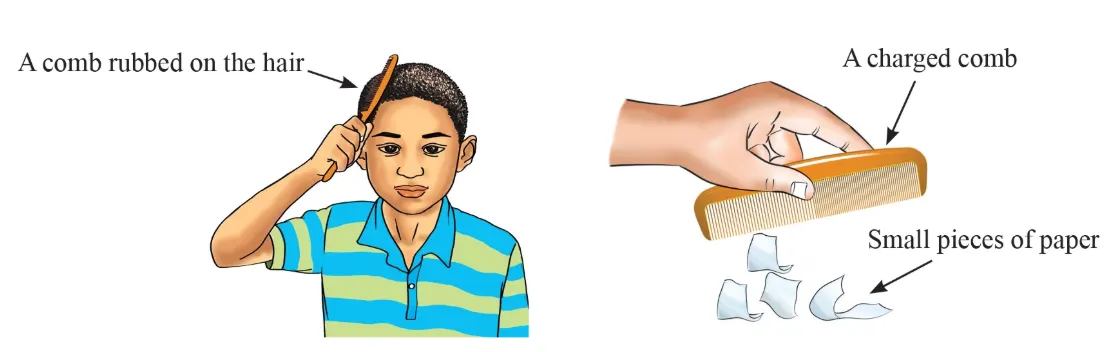
Charged comb attracts pieces of paper
Static electricity results from the accumulation of static electric charges on a material that does not conduct electricity.
Generating static electricitye
Static electricity is generated through the transfer of electrons between materials. This happens when two objects come into contact and are separated, causing one material to gain electrons (becoming negatively charged) and the other to lose electrons (becoming positively charged).
Common examples include rubbing a glass rod with cloth (Figure a), and walking across a carpet (Figure b below) or rubbing a balloon with woollen cloth (Figure c).
The magnitude of the static charge depends on several factors, including
- the materials involved,
- the surface properties, and
- the environmental conditions, such as humidity.
This charge build-up can lead to electrostatic discharge, such as a spark.

(a) rubbing a glass rod with clot

(b) walking across a carpet

(c) rubbing a balloon with woollen cloth
Generating static charges
Activity 1
Aim: To demonstrate the charging of an object
Materials: Wool jumper, dry plastic sheets
Procedure
1. Align two transparent plastic sheets on top of a book.
2. Rub the two plastic sheets with the wool jumper several times.
3. Slowly separate the two plastic sheets and listen to what occurs.
4. Bring the plastic sheets closer and observe the reaction.
5. Separate the plastic sheets, then rub them individually with the wool jumper several times.
6. Bring the sheets close to one another and observe the effect.
Questions
(a) What happened when the two plastic sheets were separated after rubbing them?
(b) Did the plastic sheets attract or repel each other when brought close?
(c) Why do you think the plastic sheets behave differently after being rubbed separately?
When the two plastic sheets are separated, a distinct cracking sound can be heard, and when they are brought together, they attract each other. This phenomenon occurs because the upper sheet acquires a different charge from the lower sheet.
Conversely, when the two plastic sheets are rubbed separately and then brought closer, they tend to repel one another due to both sheets acquiring the same charge. The process of charging through rubbing involves the removal or addition of electrons.
For instance, when the plastic sheets are rubbed against a sweater, electrons transfer from the sweater to the upper plastic sheet. Meanwhile, the protons in the lower plastic sheet attract the electrons from the upper sheet. This interaction explains why the sheets attract each other after being rubbed together.
The summary of the acquisition of charges by rubbing for some materials is given in Table below
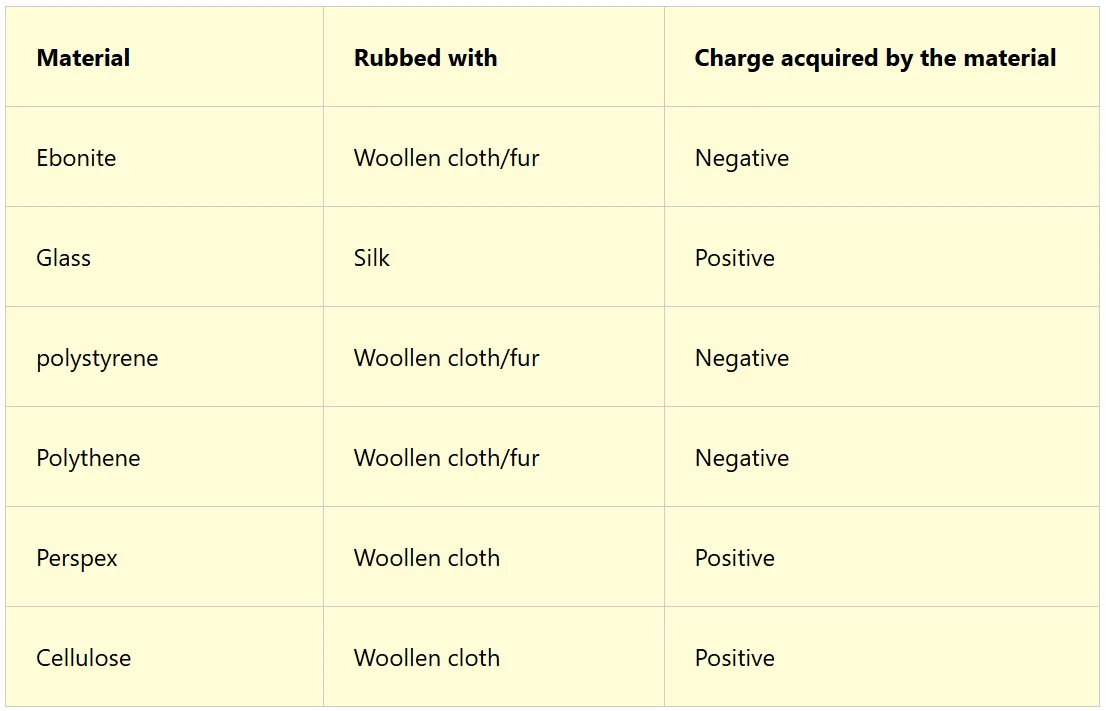
Acquisition of charges by different materials
Origin of charges
Electric charge is something that exists inside atoms. In 1890, a scientist named J.J. Thomson found out that all materials have tiny, light particles with a negative charge. He called these particles electrons.
Later, between 1909 and 1911, another scientist named Ernest Rutherford discovered that atoms also have a heavy centre called the nucleus, which has a positive charge. Normally, an atom is neutral, which means it is not charged, because the positive charge in the nucleus and the negative charge from the electrons are equal and cancel each other out.
But if the atom gets extra energy, it can lose one of its outer electrons. When this happens, the atom has more positive charge than negative charge, so it becomes positively charged. The electron that was removed can stay by itself or join another atom. If it joins another atom, that atom gets a more negative charge and becomes negatively charged.
So, gaining or losing electric charge is really about moving electrons from one atom to another. The charge on the electron equals -1.610-19C. The proton has a charge of the same magnitude as that of the electron but with an opposite charge. Electrons surround the nucleus in shells. Figure below illustrates the structure of an atom.


Origin of charges
Conductors and Insulators
Conductors possess free electrons that facilitate charge movement, enabling an even distribution of charge when a current is added, as shown in Figure below. Examples include copper, iron, and aluminium.
In contrast, insulators lack free electrons, resulting in the added charge remaining fixed in place, as depicted in Figure beloww. This leads to no rearrangement of charge, with examples such as plastic, wood, and rubber

Charge distribution in a conductor and an insulator
Determine whether an object is an insulator or a conductor based on its charge distribution
Step 1: Identify the initial location where the charges are added to the object and their final locations after a brief period of time.
Step 2: If the charges are spread evenly across the surface of the object, it is a conductor. If the charges remain in the same location where they were added, it is an insulator.
The following examples will help to determine the charge distribution in a conductor and an insulator.
Example 1
A charged sphere is brought into contact with an object of unknown material. The sphere transfers electrons to the object, and the charge distribution is measured after a short period of time.

Based on the charge distribution:
(i) is the object in Figure 1.5 (a) a conductor or an insulator?
(ii) is the object in Figure 1.5 (b) a conductor or an insulator?
Solution
(i)
Step 1: Identify the initial location where the charges are added to the object and their final locations after a brief period of time. The electrons are initially located in a group where they were added and are then spread out evenly across the surface of the object.
Step 2: If the charges are spread evenly across the surface of the object, it is a conductor. If the charges remain in the same location where they were added, it is an insulator. Therefore, because the charges are distributed evenly, the object is a conductor.
(ii)
Step 1: Identify the initial location where the charges are added to the object and their final locations after a brief period of time. A group of electrons has been removed from a specific location on the object. After short period, this region of net positive charge (due to electron deficity) remains fixed in the same location.
Step 2: If the charges are spread evenly across the surface of the object, it is a conductor. If the charges remain in the same location where they were added, it is an insulator. Based on the charge distribution, the object is an insulator.
Air as a conductor: Air is an insulator. However, under certain conditions, sparks or lightning occur, allowing charge to move through the air as if it were a conductor. The sparks that jump between your fingers and a doorknob after you have rubbed your feet on the carpet discharge you.
That is, you have become neutral because the excess charges have left you. Similarly, lightning discharges from a thundercloud. In both cases, for a brief moment, air becomes a conductor.
Separation of charge
If two neutral objects are rubbed together, each can become charged. For instance, when rubber and wool are rubbed together, electrons from the atoms of the wool are transferred to the rubber, as shown in Figure (a) and (b).
The extra electrons on the rubber result in a net negative charge, while the electrons missing from the wool lead to a net positive charge. The combined total charge of the two objects remains the same.
Charging is conserved, which means that individual charges are neither created nor destroyed. All that happened was that the positive and negative charges were separated through the transfer of electrons.

Separation of charges
Law of conservation of charge
A charge is a characteristic of matter that causes it to create and experience electrical and magnetic effects. The underlying idea behind charge conservation is that the system’s overall charge is conserved. It can be defined as follows:
According to the rule of conservation of charge, the total charge of an isolated system will always remain constant. At any time intervals, any system that is not exchanging mass or energy with its surroundings will have the same total charge.
When two objects in an isolated system each have a net charge of zero, and one body transfers one million electrons to the other, the object with the surplus electrons will be negatively charged, while the object with fewer electrons will have a positive charge of the same magnitude. The total charge of the system has never changed and will never change.
Electrostatic force
The interaction between static electric charges produces a force known as the electrostatic force. For instance, when plastic rods are charged by rubbing them with fur, they repel each other. Similarly, glass rods rubbed with silk also become charged and repel one another. Additionally, plastic rods attract the fur, while glass rods attract the silk.
French physicist Charles Coulomb measured the force between two charged objects using a torsional balance, establishing a unit of electrical charge named the coulomb in his honour. A coulomb is a much larger quantity of charge than that normally produced by rubbing.
Activity 2
Aim: To demonstrate the existence of the electrostatic force
Materials: plastic pen, plastic comb, tissue paper, human hair
Procedure
1. Tear a sheet of tissue paper into several small pieces and lay them on a table.
2. Rub a plastic pen through your hair.
3. Bring the pen closer to the pieces of paper, but do not touch them as shown in Figure 1.7.
4. Hold the pen for 15 seconds.
5. Record your observations.
Questions
(a) What happened when the pen was brought closer to the pieces of paper?
(b) What happened to the pieces of paper on the pen after holding it for 15 seconds?
(c) Discuss your observations.

Charged plastic pen attracts pieces of paper
The pen picked up pieces of paper, which were dropped off after some time. This shows that a plastic pen rubbed with human hair acquires a charge that can attract other substances, such as pieces of paper. After a few seconds, pieces of paper fall off because they acquire similar charges to the pen.
Activity 3
Aim: To show the existence of opposite charges
Materials: water, plastic pen, plastic comb, human hair
Procedure
1. Rub a comb with your hair.
2. Bring the comb close to a small, slow stream of water coming from a tap as shown in Figure 1.8 (b).
Questions
(a) What did you observe after rubbing the comb with the hair?
(b) What types of charges were in the water?

Slow stream of water is attracted to the comb
Fundamental law of static electricity
The fundamental law of static electricity, also known as the first law of electrostatics, states that, “like charges repel, unlike charges attract”.
Activity 4
Aim: To verify the fundamental law of static electricity
Materials: 2 dry glass rods, 2 ebonite rods, thread, stand, silk cloth, fur (cotton cloth)
Procedure
1. Rub a dry glass rod with a silk cloth and suspend it using a piece of thread.
2. Bring a second charged glass rod close to the suspended one as shown in Figure 1.9.
3. Record your observations.
4. Repeat steps 1 and 2 using an ebonite rod rubbed with fur.
5. Now, repeat the activity by bringing a charged glass rod close to the suspended charged ebonite rod and the charged ebonite rod close to the suspended charged glass rod. Record your observations.
Questions
(a) What did you observe?
(b) What conclusion can you make from your observations?

Verification of the fundamental law of electrostatics
If two negatively charged materials or two positively charged materials are brought near each other, they repel. However, if a positively charged object is placed near a negatively charged object, the objects attract each other. This suggests that unlike charges exert an attractive force on each other, and like charges exert a repulsive force on each other.
Activity 5
Aim: To show charge separation in materials
Materials: woollen cloth, glass rod, cotton fabric, plastic pen or comb, string, retort stand
Procedure
1. Hang a comb from a string tied to a retort stand.
2. Rub the comb with a piece of cotton fabric, then hang it.
3. Rub a glass rod with a piece of woollen fabric, then hang it.
4. Bring the charged glass rod near but not touching the hanging charged comb.
5. Bring the piece of woollen cloth that you used to rub the glass rod near but not touching the hanging comb.
Questions
(a) Which material will become positively or negatively charged in steps 2 and 3? (Refer to Table 1.1.)
(b) What did you observe in steps 4 and 5?
(c) Discuss your results.
Charging objects
A neutral object has the same number of positive and negative charges, so they balance each other out. When you bring another neutral object close to it or touch them together, nothing special usually happens because both objects have balanced charges.
However, if something causes one of the objects to have more positive or negative charges than the other, this is called an imbalance of charges. Creating this imbalance is known as charging an object.
There are different ways to charge objects:
(a) Friction: Rubbing two objects together can move electrons from one object to another.
(b) Contact (or conduction): Touching a charged object to a neutral object can transfer electrons.
(c) Induction: Bringing a charged object close to a neutral object can rearrange the charges inside the neutral object, even without touching.
These methods all involve moving electrons to create an imbalance of charges, which makes the object either positively or negatively charged.
Charging by friction
Charging by friction is the oldest method of generating electric charge, and it plays a fundamental role in understanding static electricity. This process occurs when two objects in contact are rubbed against each other, leading to the transfer of electrons from one object to another.
Mechanism of charging by friction
When two insulating materials are rubbed together, friction generates an imbalance of electric charges. Electrons, which are negatively charged particles, are transferred from one object to
another. The object that loses electrons becomes positively charged, while the object that gains electrons becomes negatively charged. This transfer of charge is governed by the principle of
conservation of charge, meaning that the total charge before and after the rubbing process remains constant. For example, when an ebonite rod is rubbed with fur, electrons move from the fur to the ebonite rod as shown in Figure 1.10. As a result, the fur becomes positively charged (due to the loss of electrons), while the ebonite rod becomes negatively charged (due to the gain of electrons).

Process of rubbing
Every day examples of charging by friction
1. Combing hair: When you comb your hair with a plastic comb, electrons are transferred from your hair to the comb. This causes the comb to become negatively charged, allowing it to attract small bits of paper when brought close.
2. Rubbing a glass rod with silk: When a glass rod is rubbed with silk, the glass rod loses electrons and becomes positively charged, while the silk gains electrons and becomes negatively charged.
3. Wool Sweater and Human Skin: In colder months, when you take off a wool sweater, you may notice sparks or hear crackling sounds. This is due to the static electricity generated as electrons transfer from the wool to your skin.
The Role of insulators and conductors
Not all materials can be charged by friction. Only insulating materials can be effectively charged through this method because their electrons are not free to move. In contrast, conductors allow electrons to move freely, which means they cannot hold a static charge. Common insulating materials include rubber, glass, and plastic, while metals are good Conductors.
Triboelectric series
The triboelectric series is a ranking of materials based on their propensity to gain or lose electrons through contact or friction. The position of a material in the series indicates whether it will tend to become positively or negatively charged when rubbed against another material (see Figure 1.11). Materials higher on the list tend to become positive, while those lower become negative.
This effect is due to the transfer of electrons between the materials, leading to static electricity. The series is a useful tool for predicting the outcome of charge transfer in various scenarios.

Triboelectric series
When two materials from this series are rubbed together, the one higher in the series will gain electrons, while the one lower will lose electrons. For example, if you rub a glass rod with silk, the glass rod will lose electrons and become positively charged, while the silk will gain electrons and become negatively charged
Charging an object by contact (conduction)
Charging by contact is achieved by bringing a charged body into contact with an uncharged one. Charges are transferred from the charged body to the uncharged body. Consider two metal plates X and Y, where plate X is positively charged while plate Y is uncharged. Both plates are then placed on insulating blocks brought into contact and then separated as shown in Figure below.

Charging by contact
Testing the metal plates after separation shows that, when a charged body is brought in contact with an uncharged body, the same electric charges are distributed among the two bodies. As a result, the initially uncharged body acquires charges of the same sign as the charges of the initially charged body.
Charging by induction
Charging by induction is a method of charging an object without actually touching it with any other charged object. Figure 1.13 illustrates the simple steps to induce a charge by induction.

Inducing a charge on a spherical ball
Step 1: A negatively charged rod is brought near the uncharged spherical ball. The free electrons from the sphere are repelled by the excess electrons on the rod, and they are shifted towards the right. They cannot escape from the sphere because the stand and the surrounding air are insulated.
Step 2: These excess charges, called induced charges, are released to the earth by touching the right part of the sphere with a wire and connecting the other part of the wire to the earth.
Step 3: The wire is disconnected.
Step 4: The negatively charged rod is removed. A net positive charge is left on the spherical ball.
Activity 6 |
Aim: To demonstrate the transfer of conduction electrons in a conductor by the induction method
Materials: iron nail, string, plastic comb, cotton cloth, glass rod, woollen cloth
Procedure
1. Suspend an iron nail from a string, as shown in Figure 1.14.
2. Rub the comb with a piece of cotton cloth.
3. Bring the comb near one end of the iron nail.
4. Rub the glass rod with a piece of woollen cloth.
5. Bring the glass rod near one end of the iron nail.

Questions
(a) What do you observe in steps 3 and 5?
(b) What type of charge does the comb acquire?
(c) Explain your results.
(d) Why does a string suspend the iron nail?
When the plastic comb is rubbed with cotton, it becomes negatively charged. When the comb is placed near the iron nail, the conduction electrons at the end of the iron nail near the negative charge on the comb are repelled and move to the opposite end of the iron nail.
This leaves an excess positive charge at the end near the comb. The positive charges on the iron nail then attract the negative charges from the comb. Further observation reveals that the iron nail is slightly pulled towards the comb, as shown in Figure

Charging a conductor by induction using a negatively charged comb
On the other hand, rubbing the glass rod with cotton causes it to acquire a positive charge. When the rod is brought close to an iron nail, the conduction electrons from the iron nail are attracted by the positive charge of the rod and move to the end of the iron nail near the glass rod. This movement results in an excess of positive charge at the opposite end of the iron nail. As a result, the iron nail is pulled slightly towards the glass rod, as shown in Figure

Charging a conductor by induction using a positively charged rod
If the charging object (comb or glass rod) is removed, the charges in the iron nail return to their normal distribution and the nail is no longer charged.
Detection of charges
Electroscopes detect the presence of electric charges on a body. The most commonly used type of this instrument is the leaf electroscope.
Structure of a leaf electroscope
A leaf electroscope was previously referred to as a gold leaf electroscope. It is an instrument used to detect electric charge on an object. It consists of a metal cap mounted on a metal rod, having at its lower end a small metal plate with a thin metal leaf attached to it. The metal used for the cap, rod and plate is normally brass.
The leaf is normally made up of gold, but any other metal, like aluminium, can be used. The metal rod and plate with attached metal leaf are enclosed in a metal or glass case to protect the leaf from air currents. Figure (a) shows an example of a leaf electroscope, and Figure (b) is its schematic diagram.

Leaf electroscope
Construction of a gold-leaf electroscope
The construction includes a metal rod with a conductive ball at the top and two thin gold leaves suspended from the bottom, which visibly respond to changes in charge. Enclosed in a protective casing, the electroscope is an essential tool in electrostatics, enabling clear observation of electrostatic phenomena.
Project 1
Construct a simple leaf electroscope using a glass jar, copper wire, straw, strips of aluminium foil, glue, and a jar lid. After construction, test different objects to observe the deflection of the leaves and determine whether they are positively or negatively charged.
The electrophorus
It is a simple device used to produce an unlimited number of electrostatic charges via the process of electrostatic induction. An electrophorus consists of a circular slab of insulating material (polythene) and a brass disc (conductor) on an insulating handle. Figure 1.18 (a) shows a picture of an electrophorus, and Figure 1.18 (b) is a schematic diagram of it.

Structure of electrophorus
Mode of action of an electrophorus
An electrophorus works by electrostatic induction. It can be used to generate positive charges from a single negative charge. The polythene slab is first negatively charged by rubbing it vigorously with fur. The brass disc is then placed on it, as shown in Figure (a).
Since the surfaces are only in contact at relatively few points, a positive charge is induced on the lower surface of the brass disc, and a corresponding negative charge is produced on its top surface. The top of the brass disc is then touched briefly using a wire that touches the ground, thereby carrying away the negative charges to the earth, as shown in Figure (b). This is known as earthing.

Action of the electrophorus
This process leaves a net positive charge on the brass disc after separation, as seen in Figure 1.19 (c). The electric force between the brass disc and the polythene base is fairly strong, so some mechanical work has to be done to overcome it.
The top of the disc can be repeatedly charged in the same way. In principle, an unlimited amount of induced charge can be obtained from a single charge, but the insulated disc slowly discharges to the surroundings. An electrophorus can be used to charge an electroscope through contact and induction.
Task 1
Construct an electrophorus using materials such as a metal tray, a foam or rubber disk, and an insulating handle. After assembling the electrophorus, use it to demonstrate the charging process by induction.
Charging and discharging a leaf electroscope
A leaf electroscope can be charged or discharged either by contact or by induction. If a charged object touches the metal cap, the metal leaf diverges from the plate. This is because the same charge has been conducted through the metal cap and the metal rod to the metal plate and the leaf. This makes them repel each other, and thus, the leaf diverges from the plate. This is charging by contact.
If you touch the brass cap with a conducting wire that touches the ground, the charge is transferred through the wire to the earth, and the leaf of the electroscope then collapses back. If the electroscope is brought near a charged object without touching it, the leaf also diverges from the plate. This is because charges on the metal cap with the same charge as the object are repelled to the leaf. This is charging by induction.
Charging the electroscope by contact
Charging by contact takes place when contact is made between a neutral electroscope and a charged object. If a positive or negatively charged object is brought into contact with the brass cap of the neutral electroscope, the leaf diverges. The neutral electroscope becomes charged when contacted by the charged object. An electroscope that becomes charged by contact always gets the same type of charge as the object used to charge it.
Activity 7 |
Aim: To charge a leaf electroscope by contact
Materials: charged ebonite rod, electroscope, silk cloth, glass rod
Procedure
1. Place the electroscope on a table and discharge it by earthing.
2. Bring the charged ebonite rod in contact with the brass cap of the electroscope as shown in Figure below.

3. Observe the leaf of the electroscope. Note: If the leaf does not stay diverged, bring the charged ebonite rod in contact with a brass cap of the electroscope until the leaf stays diverged.
4. Remove the charged ebonite rod from the brass cap of the electroscope and observe what happens to the leaf of the electroscope.
5. Charge the glass rod by rubbing it with a silk cloth.
6. Bring the charged glass rod close (not touching) to the brass cap of the electroscope. Note your observations.
Questions
(a) Explain your observation.
(b) Why does the leaf collapse when a glass rod is brought near the cap?
When the negatively charged rod is brought into contact with the electroscope, the latter gets charged and the leaf diverges. It acquires a negative charge. The charge on the electroscope can be determined by testing using the charged glass rod.
When a positively charged glass rod is brought near the brass cap, positive charges on the cap are repelled towards the brass plate. Therefore, the plate becomes positively charged. This causes the leaf to collapse, as shown in Figure

Testing a charged electroscope by using a charged glass rod
Charging an electroscope by induction
Having learnt how to charge an object by induction, the same method can be applied to charge a leaf electroscope. In this process, a positively charged electrophorus is advised.
|
Activity 8 |
Aim: To charge an electroscope by induction using a positively charged electrophorus
Materials: electrophorus, glass rod, ebonite rod, silk cloth or fur, leaf electroscope
Procedure
1. Place the electroscope on a table and discharge it by touching it with an earthed wire.
2. Charge the electrophorus by induction.
3. Hold the charged electrophorus close to the cap of the electroscope.
4. Earth the electroscope momentarily, as shown in Figure

5. Remove the electrophorus and observe the leaf of the electroscope.
6. Test for charges on the electroscope using charged rods of glass and ebonite.
Questions
What charge does the electroscope acquire?
When the electroscope is charged this way, it acquires a negative charge. The charged glass rod, therefore, causes a collapse of the leaf, while a charged ebonite rod causes further leaf divergence. Recall, the glass is positively charged while ebonite is negatively charged after being rubbed with silk and cloth, respectively.
Discharging a leaf electroscope
Having charged a leaf electroscope by either contact or induction, the same can be effectively discharged through induction. If a negatively charged object is brought near the brass cap of a positively charged electroscope, electrons in the brass cap are repelled and move down to the leaf, as shown in Figure (a).
When a positively charged electroscope is earthed by a wire, the excess electrons flow from the electroscope to the earth, causing the electroscope leaf to collapse, causing it to discharge. This cancels the positive charges. With no net charge, the leaf collapses back to the plate, and the electroscope becomes discharged, as shown in Figure (b)

Electroscope discharged by induction
Similarly, when a negatively charged electroscope is earthed by a wire, the excess electrons flow from the electroscope to the earth, causing the electroscope leaf to collapse, causing it to discharge.
|
Activity 9 |
Aim: To investigate the charging and discharging of a leaf electroscope by induction
Materials: leaf electroscope, a piece of cotton cloth, a glass rod
Procedure
1. Rub a glass rod with a piece of cotton cloth.
2. Bring the rod near but not touching the brass cap of the electroscope.
3. Record your observations.
4. With the rod still near the cap, touch the cap with an earthed wire.
5. Note what happens.
6. Remove the rod.
7. Now rub the glass rod with a piece of wool, causing the rod to become positively charged.
8. Bring the positively charged glass rod near but not touching the brass cap of the electroscope.
9. Remove the glass rod.
Questions
(a) What happened to the electroscope? Why?
(b) Which type of charge is on the leaf of the electroscope?
Task 2
Use rubbing and direct contact techniques to charge and discharge an electroscope, then analyse and share your findings with peers.
Application of the electroscope
Applications of an electroscope include:
1. Testing for the sign of charge on a body
The leaf divergence increases when a negatively charged ebonite rod is brought near a negatively charged leaf electroscope. Introducing a material of unknown charge near the cap will cause the leaves to collapse if it is positively charged. To test for a negative charge, the electroscope must first be positively charged; if the leaves collapse, the material is negatively charged. However, a decrease in divergence can also occur with uncharged objects, so an increase in divergence is the sure test for charge presence.
Table 2: Charges and their effects on the leaf electroscope
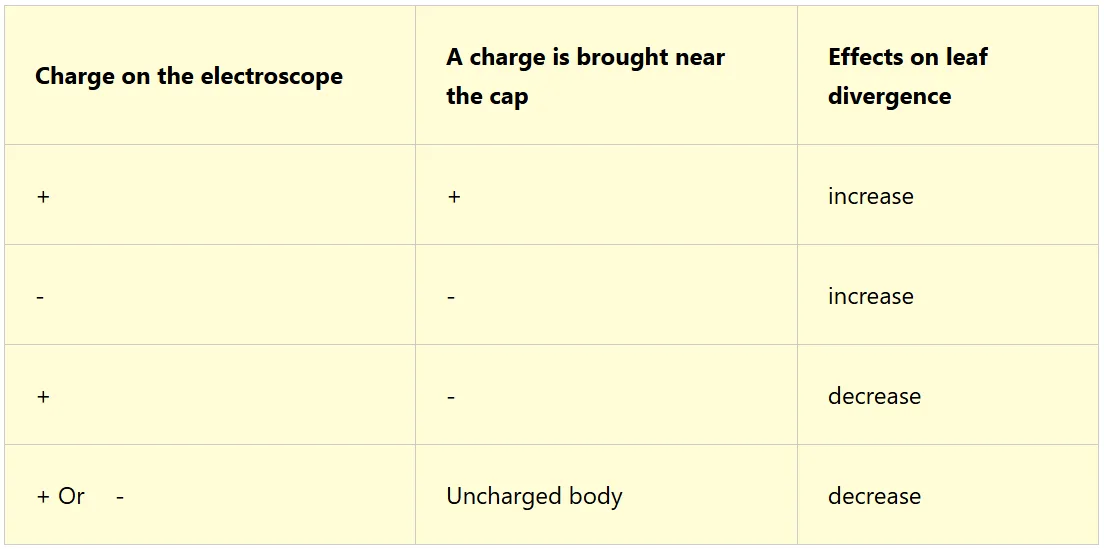
2. Identifying the insulating properties of materials
An electroscope that is positively charged can be used to test for the insulating properties of materials. If the material that is placed near the cap of an electroscope is a conductor, then the metal leaf collapses. If the material being tested is an insulator, the leaf electroscope retains its charge, and the leaf remains raised.
3. Detecting the presence of charge on a body
When a charge is induced on the leaf electroscope by a charged body, the leaf diverges. When the charged body is removed, the leaf collapses, indicating that the induced charge on the electroscope is temporary and due to the charged body.
Electrostatic potential
You have learnt that like charges repel each other, and unlike charges attract each other. Therefore, work must be done to overcome the repulsive force in moving a positive charge towards another positive charge. Likewise, work is done to overcome the attractive force to move a negative charge away from a positive charge. The above processes apply to all points in the region surrounding any charges.
This means an electrostatic force field around a charge exists. The work required to move a unit charge from a reference point to a specific point against the electrostatic force field of another charge is called the electrostatic potential at the specific point. Therefore, there is a difference in electrostatic potential between any two points in the electrostatic force field.
Potential of a charged body
A charged body is considered to be at a positive potential if, upon grounding, electrons flow from the earth to the body. Similarly, if electrons move from the body to the earth upon contact, the body is at a negative potential. This electron flow continues until the body’s potential matches that of the Earth, which is defined as zero potential as indicated in Figure 1.24. Therefore, any grounded conductor is considered to be at zero potential by Definition.

Flow of electrons to and from the body and the Earth
Potential difference (p.d.) refers to the work required to move a charge between two points with different electric potentials, measured in volts (V). The volt is named after the Italian physicist Alessandro Volta, where one volt equals one joule of work per coulomb of charge.
In a leaf electroscope, leaf divergence occurs due to this potential difference between the leaf and the cap. When a negatively charged conductor is grounded, negative charges flow from it to the earth.
Equally, a positively charged conductor can gain electrons from the ground, driven by the potential difference. If a wire connects two conductors at different potentials, electrons will flow between them until they reach the same potential, resulting in equal average potential energy for the free electrons in both conductors. Typically, electrons move from areas of low potential to high potential as shown in Figure

Flow of electrons
EXERCISE 1
1. Explain why:
(a) Nylon clothes crackle as you undress.
(b) Petrol road tankers usually have a long metal chain that hangs down and touches the ground.
(c) Some clothes tend to cling to the body of a person.
(d) It is possible for an air passenger to get an electrical shock when the passenger touches the knob of the toilet door in a high altitude flying aeroplane.
2. Children playing with a plastic comb and some pieces of paper notice that the paper pieces are attracted to the comb after it has been rubbed through their hair.
(a) Explain the concept of charge transfer in this scenario.
(b) How does the interaction between the comb, hair, and paper illustrate the principles of static electricity?
3. (a) Why do TV screens become dusty after a while? Discuss.
(b) Explain any two applications of electrostatics and hazards of electrostatics
4. If you are given two metal spheres standing on insulator stands and a positively charged rod, explain how you can charge the two metal spheres with equal and opposite charges by induction.
5. (a) How can a charged leaf electroscope be neutralised?
(b) An object with an unknown charge is brought close to the electroscope. The leaves of the electroscope come closer together. Does the object have a positive or a negative charge? Explain.
Capacitors
A capacitor is a device used to store electric charge. It consists of two electrically conductive plates separated by an insulator material. The shape of a capacitor can be square, circular, rectangular, or cylindrical.
Insulators can be ceramic, plastic film, air, paper, mica, or liquid gel. The insulating material between the conductive plates is called a dielectric material. When a power source is connected across plates, one plate is charged negatively, and the other plate positively.
The charge continues to accumulate on the plates with time until the capacitor is fully charged. Figure 1.26 (a) shows a capacitor, (b) its structure and (c) its circuit symbol.

Capacitor and its symbol
Capacitors are used as parts of electrical circuits in many common electrical devices. They store energy in the electrostatic field created by the electric charges on their plates.
Consider electric devices like the radio or stereo system; the power lamp fades out slowly when power is switched off. On the other hand, the stereo system has its sound playing for some seconds after the power is switched off.
This is because capacitors store electrical energy, and, as a result, the electronic appliances then continue being supplied with it. Capacitors are used in computers, televisions and other electronic circuits. Figure 1.27 shows mounted capacitors in a radio circuit board.

Capacitors in a radio circuit board
A fully charged capacitor has a positive charge on one plate and an equal amount of negative charge on the other. The potential difference between the capacitor plates is measured by connecting a voltmeter across them.
Capacitance
When more charges are added to the capacitor, the value of its positive and negative potential rises. Why does this happen? The reason is that the increased charge repels any incoming charge more strongly than before. Thus, more work has to be done to increase the charge on the capacitor.
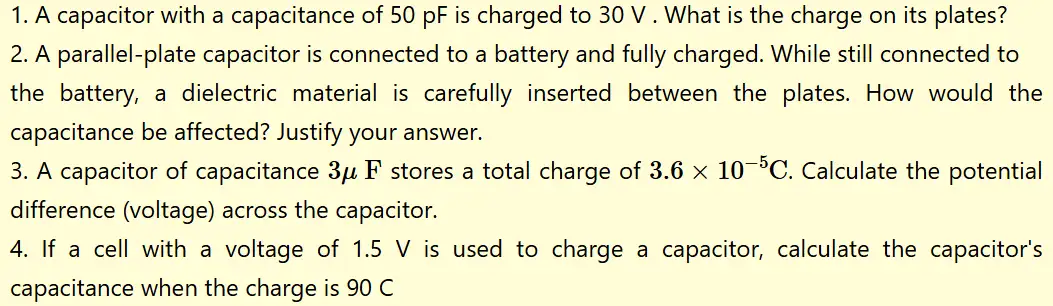
A measure of the amount of charge the capacitor (or any conductor) can hold for a given potential difference is called capacitance, C. If Q is the charge stored by a capacitor, then:
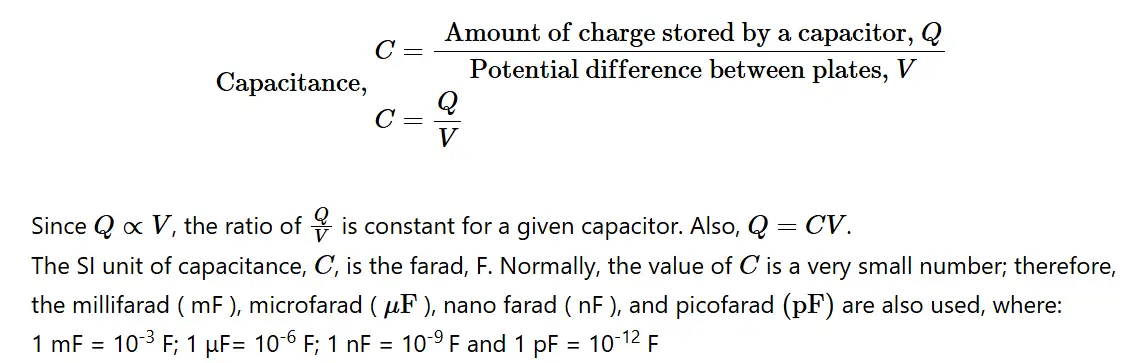
|
A farad is defined as the capacitance of a capacitor when a charge of one coulomb changes its potential difference by one volt. |
One farad is the capacitance of a very large capacitor. In real-world applications, radio receivers usually measure capacitance in microfarads, while modern electronic circuits, such as those found in hi-fi systems, often measure capacitance in picofarads.
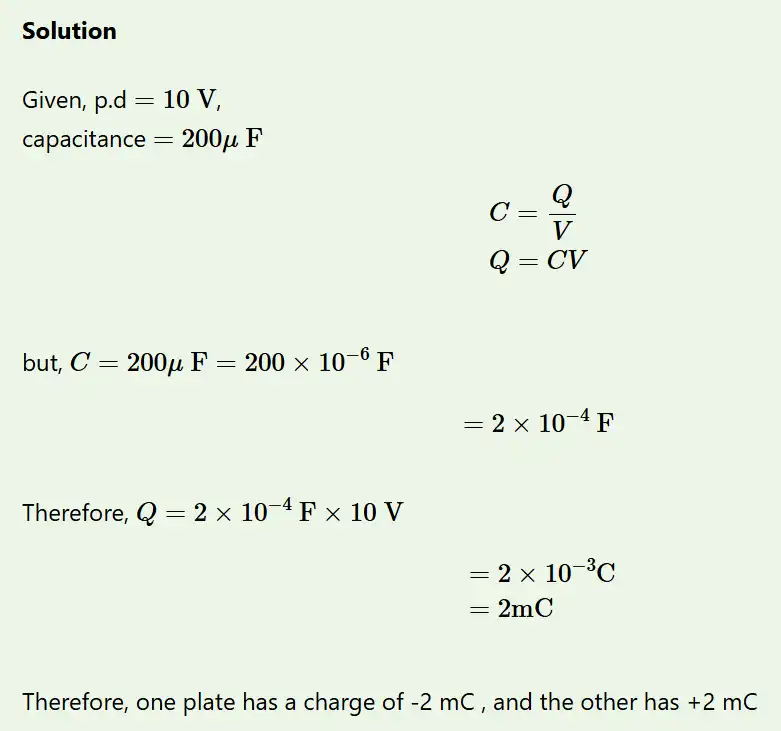
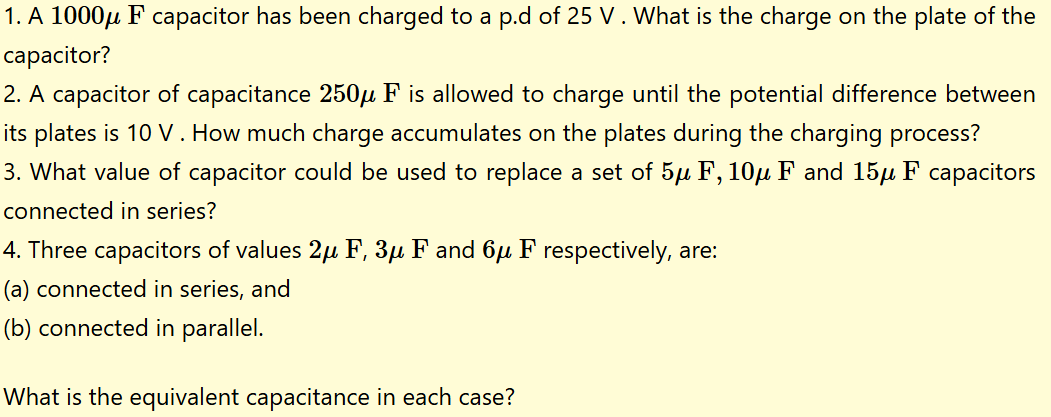
A capacitor with a capacitance of 200 μF is being charged, and the potential difference across its plates is 10 V. What is the amount of charge accumulated on its plates?
EXERCISE 2
Types of capacitors
Different types of capacitors depend on the dielectric materials used to make them. These include the following:
1. Paper or plastic capacitors
A paper or plastic capacitor has metal foil strips as its conductor plates. Waxed paper or plastic forms the insulating material. Polyester film can also be used as a separating or insulating material. See Figure 1.28. Insulating materials are rolled up and sealed inside a metal box to prevent moisture from entering, which could reduce the insulation.

Paper capacitor
2. Mica capacitor
Note that any arrangement of two conductors separated from one another by an insulator forms a capacitor. In an ordinary laboratory, this could be two sheets of metal foil isolated by small pieces of plastic in between, with air as the insulating material.
In a mica capacitor, the sheets of metal foil are separated by strips of mica, as shown in Figure below. Mica is preferred because it is a natural mineral and splits easily into very thin sheets.

Mica capacitor
3. Electrolytic capacitor
Metal sheets are separated by paper previously soaked in a chemical compound (Figure 1.30). The soaked paper is not an insulating material. As the capacitor charges, a thin layer of aluminium oxide is formed on the positive plate, thereby providing a thin insulating layer between the plates.
The thinner the layer, the higher the capacitance. Electrolytic capacitors are connected with great care. Their ends are labelled positive or negative as a safety precaution because a wrong connection can lead to an explosion.

Electrolytic capacitor
4. Air-filled capacitors
In an air-filled capacitor, air forms the insulating material (Figure below). The capacitance of such devices is altered by changing the overlapping area between the plates.

Air-filled capacitor
An air-filled capacitor is a good example of a variable capacitor. The semicircular plates are separated by air. Variable capacitors are mainly used for tuning radio sets. One set of plates is fixed, while the other one can be rotated using a knob.
Rotation changes the area of the plates. Generally, the capacitor whose capacitance can be varied is termed a variable capacitor. On the other hand, the capacitor whose capacitance cannot be changed is a fixed capacitor.
Charging a capacitor
Consider the circuit in Figure 1.32 for charging a capacitor.

An uncharged capacitor has no potential difference between its plates. It does not prevent the current from arriving at one plate or leaving the other. This is because the initial current in the circuit is determined only by the resistance of the connecting wires.
Due to the presence of insulation between the capacitor plates, electrons tend to accumulate on the plate connected to the negative terminal of the charging cell. This is partly due to the attraction of the positive side of the cell or repulsion from the nearby negative charge.
Current flows until the p.d across the capacitor is equal to the voltage of the charging cells. Charging of the capacitor then stops. Figure 1.33 shows a graph of charge against time for a charging capacitor.

Graph of the charge against time for a charging capacitor
The resistance, R, controls the current in the circuit.

The gradient of the charging curve gives the current. Therefore, the initial current is the gradient of the graph at the origin (time = 0).
|
Activity 10 |
Aim: To demonstrate the charging of a capacitor
Materials: a cell, an uncharged capacitor, a high resistance voltmeter, a resistor, a switch, connecting wires and an ammeter
Procedure
1. Connect the circuit as in Figure 1.32, keeping the switch open.
2. Close the switch and then record the values of current at different time intervals.
3. Tabulate your results as follows:

Questions
(a) Plot a graph of current against time.
(b) What does the area under the graph represent?
The area under the current (I) versus time ( t ) graph represents the charge ( Q ). When a cell is connected to a circuit, electrons flow accumulating on the plate connected to the negative terminal, while the opposite plate experiences less accumulation due to attraction from the positive terminal.
Charging continues until the potential difference (p.d.) between the plates equals the total potential difference across the cell, at which point the current drops to zero. The capacitor stores equal but opposite charges, +Q and −Q, on its plates.
Discharging a capacitor
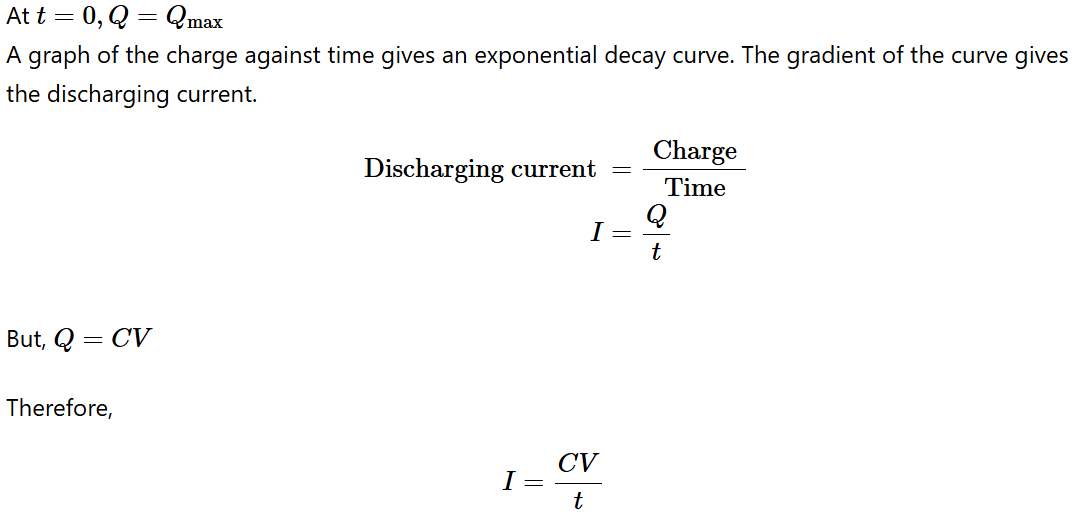
Theoretically, an isolated but charged capacitor should hold its charge indefinitely. However, due to leakage between the plates, the capacitor is eventually discharged. A capacitor can also be discharged by connecting its plates to a resistor. Figure 1.34 shows a circuit used for discharging a capacitor.

Discharging a capacitor
Figure below shows a graph of charge against time for a discharging capacitor.

Graph of discharging a capacitor
Construction of an air-filled capacitor
Project 2
In groups, construct an air-filled capacitor. Note that any arrangement of two parallel conductors, such as metal plates placed close together but at a suitable fixed distance, makes up a capacitor. When air forms the insulating medium between the plates, the dielectric here is air.
Combination of capacitors
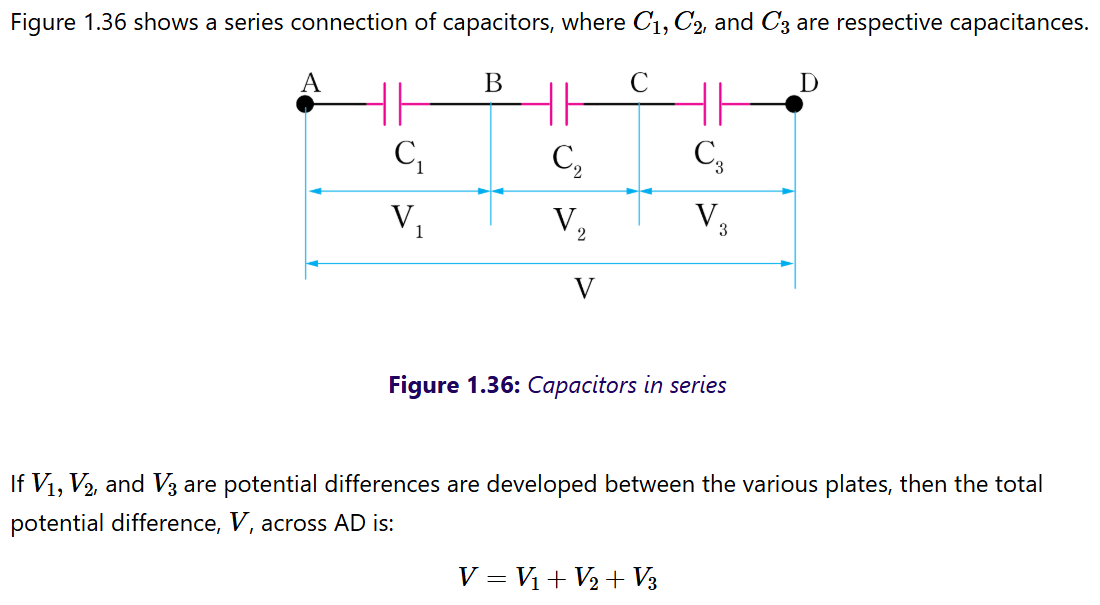
Capacitors have voltage ratings that should not be exceeded. Continuous charging using a large voltage can result in an explosion, as the potential difference between the plates can break the insulation. To adjust the voltage rating and capacitance, capacitors are connected either in series or in parallel in a circuit.
Capacitors in series
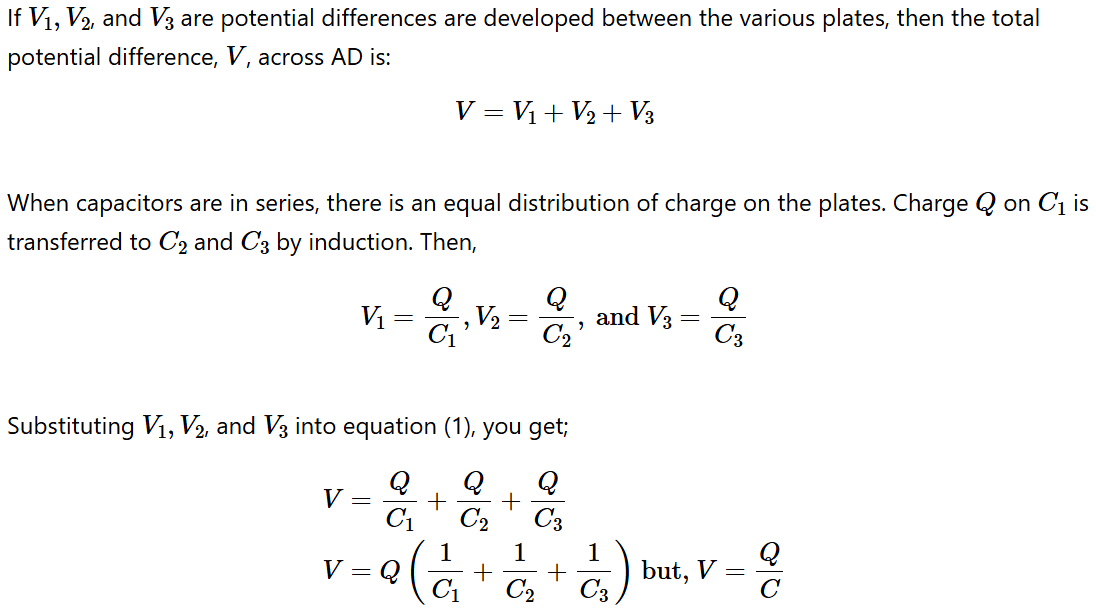
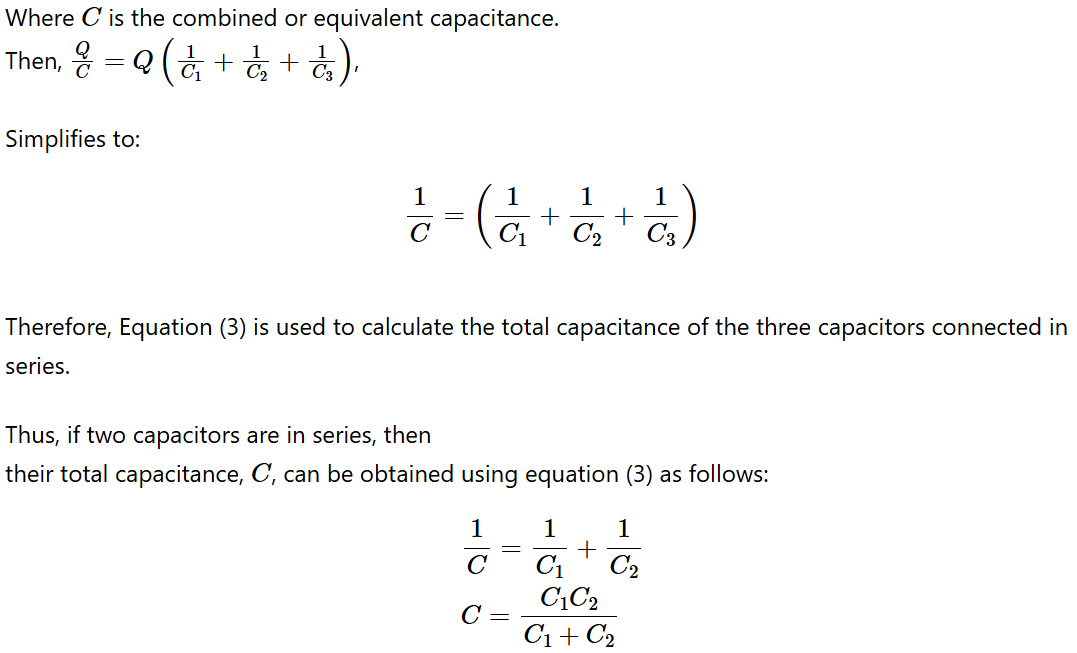
Example 3
Three capacitors, labeled A, B, and C, have capacitances of 10 μF, 20 μF, and 30 μF, respectively, and are connected in series. Find the value of a single capacitor that could replace them.
Solution
Use the formula for capacitors in series.
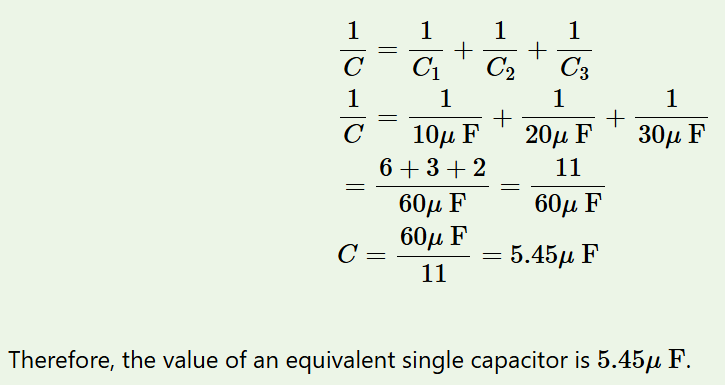
Capacitors in parallel
In a parallel arrangement, all capacitors have the same potential difference across them, as shown in Figure below. However, the charges for all capacitors are different.

Capacitors in parallel
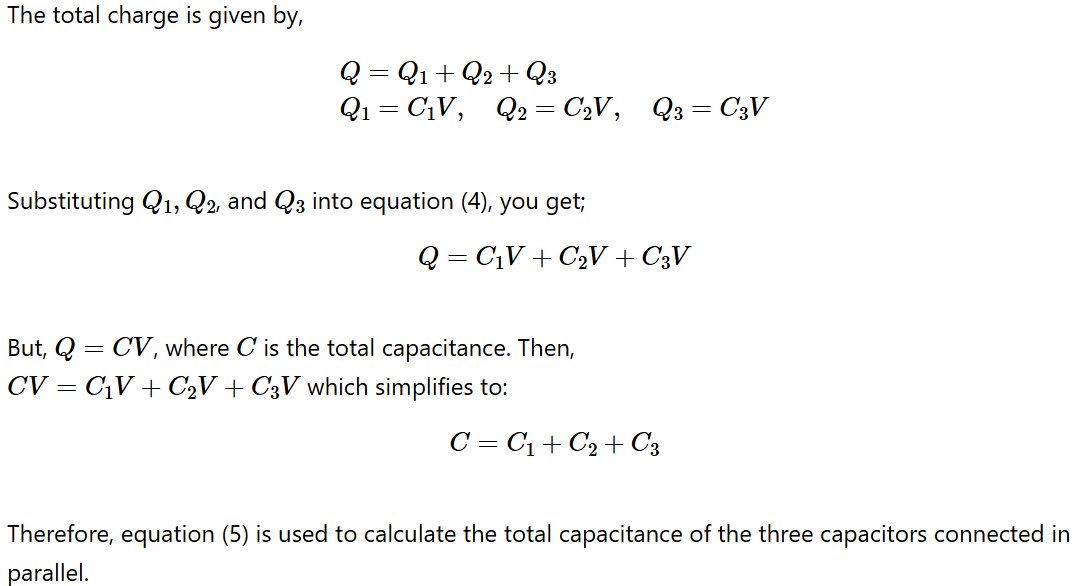
Therefore, equation (5) is used to calculate the total capacitance of the three capacitors connected in parallel.
Example 4
An electric circuit has two capacitors each with the capacitance of 20 μF. If they are connected in parallel to a cell. Calculate their total capacitance.

EXERCISE 3
Factors affecting capacitance
The capacitance of a parallel plate capacitor is affected by three major factors, namely:
(a) area of the plates;
(b) insulating property of the medium; and
(c) distance between the plates.
(a) Area of the plates
An increase in the area of the plates causes a decrease in the potential difference between the plates, hence an increase in capacitance.

Area of plates of a capacitor
From experiments, C∝A, where C is the capacitance, and A is the effective area between the plates Y and Z , as shown in Figure 1.38. A distance, d, separates the plates. If d is kept constant, and Z is moved parallel to Y, the overlapping area is varied.
(b) Insulating property of the medium
If the air between the plates of a capacitor is replaced with another insulating medium, such as glass, paper, or polythene, while the area A and the distance d remain constant, the capacitance increases. From experiments, capacitance C is directly proportional to the insulating property of the medium between plates Y and Z

Insulating property of materials
(c) Distance between plates
A charged capacitor is connected such that one plate is earthed while the other is connected to an electroscope, as shown in Figure 1.40. The distance between the plates varies, and its effect on the leaf divergence is noted. It is observed that the closer the plates are to each other, the smaller the divergence and the lower the potential. In conclusion, capacitance increases with the closeness of the plates. Thus, C∝1d, where C is the capacitance, and d is the distance between plates.

Capacitor connected to an electroscope
Charge distribution on a conductor
Induced charge resides on the surface of a conductor. Conductors appear in many different shapes, such as spherical, pear-shaped and cylindrical surfaces. Charge distribution on conductors depends on the shape of the conductor.
Charge distribution on the surface of a conductor
The distribution of charges on a conductor depends on the shape of the conductor. A proof plane and a gold-leaf electroscope can be employed to investigate this phenomenon. This is accomplished by successively pressing the proof plane against various regions of the surface of a conductor and then transferring the collected charge to the electroscope.
The extent to which the leaves of the electroscope diverge provides a rough estimate of the amount of charge that has been transferred within a certain region, which, in turn, offers insight into the surface charge density of the conductor, as shown in Figure

Testing charge distribution according to the shape of the conductor
The charge density of charged conductors of various shapes, such as spherical, cylindrical, and pear-shaped, can be tested. To examine the charge distribution on a conductor, carry out Activity 11
Activity 11
Ai1.m: To examine the distribution of charge through various conductors
Materials: proof plane, leaf electroscope, aluminium foil, various conductors (pear, spherical, cylindrical and conical conductors

Procedure
1. Charge a pear-shaped conductor.
2. Using a proof plane, touch the flat side of the conductor
3. Hold up the proof plane to an Activity 1.12 electroscope and note minor deflections.
4. Touch the pointed side of the conductor with the proof plane
5. Hold up the proof plane to an electroscope and note the deflection
Questions
(a) What can you say about the deflection of the leaf in steps 3 and 5?
(b) Write a summary of your observation.
In a solid conductor, the electrons move apart when charges are gathered from various points on the conductor. The extent of this divergence is influenced by the quantity of charges collected at each location. As demonstrated in Activity 11, the leaf shows greater divergence when charges are drawn from a sharp point compared to the flat end of the object.
Conversely, in a hollow conductor, charges collected from the exterior cause the leaf to diverge, while those collected from the interior show no divergence. This suggests that in any conductor, charges primarily exist on the outside rather than within the material.
Activity 12
Aim: Demonstrate where the charge resides
Materials: Proof plane, leaf electroscope, aluminium foil, hollow charged conductor

Procedure
1. Charge a hollow shaped conductor as shown in Figure 1.43.
2. Using proof plane, touch of the inside the conductor.
3. Hold up the proof plane to an electroscope and note the deflection.
4. Touch the outside of the conductor with the proof plane.
5. Hold up the proof plane to an electroscope and note the deflection.
Questions
(a) What can you say about the deflection of the leaf in step 3 and 5?
(b) Write a summary of your observations.
Task 3
Construct a proof plane using materials such as aluminium foil, a small piece of cardboard, and a wooden stick. Once constructed, use the proof plane in conjunction with a leaf electroscope to determine the sign of the charge on a charged object.
Lightning and Thunderstorms
Lightning, a dramatic electrostatic phenomenon, results from charge separation within storm clouds. Ice crystals and water droplets collide, creating positive and negative charges that segregate.
A stepped leader, an ionised air channel, descends from the cloud, meeting a positive charge rising from the ground. This interaction forms the return stroke, the visible lightning flash. The rapid heating of air by lightning causes its expansion, resulting in the sound waves we recognise as thunder. The process occurs in milliseconds.
Lightning is a large spark due to electrostatic discharge within a cloud, between two clouds or between a cloud and the ground. Interaction between updrafts and downdrafts in the cloud produces static charge by friction.
The lower portion of the cloud becomes negatively charged, and the upper part is positively charged. The ground beneath the cloud can become positively charged by induction. Figure 1.44 shows positively and negatively charged clouds.

Positively and negatively charged clouds
As charge builds up beyond a certain limit, the insulating property of the medium between positive and negative charge centre breaks down. Hence, a large current suddenly passes, ionising the air molecules on its way, accompanied by the sudden expansion of the air.
The ionisation of air results in the observed flash of light (lightning), as shown in Figure below. Sudden expansion results in the booming sound (thunder) that is heard a few seconds after the flash is seen.

Lightning
Thunderstorms are intense weather conditions characterised by lightning, heavy rain, and powerful winds.
The electrical current and heat generated by lightning can lead to significant damage to both property and lives. Lightning can reach temperatures of approximately 27,000 degrees Celsius. When lightning strikes, it creates a tunnel-like gap in the air known as a channel. Once the lightning disappears, this channel collapses, and the resulting sound from this collapse is what we hear as thunder.
Lightning protection
Lightning cannot be prevented, but protection against destruction is possible by using lightning conductors. A lightning conductor works because the charge concentrates more on sharp points, such as mountains, trees, and tall houses. These sharp points have a high density of earth charges, so they are liable to be struck by lightning.
Structure of the lightning conductor
The lightning conductor in Figure 1.46 is made of: a copper plate, a copper rod and copper spikes.

Lightning conductor
A lightning conductor, also known as a lightning rod, is a metal rod, typically made of copper, installed atop a structure to protect it from lightning strikes.
It offers a low-resistance path for the electrical current of a lightning strike to travel safely to the ground, thereby preventing damage to the building. This system usually comprises a copper wire connecting the rod to a grounding system, such as a deep underground copper earth pole.
The lightning conductor should be taller than the house to be protected. When lightning strikes the conductor, electric charges flow along the wire and are dissipated to the ground, where they cause no harm and thereby protect the building.
Task 4
Examine Figure below, then summarise your observations. Discuss with your colleagues for more understanding.

Mode of action of a lightning conductor
A negatively charged cloud passing overhead causes the sharp spikes of the conductor to become positively charged by induction. The acquired charge on the spikes is safely conducted to the ground; hence, no lightning occurs, and no harm is caused to the building.
Project 3
Study how lightning conductors are installed on buildings around you, then develop a simple lightning conductor for your Physics laboratory.
Task 5
Practical applications of static electricity
1. Use the Internet, your school, or your community library to find information about the practical applications of static electricity.
2. Research one useful effect of static electricity and one problem caused by static electricity.
3. Write a short paragraph explaining your research
Chapter summary
1. Static electricity is the accumulation of excess electric charges in a region that does not conduct electricity, allowing the charge to remain in place.
2. Every atom contains a positively charged central part known as the nucleus, which attracts all the electrons firmly to itself. There are two types of charges: negative and positive charges.
3. An ebonite rod rubbed with fur becomes negatively charged. A glass rod rubbed with silk becomes positively charged.
4. The fundamental law of static electricity states that like charges repel, unlike charges attract.
5. Conductors are materials with electrons that flow freely from atom to atom. Any excess charge on a metallic conductor will distribute itself over the surface of the metal.
6. Insulators are materials that hinder the free flow of charge.
7. Excess charge on an insulator will remain in the location where it was introduced.
8. Capacitors are devices for storing charge. They are used in computers, radios and other electronics.
9. The SI unit of capacitance is the Farad.
10. Charge is normally concentrated on the sharp points of conductors.
11. Charges on a conductor will distribute themselves to reduce as much as possible the force of repulsion.
12. Hollow conductors have their excess electrostatic charge distributed on their outer surfaces.
13. Lightning is a large discharge of static electric charge within a cloud, between two clouds or between a cloud and the ground.
Revision Exercise
1. Choose the most correct answer in items (a) to (e).
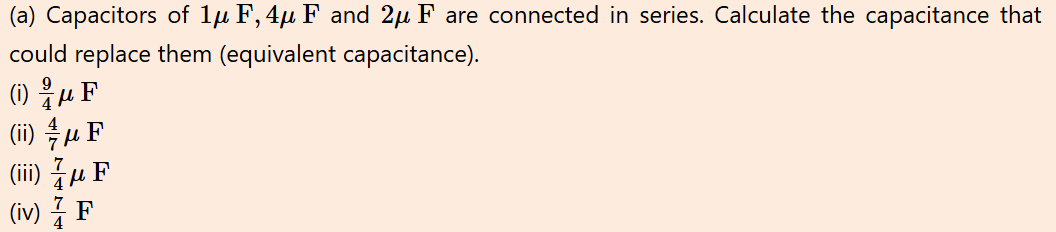
(b) When a capacitor is charged and disconnected from a battery, what will happen to its charge and voltage if the distance between the plates is increased?
(i) The charge will remain constant, but the voltage will increase.
(ii) Both charge and voltage will decrease.
(iii)The charge will decrease, but the voltage will remain constant.
(iv)The charge will remain constant, but the voltage will decrease.
(c) Object 1 is given a negative charge and placed on a beam balance. Object 2, which is also charged, is brought close to body 1 , and the balance reading changes, as shown in Figure

(c) Which action would decrease the reading on the balance furthest?
(a) Adding the same number of electrons to both objects
(b) Remove the same number of electrons from the bodies
(c) Transfer electrons from body 1 to body 2
(d) Transfer of electrons from body 2 to body 1
(d) What should you do if you find yourself outdoors during a severe thunderstorm?
(a) take shelter under the nearest tree.
(b) stand under power lines.
(c) move to higher ground.
(d) hide in a ditch.
(e) A negatively charged metal rod is brought near side P of a neutral metal sphere PS. Which diagram in Figure 1.48 correctly shows the resulting charge distribution on the metal sphere?

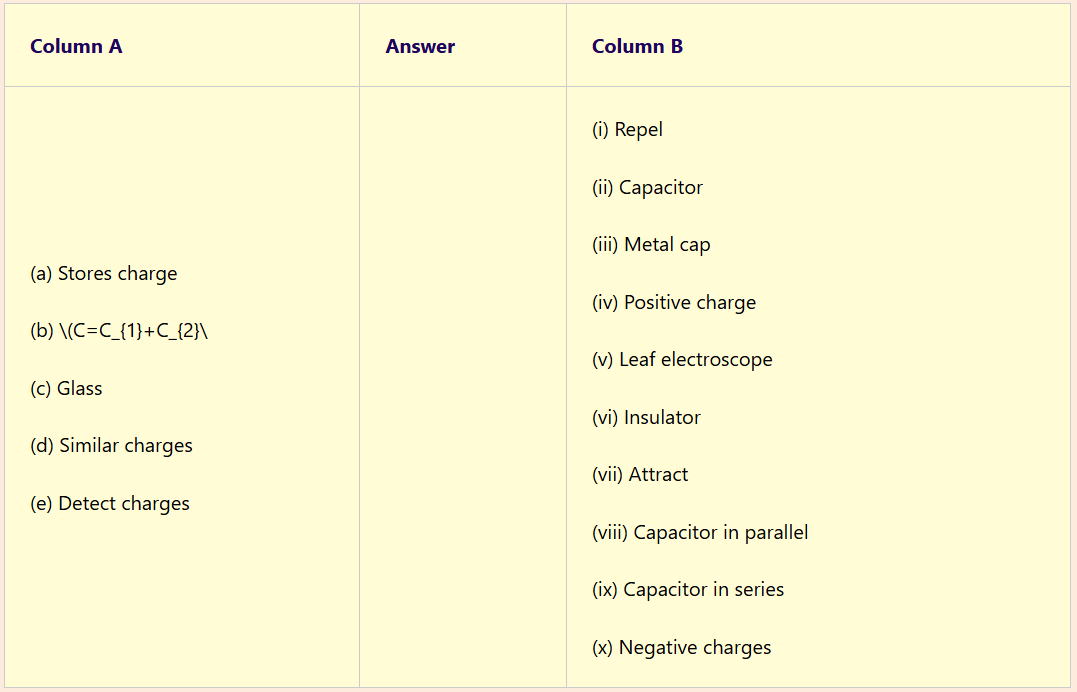
2. Match each item in column A against its corresponding item in column B by writing the correct response in the space provided.
3. (a) When a glass rod is rubbed with a piece of cloth, what type of charge does the glass rod acquire? Considering electron transfer, why does this happen?
(b) Describe what happens when an ebonite (or plastic) rod is rubbed with fur. What charge does the rod gain, and why?
(c) What happens when a charged electroscope is touched with a finger? What is the name of this process, and how does it work?
4. Identify those which could become negatively charged for each of the following pairs of materials being rubbed together.
(a) Glass and silk
(b) Fur and glass
(c) Comb and hair
(d) Fur and hard rubber
5. Complete the table by working out the overall charge on each object. Show your calculations. State whether the object is positively charged, negatively charged or neutral and why.

6. (a) The fundamental law of static electricity governs how charged objects behave. State this law, and provide at least one reallife example or experimental observation that demonstrates it.
(b) Explain how a balloon rubbed against your hair can be attracted to small pieces of paper.
7. (a) Draw a well-labelled sketch of a gold-leaf electroscope.
(b) How is the electroscope used for testing the types of charges?
8. If a metal rod is given a negative charge and brought near another neutral metal rod,
(a) Will there be an electric force between them?
(b) If there is a force, will it be attractive or repulsive? Why?
(c) What could happen if the first rod were given a positive charge instead of a negative one?
9. Two rubber balloons are rubbed with hair; will the electric force between one of the balloons and the hair be attractive or repulsive? Or, will the electric force between the two balloons be attractive or repulsive? Explain.
10. State what happens in the following conditions:
(a) An ebonite rod is rubbed with fur.
(b) A negatively charged electroscope’s cap is touched by a neutral glass rod.
(c) A proof plane is inserted in a hollow sphere and tested for charge.
11. Look at the following images in the table. Redraw the images in the second column to show how the spheres will move because of the nature of the charges. Write an explanation in the last column.

12. (a) Why is lightning attracted to tall structures? Explain the factors that make certain objects more likely to be struck by lightning during a thunderstorm.
(b) List and describe at least three types of capacitors, including their construction, properties, and typical applications.
(c) Identify and explain the function of at least three household or industrial appliances that use capacitors
13. A capacitor of two parallel plates separated by air has a capacitance of 15 pF . A potential difference of 18 volts is applied across the plates.
(a) Determine the charge on the capacitor.
(b) If the space between is filled with mica, the capacitance now
increases to 240 pF . How much more charge can be put on the capacitor using the 18 V supply?
14. A sharp needle was brought close to the cap of a charged leaf electroscope. Explain why the leaf collapsed.
15. (a) Determine the effective capacitance of the circuit shown in Figure 1.50.
(b) How much charge is stored?

16. After walking on a carpeted floor, you sometimes get a mild electric shock when you touch a metal door knob. Explain how this happens.
17. The ruler Figure below has been rubbed with a cloth. Describe what is happening in itand why.
