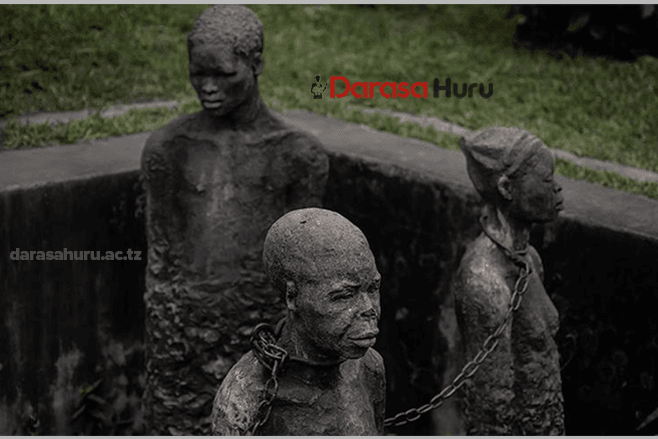
TH SLAVE TRADE FROM THE 15TH CENTURY TO THE 19TH CENTURY
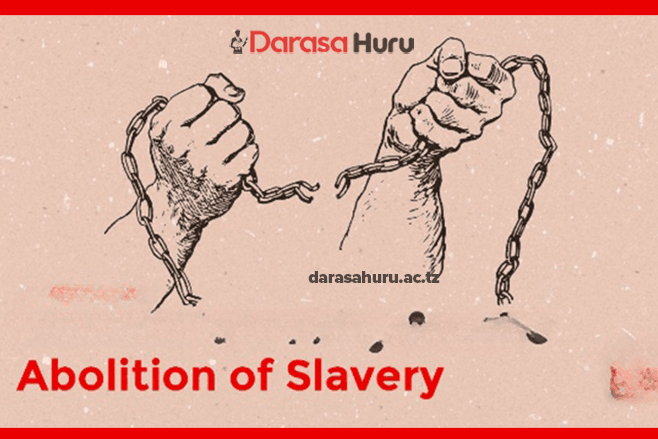
The slave trade which prevailed from the 15th century to the 19th century, forcibly transported millions of Africans to different parts of the world, such as the Americas, Europe and the Middle East. The trade enriched European economies, while upsetting African communities and leaving a legacy of inequality in Africa.
In this chapter, you will learn about the origins and development of the East African Slave Trade and the Trans-Atlantic Slave Trade. The competencies developed will enable you to advocate justice and equality at family, community and national levels.
Background to the development of the slave trade
The slave trade refers to the systematic practice of capturing, buying, selling and transporting people as slaves, often as forced labour. Enslaved individuals were considered as property and deprived of their freedom. The trade took place in various regions, such as the Atlantic and Indian Ocean coasts.
People were taken from their homeland, sold to slave traders, and transported to work on plantations, in households, or in other exploitative set ups. This practice caused immense suffering, dehumanisation and long-lasting social and economic consequences for the many communities involved.
In Africa, the slave trade was rooted in economic, social and political transformations that shaped the continent across time and space. While forms of servitude existed in African communities even before the external influences, the arrival of Arab and European traders expanded and intensified the trade, integrating Africa into global commercial networks.
Enslaved Africans became a crucial labour force in various regions, particularly in the Middle East, the Americas, Europe and the Indian Ocean islands. The impact of slave trade extended beyond human suffering, contributing to long-term disruptions in African communities and economies.
One of the earliest phases of African involvement in the slave trade was through the Trans-Saharan and Indian Ocean networks whereby enslaved people were taken to North Africa, the Middle East and Asia. Arab traders, working with African intermediaries, transported captives across the Sahara and the Red Sea, where they were sold into domestic service, the military and agricultural labour. This trade began as early as the 7th century CE and continued for over a thousand years, with varying intensity, depending on regional demand and political conditions.
WHAT IS SLAVE TRADE?
Slave trade is the process of buying and selling human beings as commodities in the market, in Africa slave trade was an outcome of the contacts between Africa and the external world where by trader’s form Asia and Europe exchange their industrial good for slaves from Africa.
METHODS/TECHNIQUES USED TO OBTAIN SLAVES
Slave traders used various techniques to obtain slaves in Africa
Buying domestic servants and using them as slaves
This technique was used by some African chiefs. They sold their domestic servants in order to get guns and gun powder from coastal traders. Examples of the African chiefs who used this technique were Machemba of the Yao and Bwana Heri of Pangani buying criminals, debtors, tax evaders, prisoners and social misfits. Local chiefs sold them to slave traders. The chiefs fought many wars for the purpose of getting war captives. The captives were in turn sold to European or Arab slave buyers
Kidnapping
To kidnap means to illegally abduct a person and hold him or her as a captive. People were kidnapped at ceremonies, during burials or other public events when they were defenseless. They were then sold to slave buyers. This technique was used by the Yao who kidnapped, transported and sold people to Arab traders. The technique was also used in Ghana.
Raiding villages and capturing people
This technique involved carrying out attacks on villages, usually at night. It also involved using gun shots to evoke fear and panic among people. These people became easy targets as slave captives Ambush. This technique involved conducting sudden attacks on people. People who were hunting, travelling or doing some agricultural activities were ambushed, captured and sold as slaves.
Trickery
This included taking people as porters and selling them as slaves after arriving at the coast. For example, in the 19th century, 77 Krobo women in the country known today as Ghana were tricked into slavery after they were asked to sell pots to neighbouring ethnic groups Pawning, under this method individuals were sold into slavery in order to pay off a debt, important chiefs would sell people pawn, sometimes the family head would sell a person as long as the pawn was not freed.
Legal system
As the slave trade grew, chiefs began to use laws to provide them with slaves to sell; they administered laws for their own benefits not for the benefit of the whole community.
Tribute from vassal states
A vassal state is a state/country that is controlled by a more powerfully state/country and has to provide military support or pay tribute to it when needed. during the period of slave trade same of the conquered states were required by their conquerors to pay tribute in form of slaves those slaves were then sold to the traders.
ORIGIN AND DEVELOPMENT OF TRIANGULAR /TRANS ATLANTIC SLAVE TRADE
The Trans-Atlantic Slave Trade involved the selling and buying of Africans from Africa and then exporting them to the Americas and Europe across the Atlantic Ocean. The trade started at the end of the 15th century and began to decline in the 18th century. It was called the Trans-Atlantic Slave Trade because it passed through the Atlantic Ocean. It is also known as the Triangular Slave Trade, which involved three continents, namely Africa, Europe and the Americas.
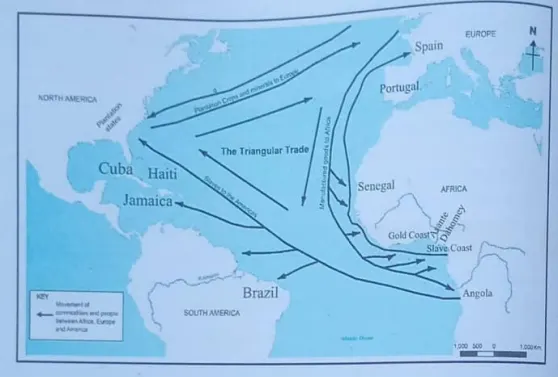
Triangular Slave Trade was a trade which was conducted by European merchants across the Atlantic Ocean from the 15th to the 19th centuries; it was called triangular trade because it involved three continents of Africa, Europe and America which according to their geographical location formed the shape of a triangle.
It was also called the Trans-Atlantic Slave Trade because it passed through the Atlantic Ocean In this trade Africa was a source of slave labour to America, a journey of enslaved Africans across the Atlantic ocean was known as the middle passage America was a source of raw materials like cotton, sugarcane, coffee, tobacco, gold, silver, etc. needed in Europe, where by Europe was a source of manufactured industrial products like clothes, guns, wine, spirit, etc needed in Africa to exchange for slaves.
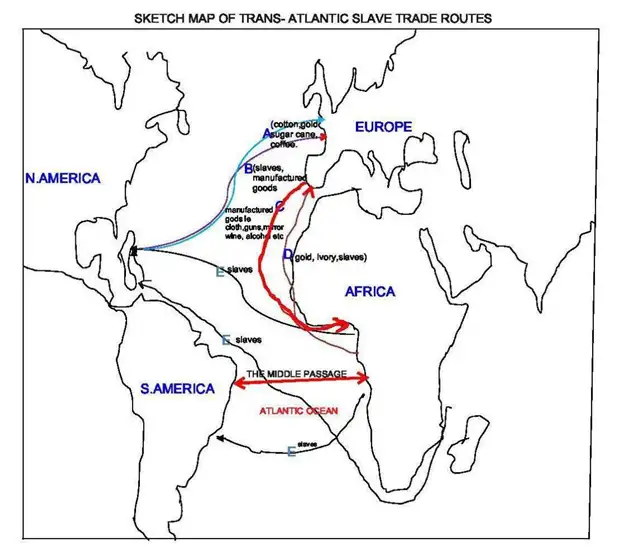
PARTICIPANTS IN THE TRIANGULAR SLAVE TRADE
The West African slave trade was dominated by European merchants namely the British, Portuguese, Spaniards, Dutch, French, and Danes where by the European merchants stayed at the coast waiting for slaves brought to them by chiefs or agents of African chiefs
FACTORS FOR THE RISE OF TRIANGULAR SLAVE TRADE
i. Development of maritime technology
The technology enabled making of stronger high sea-going vessels and compass direction to direct voyages. Advancement of this technology made overseas journeys to contact distant lands and allowed easy transportation of goods across the Atlantic Ocean.
ii. Discovery of the New World by Christopher Columbus on 24 October 1492
In 1492, Christopher Columbus from Spain became the first European to reach the American Continent. This continent was settled by indigenous American populations (red Indies) that belonged to different ethnic groups. After his journey, many settlers from Spain, Holland, Britain, France and Portugal went to live in the Americas. They opened sugarcane, cotton, coffee, and tobacco plantations in the Americas. Also, they opened silver and gold mines in the Continent.
iii. Profitability of the trade
European merchants acquired high profits in dealing with slaves. Slaves were acquired cheaply in Africa in exchange of cheap manufactured goods such as cloths and guns from Europe and exchanged in the New World for abundant expensive items like bullions and raw materials like sugar, tobacco and tea which were badly demanded in Europe
iv. Accessibility factor
The accessibility between the new world and the West African coast facilitated the rise of the Trans-Atlantic slave trade. The distance from West Africa to the new world is very narrow thus it made it possible for the transportation of goods between the two regions.
v. The inability of the indigenous people
At first the Europeans were using Native Americans, red Indians to provide cheap labor on the plantations and mining centers; but these later died in huge numbers due to plague. This called for the importation of African slaves which contributed to the rise of the Trans-Atlantic slave trade.
vi. Climatic conditions of the New World
Due to tropical climate of the new world Africans could easily live there since they were used to tropical climates and had immunity of tropical diseases more than people from Europe and Asia. They were able to withstand diseases and conditions of the New World
vii. The existence of seasonal winds
Seasonal winds, like the northeast trade wind, north equatorial current, the southwest and the Gulf streams encouraged the growth of this trade by enabling the vessels of the merchants to sail to Africa, New World and Europe.
viii. Establishment of sugarcane and coffee plantations in the new world
After the discovery of the new world, many Europeans migrated to America; these included the British, French, Portuguese and the Dutch. Many of these immigrants established plantations that caused more demand for slave labor. The increased demand contributed to the development of Trans-Atlantic slave trade.
ix. Industrial revolution in Europe
Due to industrial revolution it emerged the problem of overproduction versus under-consumption in Europe, therefore Africa and America became the solution for the problem whereby they provided market for the European manufactured goods and America provided raw materials,
x. The prior knowledge of Africans’ abilities by the Europeans
Since 1440s Portuguese explorers like Phillip Gonzales had carried some Africans to Europe where
they were enslaved and proved physically efficient for manual duties. With such experience, when the experiment on the Red Indians/indies and European labour in the New World proved unprofitable, the Europeans with conviction knew African slaves would provide the needed cheap labour efficiently
xi. The role played by African chiefs
Local rulers in Africa were crucial for the development of the Trans-Atlantic Slave Trade. They took all the risks in slave raids in the interior and transported them to the coast where the European merchants who by then never entered the interior of Africa found them to be exchanged for the cheap goods like firearms that local rulers and traders needed from them
xii. Possession of capital by the European merchant
By the start of the Trans- Atlantic trade, European wealthy classes had accumulated enough capital through primitive means like the crusades of the 11-12th centuries and enclosure system. It was this capital that was invested in ship building, cottage industries and purchasing trade items like slaves from Africa
xiii. The expensiveness of White slaves
The plantations and mines required a regular supply of labour. Europe could not supply labour to the plantations and mines in the Americas because her population had been severely reduced by the bubonic plague. The disease is also known as the Black Death. Also, Europeans died easily from the tropical diseases As a result, the owners of the plantations and mines in the Americas formulated four strategies of getting labour.
The first strategy involved using indigenous American inhabitants (red Indies) to do the work. This strategy did not solve the problem because many indigenous Americans died of diseases which were transmitted to them by the Europeans, such as typhoid and smallpox. They were also not strong enough to do tough work because they had just evolved from the hunting and gathering mode of earning a living.
The second strategy involved using indentured labourers from Europe. They included contract labourers, debtors, criminals and prisoners. Nevertheless, they were not a reliable source of labour because they were few in number and costly to maintain. also they could only work for a specific period of time, after which they were free to return home.
The third strategy involved obtaining labourers from Asia to work on the plantations and in the mines. However, the long distance from Asia to the Americas was an obstacle because the cost of transporting the Asians to the Americas and Europe was high.
The fourth strategy involved obtaining slaves from Africa. Africa was seen as the best option against labour shortage. Therefore, the Portuguese, Dutch, French and British began to transport millions of Africans across the Atlantic Ocean to the Americas.
EFFECTS OF THE TRANS-ATLANTIC SLAVE TRADE IN AFRICA
The Trans-Atlantic Slave Trade was one of the greatest crimes in human history because it involved selling of human beings as commodities. The following were some of the effects of this trade on Africa:
(a) Economic effects
It caused stagnation in technological development, this was because of the removal of skilled people from Africa . Frequent wars and fear of being captured created a great sense of insecurity that further hindered technological development in Africa. .
It caused the decline of African traditional industries because some skilled African craftsmen were taken as slaves. This, in turn, hindered the transmission of artisan skills and knowledge from one generation to another.
The slave trade increased the wealth of certain states. States like those in the forest zone of West Africa became rich by selling slaves. Examples of such states were Benin, Oyo, Dahomey and Asante.
Agricultural production decreased in areas which had been affected by slave raiding. People had less time to engage in agricultural production because of the attacks. This led to famine, hunger and starvation.
Decline of Trans-Saharan Trade, the rise of the Trans-Atlantic Slave Trade led to the decline of the Trans-Saharan Trade. This was due to the frequent slave raids and wars which created an atmosphere of insecurity. This atmosphere affected the production of trade items.
The Trans-Atlantic Slave Trade led to the exploitation of Africa through unequal exchange of the trade items. The European traders took more valuable items like gold and human labour in ther form of slaves from Africa. These items were exchanged for less valuable or luxurious items such as wine and mirrors from Europe.
(b) Political effects
i. Rise and growth of some African states. Some African states acquired political and economic strength from participation in trade with the Europeans. States like Oyo, Benin, Dahomey and Asante, acquired firearms and wealth from the trade with the Europeans. Firearms were essential in state expansion and slave raiding.
ii. Downfall of some states. Some states crumbled by attacks from more powerful states for slaves and wealth like gold and silver needed by European traders. Slave trade also robbed them of their badly needed labour force for their development.
iii. Paved way for the future colonization of Africa. Through mercantilism, Africans economic potentialities such as minerals, fertile lands and abundant labour were exposed to the European nations. After industrial revolution, European industrial powers viewed Africa a solution to their industrial demands.
(c) Social effects
i. Occurrence of famine. Famine was caused due to agricultural decline caused by destabilizations by frequent slave raiding. Suddenly also slave trade led to labour shortage in farms and over concentration of many societies on trade and abandoning agriculture.
ii. Spread of diseases. The interaction with the European merchants exposed Africans to European diseases such as small pox, measles, syphilis and gonorrhea carried to Africa by the European merchants. Other associated diseases like cholera and diarrhea were also spread due to congestion of slaves in small rooms with poor hygiene before transportation to the New World. Diseases claimed a lot of lives.
iii. Rise of state of fear and insecurity. Slave trade devastated African societies by introducing guns which encouraged frequent inter-society wars for slave raiding and wealth looting. Societies were destabilized and people forced to wonder around in fear.
iv. Depopulation. A large number of African productive youths ageing between 15 and 35were caught and shipped to the Americas as slaves. Additionally famine, raids and wars of slave capture also claimed lives of many Africans. Surely numerous cultures lost generations of their fittest, young and able.
v. De-culturalization. Mercantilism contributed to the destruction of African culture and heritage. In contacting Europeans, many Africans particularly middlemen adopted European ways of life like languages and dressing codes and mixed them with their traditional ways of life.
vi. African families were torn apart. Countless African families were torn apart as some members were captured and exported to the Americas and the Caribbean as slaves while the lucky ones who escaped slavery in the New Worlds remained in Africa.
vii. Spread of Christianity. In contacting the European merchants, some Africans adopted Christianity. This brought a new aspect in Africa, that created classes based on religions as societies were torn apart between Christians and Non- Christians.
SLAVE TRADE IN EAST AFRICA (THE EAST AFRICA SLAVE TRADE)
In East Africa slave trade started during the early contact between east Africa Middle East and far east as early as 200 BC. But it was in small scale. From the 7th century Arabs intensified the trade followed by the Portuguese and the French in the 15th century who took slaves from East Africa to America and the French sugar and coffee plantations in the Islands of Mauritius, Mayotte, Madagascar and Reunion. After the defeat of the Portuguese in east Africa in the 17th century the Oman Arabs dominated the trade of slaves in the Indian Ocean. They exported them to work in mines and as domestic servants in Arabia, Persia and china.
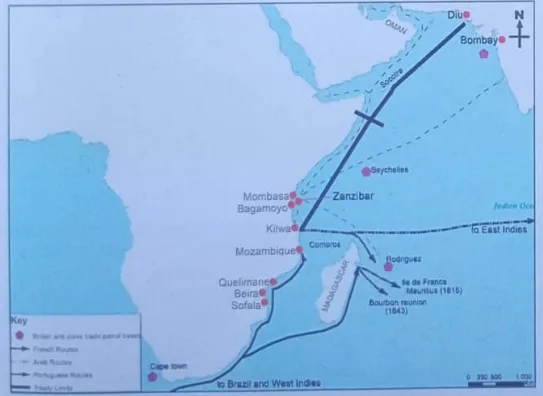
Slave trade routes from the East African coast to other parts of the world
REASONS FOR EXPANDING THE SLAVE TRADE IN EAST AFRICA IN THE 18TH CENTURY
Increased demand for slaves in Arabia and Asia
In these areas slaves were used as domestic servants, soldiers and farm labourers. The slaves came from the non- Muslim societies of the interior of East and Central Africa. They were transported to the coast and sold at the slave markets in Zanzibar, Kilwa, Bagamoyo, Pemba, Mikindani and Mombasa. Slaves were chained so that they could not escape and run away as they were transported by Arab slave dealers to the markets.
Increase in the demand for slave labour in the Portuguese coffee and sugarcane plantations in Brazil
In the first half of the 18 century, the Portuguese expanded their plantations in Brazil. Their source of slaves in West Africa and Mozambique could not provide enough slaves. They subsequently turned to East Africa as a new source of labourers, thereby increasing the number of slaves from the region
Opening of cloves and coconut plantations in Zanzibar and Pemba by the Oman Arabs
He also; the growing of these crops increased the demand for slaves from the interior
Opening of sugar plantations in the Islands of Mauritius, Mayotte, Madagascar and Reunion by the French
Initially the French depended on slaves from Mozambique. However, by the year 1770s, the demand for slaves had exceeded supply. As a result, the French went as far as Kilwa to obtain slaves.
The growth of the ivory trade in east Africa
During the 19th century, the trade in ivory expanded considerably across the East African region. This trade fuelled the development of the slave trade because it needed additional porters for carrying ivory from the interior to the coast. Upon their arrival at the coast, the porters were sold as slaves so that they could work on the agricultural plantations which had been established along the coast and in the Indian Ocean Islands such as Pemba, Zanzibar, Mayotte and Comoro
Greater demand of slaves by some of the local chiefs
They wanted slaves for producing food for the caravans in the long distance trade. The food grown was sold to the caravan leaders. This increased the demand for slave labour, hence the expansion of the trade.
The role played by Sultan of Zanzibar
Sultan Seyyid Said, played an equally important role in the expansion of the slave trade in East Africa. He encouraged Arab traders to go to the remote parts of the interior of East Africa to get slaves.
EFFECTS OF THE SLAVE TRADE ON EAST AFRICA
The slave trade had a number of effects on East Africa. Some of its effects were socio-
cultural and psychological and others economic in nature
(a) Socio-cultural effects
i) Introduction of new foods, the food introduced through trade routes such foods were maize, pawpaw, rice and groundnuts both at the coast and in the interior.The increase of farming plantations, in some areas especially the clove plantations were slaves worked.
ii) The interior was opened to the outside world this later encouraged the coming of the European missionaries. Many European Christian missionaries came to east Africa to preach against slave trade and to campaign for its abolition.
iii) The trade routes became permanent routes and inland roads which led to growth of communication network.
iv) Development of Swahili language, this was introduced in land and is now being widely spoken in Tanzania, Kenya, Uganda and eastern Congo.
v) Introduction of Islamic religion, Islam as a religion was introduced by the Arabs and it spread, especially in Yao land and in Buganda land.
vi) Formation of the new race called Swahili; this race was formed through intermarriages between Arabs and some Africans.
vii) Growth of towns, there was growth of towns such as Tabora and Ujiji.
viii) Slave trade encouraged large scale trade whereby contact was established between the trade masters and indigenous/local population.
ix) Africans were dispersed to other parts of the world e.g. Arabia, America and West
Indies. In Africa Sierra Leone and Liberia were founded to accommodate former
slaves from Europe and America.
b). Negative effects
i) Depopulation of Africans: The people who would have great leaders and empire builders were killed. It is estimated that over 15 to 30 millions of people were sold into slavery while millions died in the process being transported ..
ii) Destruction of villages and families and broken up by slave raiders and never to be reunited, this later resulted in to loss of identity.
iii) Diseases broke out among the slaves, for example the Spaniards introduced syphilis which spread to other traders.
iv) Displacement of people: Many people became homeless and destitute and stayed in Europe with no identity.
v) Disruption of economic activities: This is because the young and able craftsmen, traders and farmers were carried off, causing economic stagnation as the economic workforce depleted.
vi) Progress slowed down which resulted in famine, poverty and destitution and helplessness.
vii) There was a decline in production of traditional goods such as coffee, beans, bark cloth and iron which greatly hindered the cash economy.
viii) Decline of African industries, which also faced a lot of competition from imported manufactured goods for example the bark cloth and iron working industries.
ix) Introduced of guns to the interior, which caused a lot of insecurity and increased incidences of wars for territorial expansion
x) Clans and tribe units, languages were broken and inter-tribal peace was disturbed for example Swahili language replaced the traditional languages in the interior.
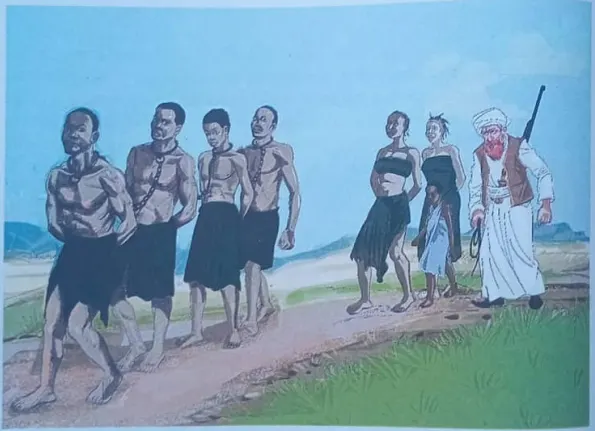
A slave caravan from the interior to the East African coast
THE PSYCHOLOGICAL EFFECTS OF SLAVE TRADE TO ITS VICTIMS
Slavery reduced Africans to mere objects.
The Arab slave traders and Caucasian slave owners looked down upon dark-skinned people.
They considered them to be inferior and closer to animals than other races.
Slaves were greatly mistreated. They worked for long hours under harsh conditions for no pay.
They were punished severely for small mistakes and were even killed at their masters will.
All of these resulted in psychological effects some of them being:
i) Damage of slave’s self-worth
ii) Inferiority complex before their masters
iii) Separation of families and homes
iv) Loneliness
v) Stress due to unsure about their future, survival and food. Traumatize due to severe punishment
vi) Insecurity
vii) Fear and doubts
viii) Sufferings due to difficult
OMAN -ZANZIBAR SULTANATE AND THE ZANZIBAR COMMERCIAL EMPIRE
Due to the decline of Portuguese rule in east Africa in 1698 the region of east Africa was immediately fell under the control of Oman traders, The Oman control of east Africa became effective after the second half on the 19th century after sultan said seyyid the sultan of Oman had shifted his capital from Muscat to Zanzibar in 1840 after being assisted by the British.
Foreign control of the coast by Oman rulers began when the Mazrui in Mombasa established the Mazrui dynast (independent sheikhdom under Mazrui family) In 1741, this was when the Yarubi, the ruling family of Oman, was overthrown by the Busaidi ruling family in 1741, many of the Oman governors in East Africa including Mazrui did not recognize the new ruler therefore Mazrui declared independence from Oman until 1822 when sultan of Oman Seyyid Said who came to power in 1806 with the help of the British East India Compa By 1825, except for Mombasa, the whole northern coast was under sultan seyyid said control.
He attacked and captured Mombasa in 1837, In the south, his control reached Kilwa Kisiwani, Mafia, Kilwa Kivinje and Lindi with the fall of Mombasa, he was now in full control of the East Africa coastal towns. In 1840, he shifted his capital from Muscat to Zanzibar to make sure he controlled all the East African city states in which trade was rapidly increasing. This enabled him to establish the Oman-Zanzibar Sultanate
WHY DID SULTAN SEYYID SAID SHIFT HIS CAPITAL FROM MUSCAT OMAN TO ZANZIBAR IN 1840?
Seyyid Said moved his capital from Muscat to Zanzibar for a number of reasons
i. Good climatic conditions at Zanzibar, the climate was suitable for settlement and agriculture, this attracted Seyyid Said to transfer his capital to Zanzibar.
ii. He wanted to control the Indian Ocean trade by himself, since it was a very profitable trade at the coast of East Africa.The presence of profitable trade items like ivory, gold slaves, copper etc. which were plenty at the coast of East Africa, made him to transfer his capital from Muscat to Zanzibar.
iii. He wanted to end the Busaidi- Mazrui conflicts which were caused by the failure of Mazrui governor at Mombasa to recognize the rule of the Busaidi of Oman Empire.
iv. He wanted to effectively control East African coast since his representatives were ineffective and corrupt.
v. Zanzibar was strategically located, The strategic location of Zanzibar as market for goods attracted Seyyid Said to move his capital from Muscat to Zanzibar so as to control the rich market at Zanzibar.
vi. The presence of deep and wide natural harbors at Zanzibar, which could allow large ships from America. Britain, France, Spain, Germany to land and load and off-load their goods for him, this made him to transfer his capital to Zanzibar from Muscat ..
vii. Political and religious persecutions in Saudi Arabia, this forced Seyyid Said to move his capital to Zanzibar from Muscat. Oman had become insecure for him to live and carry on with administration
viii. The hospitality of the people of East Africa coast to the foreigners, also led him to transfer from Muscat to Zanzibar.
ix. He wanted to gain more popularity and prestige by being a ruler of two territories i.e. the ruler of Oman and Zanzibar.
x. The desire of sultan to expand his empire, Seyyid Said’s failure to expand his empire in Oman forced him to turn his attention to Zanzibar thus the desire to expand his empire led to his transfer of the capital to Zanzibar.
xi. The presence of fresh sweet drinking water at the coast of East Africa made him to transfer his capital to Zanzibar from Muscat which had salty water not suitable for drinking.
xii. The influence from the British government, the British wanted sultan to attack the influence of the French in the coast of east Africa.
xiii. Presence of good soil fertility, the fertility of the soils in Zanzibar which supported the growth of cloves and spices made him to transfer his capital to Zanzibar
EXPANSION OF COCONUT AND CLOVES PLANTATIONS IN ZANZIBAR
It is said that the first person to plant cloves in Zanzibar was SALEH -HARAMIL-EL ABRY, he planted the trees in Mtoni and Kizimbani in 1818, from that the oman arabs under sultan Seyyid Said expanded the cloves and coconut plantations in Zanzibar by confiscating most of the arable land of Tumbatu and Hadimu, they used African slaves to cultivate their farms and produce cloves and coconuts, most of those slaves were from the interior of east Africa.
WHY SULTAN SEYYID SAID EXPANDED CLOVES AND COCONUT PLANTATIONS IN ZANZIBAR?
Seyyid said saw cloves as a potentially profitable export, he therefore encouraged the expansion of cloves plantation in Zanzibar and Pemba.
Coconut plantations were important due to the production of copra, which is a dried white fresh coconut, copra was exported to Europe and Asia to be used in making soap and cooking oil.
Absence of African resistances against sultan economic ambitions in Zanzibar, Availability of fertile soil in Zanzibar and good weather for growing crops like cloves and coconut.
Availability oc cheap labour at the coast, these were in the form of slave labors taken from the interior part of east African coast.
ARABS AND INDIANS SETTLEMENT IN ZANZIBAR
Why sultan encouraged Arabs settlement in Zanzibar?
After establishing effective control of east Africa with it headquarters in Zanzibar sultan Seyyid Said encouraged Arabs to settle in Zanzibar because of the following reasons.
Arabs owned cloves plantations, they organized planting activities, harvesting, and packing of cloves, the Arabs used slaves to do all these activities.
Arabs traders organized trade route into the interior of east Africa. They went as far as inland like Congo, and the river Nile in search of slaves and ivory, these commodities were sold for large profit to Arabia, America, and Europe, this helped to boost the economy of Zanzibar.
Arabs traders organized trade ships for trading voyages; they went to Europe and Asia to trade and brought foreign goods and income to Zanzibar.
Seyyid said needed Arabs governors to help him in ruling the coast of east Africa.
He appointed Arab Liwalis to rule the coastal city states though he retained most of the power.
Why sultan encouraged Indians settlement in Zanzibar?
Also sultan Seyyid Said invited Indian traders known as BANYANS to come and settle in Zanzibar because of the following reasons.
The opened banks which financed trading activities
They were money lenders, they loaned money to the Arabs traders.
They exchanged currencies for the local and foreign traders in Zanzibar.
Sultan also gave Indians position in the government, he appointed some Indians as tax collectors, and custom officials at the port.
Indians owned many businesses in Zanzibar, these businesses generated a lot of income, the sultan taxed all traders in Zanzibar.
THE IMPACTS OF OMAN ARABS RULE AT THE COAST
Oman Arabs rule which started with the Mazrui at Mombasa and followed by Sultan Seyyid Said in Zanzibar had political, social and economic effects at the coast along the Indian Ocean and the interior of East Africa as shown below:
(a) Political Impacts
The people at the Coast lost their freedom, in the beginning when the Mazrui ruled many parts of the coast from Mombasa the Oman Arabs overthrew leaders of the Mombasa local Swahili known as Thalatha Taifa and Tisa Taifa.
Even when the Mazrui were taken out of East Africa Sultan Said ruled these people including the destruction of Sheha chiefs among the Tumbatu of Northern Zanzibar, Jumbe or Mwinyi Mkuu of the Hadirnu and the Diwani in Pemba.
(b) Social Impacts
Spread of Islam at the coast. The Arabs built many mosques to convert people into Islam. At that moment there was high movement of Arabs traders inside East Africa. Areas such as Tabora and Ujiji had many Arab traders who changed people into Islam religion.
Development of Kiswahili language like the time of the Portuguese continued to vocabularies which expanded the language. Apart from receiving many new vocabularies the language extended to many parts of East and Central Africa along the trade routes.
Intermarriage, Intermarriage between the Arabs and the Swahili took place as the era of early contact between the Coast and Asia through the Indian Ocean. This situation still led to the emergence of a group of people with mixed blood.
(c) Economic Impacts
Expansion of trade in ivory and slaves between the coast and the interior. Seyyid Said was interested in trade and used to refer himself as nothing but a trader. He sent trade caravans into the interior to collect ivory and slaves and bring them to the coast to sell them to Arabs and the French.
Introduction of cloves and coconuts plantations. Plantations led to the loss of land that belonged to the Hadimu, Tumbatu and the people in Pemba. Many of them together with the African slaves from inside East Africa became cheap labourers who worked under very hardship conditions.
Revision Exercise
1. Choose the most correct answer.
(i) The following powers participated in the East African Slave Trade, except:
A. Portugal.
B. France.
C. USA.
D. Britain.
(ii) The Triangular Slave Trade involved Europe, Africa and
A. the Middle East.
B. the Far East.
C. the Americas.
D. Eastem Asia.
(iii) One of the following is an effect of the Trans-Atlantic Slave Trade in Africa:
A. The growth of coastal city-states
B. The development of long-distance trade
C. The emergence of a new race called Mulatos
D. The rise and spread of Swahili culture
2. Write True for a correct statement and False for an incorrect statement, and then make the incorrect statement correct.
(a) The Trans-Atlantic Slave Trade strengthened African communities.
(b) European goods helped African economies to become more independent.
(c) The decline of African populations made communities weaker.
(d) The European demand for slaves increased warfare in Africa.
(e) African rulers had full control over the trade with Europeans.
3. Identify two major foreign powers that dominated the East African Slave Trade in the Indian Ocean during the 18th and 19th centuries.
4. Compare and contrast the East African Slave Trade and the Trans-Atlantic Slave Trade.
5. Why was African slave labour preferred to other kinds of labour?
6. If you were to design a museum on the slave trade, what artifacts or documents would you include in the museum?
7. List the major European powers that participated in the Trans-Atlantic Slave Trade.
8. How did the Zanzibar Commercial Empire influence the socio-economic structures of East Africa?