
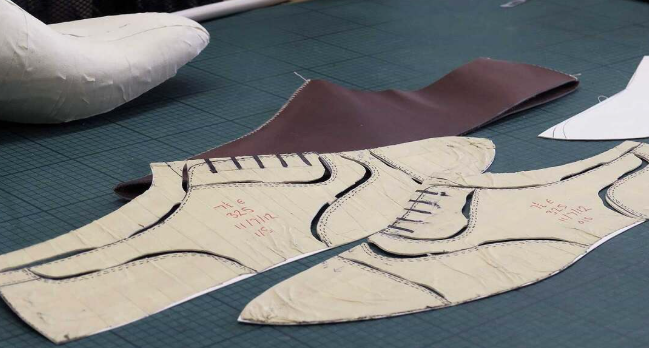

MAKING TRAINING SHOE PATTERNS – Leather Goods and Footwear
By the end of this element, you will be able to understand the meaning of a training shoe, identify the parts of the training shoe, identify tools, equipment, and materials used in making a training shoe, differentiate between training shoes from other types of shoes, and design patterns for a training shoe.
Meaning of training shoe
A training shoe is a generic name for footwear primarily made for sports and other physical exercises.
Parts of a training shoe
Training shoes are made up of two basic parts, namely the upper part and the bottom part. The upper part covers the entire shoe, covering the foot above the sole. Its components are attached by stitches to become a single unit.
The bottom part is the entire part of the shoe that sits beneath the wearer’s foot, encompassing the outsole, midsole, and insole. The upper and bottom parts of the training shoe are shown in Figure below.

Sketch of a training shoe
When designing training shoes, a designer must first have a design idea and figure out its components depending on the design and the construction of the shoe. Some training shoes have an Achilles tendon protector, a reinforced collar, and other pieces with padding to promote maximum comfort for the wearer. Padding in training shoes is also encouraged to be considered for the sock linings inserted into the insole of the training shoes.
Tools, equipment and Materials used for making training shoe
Tools: sports shoe last, cutting knife, pencil, flexible measuring tape, set of punches, awl, scissors, cutting board, marking pen
Equipment: computer, plotter, workbench
Materials: hard manila, soft manila, masking tape
Difference between training shoes and other types of shoes
Training shoes offer enhanced stability, cushioning, and traction to help safeguard the wearer from common training injuries that other shoes do not provide. They offer maximum balance due to their flat soles and cushion pads, which last longer due to their stability. Great ventilation, good grip on the sole, and lightweight materials provide comfort and therefore reduce fatigue from shoe usage.
Procedures for training shoe pattern-making
1. Cover the last with masking tape.
2. Draw the style lines on the shoe last shell as shown in Figure below.

A sketch of a training shoe
3. Construct the toe cap and top-line contours. The toe cap contour starts from P to Q, 5 mm away from point E on the vamp line, as shown in Figure below.. Point P is 13 mm away from the centreline.

Style lines
4. Construct quarter and counter contours, as shown in Figure below.

Style lines
5. Construct a standard pattern, add a lasting allowance around the feather line, and design a heel grip to accomplish the standard pattern, as shown in Figure below.

Standard pattern with lasting allowances
6. Separate the basic pattern pieces from the standard pattern, as described below for each part of the shoe.
Toe cap: Align the toe cap centreline with the folded edge of the pattern paper, as shown in Figure below.

Toe cap aligned on the folded pattern paper
Copy the toe cap contours, and add 10mm for underlay allowance, as shown in Figure below.

Copying toe cap contours.
Cut the toe cap contours through both sides of the folded pattern paper, cut the notches, unfold the pattern, and cut the inside marker, as shown in Figure below.. Then label the pattern with its pattern descriptions.

Toe cap pattern with notches and inside marker
Overlay collar: copy the contours, eyelet markers, and other necessary markers of the overlay collar, as shown in Figure below.

Copying the overlay collar contour
Cut the collar contours through both layers of the folded pattern paper, and unfold the pattern paper, as shown in Figure below.

Overlay collar pattern
Quarter: copy the quarter contours with their markers on the folded pattern paper, as shown in Figure below.

Copying the quarter contour
Add 3 mm trimming allowance, and 8 mm underlay allowance, cut the contours through both layers of the pattern paper, cut the markers, unfold the pattern, and cut the inside marker, as shown in Figures below.

Addition of underlay and trimming allowance

Unfolded quarter pattern
Counter: copy the counter contours on the folded pattern paper, add a 3 mm trimming allowance, cut the contours, and cut notches, as shown in Figure below.. Then, unfold and label the pattern with its pattern descriptions.

Copying the counter contour, cutting, and marking
Tongue: Copy the tongue pattern,copy the upper 1/3 of the tongue construction line and the marker, as shown in Figure below.

Copying the tongue contour
Spring (rotate) and copy the middle 1/3 of the tongue construction line and the marker, as shown in Figure below.

Copying the middle 1/3 by rotating the tongue
Spring (rotate) and copy the lower 1/3 of the tongue construction line and the marker, as shown in Figure below.

Copying the lower 1/3 of the tongue construction line
Add a 12 mm stitching line marker, cut the contours through both layers, cut the makers, unfold, and label the pattern as shown in Figure below.

The complete tongue
7. Constructing lining standard pattern. The lining standard is made by laying the standard pattern on the pattern paper, tracing its outside contour, and copying the tongue lining contour, counter lining contour, and vamp lining contour, as shown in Figure below.

Standard lining pattern.
Activity 1: Constructing basic lining patterns of training shoes
Materials: draft paper, hard manila paper, masking tape
Tools: pencil, awl, cutting knife, cutting board, eraser, and flexible measuring tape
Procedures
1. Prepare tools and the working table.
2. Make a quarter lining pattern.
3. Make a counter-lining pattern.
4. Make a vamp lining pattern.
Questions
1. What are the advantages of master patterns in the production of training shoes?
2. Why is it important to handle tools and equipment safely?
Exercise
1. Explain three features that differentiate training shoes from other shoes.
2. What is the importance of cushioning in training shoes?