

MAKING FOLDER PATTERNS – Leather Goods and Footwear
By the end of this element, you will be able to define a folder, identify the tools, equipment, and materials used in making folder patterns, and design folder patterns.
Meaning of a folder
A folder is a sophisticated and practical product designed for organising, securing and carrying essential documents, papers, and materials.
Tools and equipment used in making folder patterns
The tools and equipment used in making folder patterns include scissors, sliding knife, steel ruler, cutting boards, pencil, pen, tape measure, marking wheel, hole punch, and computer-aided system.
Materials used in making folder patterns
Several materials are used in making folder patterns, including A4 paper, draft paper, soft manilla paper, and hard manilla paper.
Procedure for making folder patterns
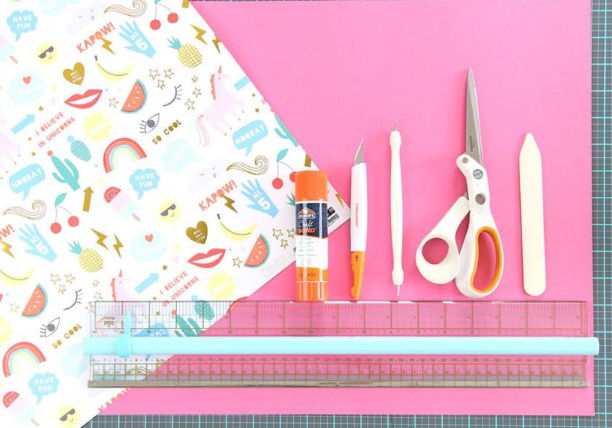
1. Preparation of tools, equipment, and materials: Prepare the tools and materials that can be used in making folder patterns, as shown in Figure below

Design tools
2. Identification of the required design: Select a design that corresponds to the required final product, as shown in Figure below

Sample of folder design
3. Making a sketch: Sketch the folder on a piece of paper. Drawing the folder on plain paper before transferring it to Manila helps to advance the ability to design and ensure a good appearance of the final product, as shown in Figure below

sketch of a folder
4. Interpret measurements into sketches: A pattern is a two-dimensional template that has all the information you need to cut specific shapes out of a flat material that can be assembled to form a design. In this stage, analyse all measurements, interpret measurements into a sketch, and redraw them to a manila sheet, as shown in Figures below

Folder pattern

Folder pattern with allowances
Mark all compartments you have designed to show the position of the snap button and fastening accessories, as shown in Figure 1.13.

Making compartment
Add folding allowances and other allowances required, and punch holes in the marked parts, as shown in Figure 1.14.

Punching of pattern
5. Cut Lines: The lines on a pattern that indicate where you need to cut your leather; these are usually the outside borders of the pattern but may include internal cut-outs, as shown in Figure 1.15.

Cutting manila
Cut out individual patterns for each compartment found in the master patterns. Label the patterns. Each piece of the pattern should be labelled with all necessary information. This information should tell you: which piece of the pattern is this, the dimensions of the pattern, and what material it should be cut from.
6. Store patterns in a prepared place: Storage of patterns helps to avoid waste of time during production.
7. Clean the tools and equipment: This is important due to preventive maintenance to improve the long life of the machine and tools.
Activity 1: Making a folder pattern with a length of 35 cm and a width of 25 cm without allowance
Materials: soft manila paper, hard manila paper, plain paper
Tools: pencils, eraser, cutting board, tracing wheel, scissor, set square, set of punches, hammer, rasper file, cutting knife
Perform the following procedures to complete the task
1. Prepare the tools, equipment, materials, and working table.
2. Interpret measurements.
3. Draw lines on hard manila paper according to the measurements.
4. Cut a piece of the pattern.
5. Label the patterns.
6. Clean the tools and store them in an appropriate place.
Activity 2: Create menu folder patterns.
Exercise
1. Briefly, explain the function of compartments in the document folder.
2. Mention the fasteners used in the document folder.