INTERACTIONS IN SOUTHERN AFRICA
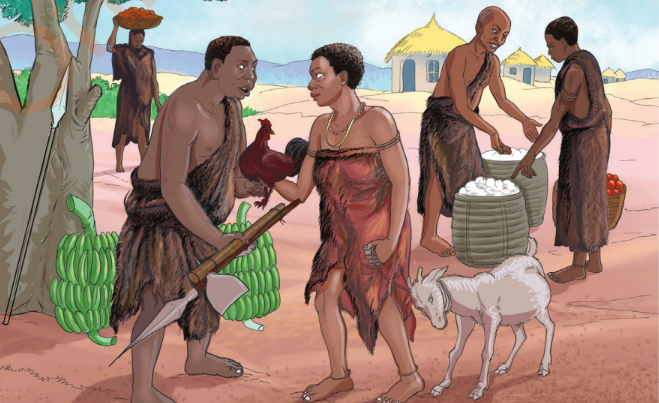
Before colonization, Southern Africa was a region of dynamie socio-economic and political interactions. These interactions shaped the development of various communities and fostered trade, migration, warfare and cultural exchanges.
A good example of pre-colonial interaction in Southern Africa is the Ngoni migration, which involved Nguni speakers moving from Southern Africa to Central and East Africa in the 19h century.
Factors for early interaction in southern Africa.
1. Migration
During the early period (1000-1500 CE), migration influenced interactions in Southern Africa. The Bantu migrations into Southern Africa shaped the region’s population, economic activities and culture. For instanee, the Bantu introduced iron- working, agriculture and new political siructures, thereby facilitating their interaction with the indigenous San and Khoikhoi groups.
2. Trade
it was another significant factor in the early interactions in Southern Africa. The Indian Ocean trade network brought goods such as beads, cloth and ceramides into the interior of Southam Africa. The Swahili city-states on the East African coast, such as Kilwa and Sofala, facilitated these trade links. The Great Zimbabwe state (cirea 1100-1450 CE) became a major centre of gold trade, linking Southern Africa with the broader Indian Ocean worlds. Gold, ivory and cattle were exchanged for luxurious items, thus integrating Southam Africa into the global trade networks.
3. The Mfecane (1815-1840)
A series of forced migrations and conflicts, had roots in the competition for land and resources that began in the 18th century and exemplifies the Southern African interactions.
A brief history of Mfecane
The word Mfecane is derived from the Nguni language which means; crushing or grinding or the war of wondering The Sotho called it “Defecane” to mean the same period. It was also called “Lifecane” by other peoples of South Africa
It was the period of upheavals and population migration which occurred in zuin land in south Africa in the 19th century 18001830s. It took place among the sastern Bantu tribe such as the Ngwane under Sobhuza .. Mthethwa under Dingiswayo. Ndwandwe under Zwide. Minor group of the Zulu clan under Senzangakona The rise of Mfecane among such groups happened when the groups started to conquer each other.
Causes of the Mfecane
Increase of population.
This was the main internal factor that led to Mfecane,, in Nguniland population rapidly expanded that it outmatched the available resources. As land became inadequate for farming and pasture. The demand for land raised conflicts that forced Nguni tribes adopt regular armies to fight for more land, thus Mfecane.
The struggle to control trade with the Delagoa Bay. From the late 18th C. European maritime traders at the Delagoa Bay ware trading with African societies like the Mthethwa, Ndwandwe and Zulu. The struggles to control the trade and acquire items like slaves, ivory and gold needed by maritime traders led to conflicts among the chiefdoms.
The Boers expansion northwards
The Boer Trek in the interior intensified the severity of Mfecane. With their determination to control any fertile land in the interior, the Boers fought African tribes included the Zulu, Nguni, Xhosa and Kumalo. The wars caused a lot suffering as tribes started fighting each other for the little land left.
Rise of Zulu – Tshaka
This contributed to the development of Mfecane. He was a powerful leader with strong army, which used short stabbing spears to fight the other clans by defeating and absorbing them into his chiefdom
Territorial expansion
Made various clans wage the wars among themselves. Each clan desired to expand boundaries in order to make a larger territory
The great pride in military skills of Nguni trial leaders. The Nguni tribal leaders like Zwide of the Ndwandwe and Shaka of the Zulu fought each other to control the region by forcefully incorporating their neighbours into their hegemony.
Deadly cattle raiding acts.
The Nguni adopted lethal cattle raiding activities against each other to expand their herds. As herds expanded communities competed for more grazing lands. The two; cattle raiding and need for more pastureland resulted in endless conflicts which ultimately led to Mfecane.
Transformation from communal to feudal system.
Emergence of classes gave way to the rise of strong landlords – tribal leaders who were itching to consolidate power
by acquiring more land. This settled the Nguni into small but rival chiefdoms such as Ngwane, Mthethwa, Zulu and
auwawandwe which contested for control of land in the region.
Attacks by the Griquas
Since the early 19th C, coloured people from the Cape colony, known as Griquas, were a source of instability among the southern Bantu communities. Using horses and firearms, the Griquas from time to time attacked the Nguni societies like the Sotho and capture women and children whom they sold as slaves to the Boers and British farmers
EFFECTS OF THE MFECANE
Mfecane was indeed one of the notable 19th C African revolutions that have far reaching effects that touched a vast region of South, Central and East Africa. However much it brought havoc, it also brought considerable military, political and social development. The effects include;
i. Massive depopulation
Large parts of southern Africa namely, the regions of Natal, Orange Free and Transvaal states were largely depopulated. Some societies were annihilated as thousands were massacred and more forced to flee from the constant tribal wars ..
The spread of Zulu military techniques to the same areas.
For example, many societies in East and Central Africa adopted the Ngoni’s weapons such as short stabbing spears and long shields. They also adopted fighting techniques such as the use of cow-horn formation when confronting enemies.
It led to the growth and consolidation of large states in Central and East Africa
As the Ngoni moved northwards, they destroyed states such as Rozwi in Zimbabwe, Lozi in Zambia, and Undi in Malawi. The Ngoni set up multi-ethnic states of different sizes. They included the Ndebele State in Zimbabwe, the Shangani State in present-day Mozambique and various Ngoni states in present-day Zambia, Malawi and Tanzania
Depopulation in Natal
The number of people decreased in larger areas such as the Veld. They died during the wars while others flew from the region and concentrated themselves in other regions, which could be defended from frequent attacks by Shaka soldirs.
Separation of Bantu tribes
Mfecane forced migrations of several Nguni tribes from southern Africa. The migrating tribes like the Ngoni and Ndebele also invaded societies they came across forcing them out. This chain of reaction led to continuous trouble and migrations that redistributed Bantu tribes in South, Central and East Africa.
Emergence of powerful military leaders
The severity of tribal wars led to the rise of strong military leaders who emerged to defend their tribes. The leaders included Shaka of the Zulu, Mzilikazi of the Ndebele and Moshoeshoe of the Basulo.
The fall of peace in many societies neighbouring South Africa existed due to Mfecane
Many groups which moved away from Natal conquered local people on their way and disturbed peace. Zwangendaba fought the Shona of Mwenemutapa in the movement to the North and disorganized the people in Eastern Africa especially in the West and South of Tanganyika.
Mfecane helped the Boers to settle in large areas of Natal and the Veld
This is because many people had left the areas when the Boer Trek started in the 1830s. The Boer settlers were able to take over land which was left unoccupied as a result of Mfecane in Natal.
Military transformation.
The intensification of tribal wars, forced the Bantu tribes to have a military outlook that they never had before. Certainly, southern Africa became a home of military innovation. For instance Shaka the notable military innovator introduced new weapons, the Assegai (short stabbing spear) and new tactics like the age-regiment system and cow-horn military strategy. Such inventions were previously unknown in local warfare.
Death of Shaka Zulu
Shaka was murdered by his own brothers Dingane and Mhlangane on 14th December 1828 with the help of Mbhopa; Shaka’s Induna. Shaka was killed because of his brutality especially after the death of his mother Nandi
Ngoni migration
Mfecane resulted into the migration of Nguni-speaking people to Central and East Africa. These people were called the Ngoni in Tanzania, Zambia and Malawi; the Matebele in Zimbabwe; and the Kololo in South-eastern Zambia
NGONI MIGRATION
The Ngoni were Bantu-Nguni speaking people of Northern Zululand in South East Africa. They were originally Ndwandwe people under Zwide’s leadership. Ngoni migration was the movement of the Ngoni people from Natal in South Africa to Central and East Africa. Their migrations started in the 1820s as a result of the Mfecane wars
The arrival of the Ngoni in Tanzania (Tanganyika)
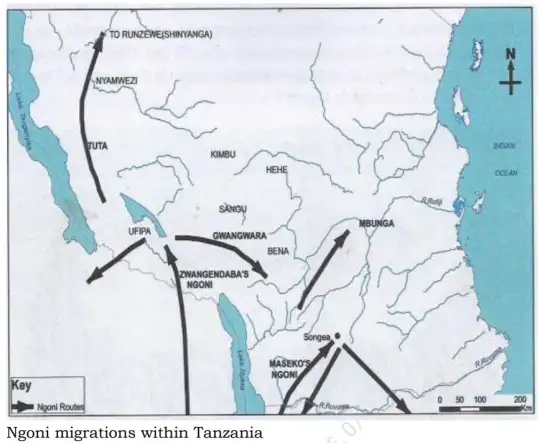
The Nguni-speaking people moved out of the Natal region in South Africa in different groups and went to different areas under different leaders. For example, Shoshangane led his group north-eastwards to Mozambique. Moshoeshoe and his people went to the present-day Botswana. Sebituane and his group moved into the present-day Zambia and Mzilikazi and his people settled in Zimbabwe. The Ngoni who came to Tanzania were in two groups. The first group was under the leadership of Zwangendaba and the second one under the leadership of Mputa Mseko
A. The Ngoni under Zwangendaba
Zwangendaba led the first group of Jere-Nguni speakers. He left the Natal region in the 1820s, after he had gathered some followers. Zwangendaba and his people crossed the River Zambezi in 1835. This group arrived and settled for some time in Ufipa in about 1840. Zwangendaba died in 1845. After his death, his followers split into five sub- groups. The groups were the Tuta, Gwangwara, Mpenzane, Mombera and Ciwere. Two of these groups, the Gwangwara and Tuta, remained in Tanzania and the rest moved into and settled in Malawi and Zambia.
The Tuta group
From Ufipa, the Tuta under Mpangalala moved northwards to the area called Shinyanga region at present. Along the way they raided and defeated the Holoholo people, who shortly reorganised themselves and defeated the Tuta. From this time onwards, the Tuta fought many other wars in north-western Tanzania and eventually settled in the Runzewe area of present-day Kahama District in Tanzania
The Gwangara group
The Gwangwara group, led first by Zulu Gama and later by Mbonani, moved south- eastwards from Ufipa to Songea district,. Before settling permanently in Songea, the Gwangwara clashed with the Hehe. The clashes gave the Hehe a chance to reorganize into a more centralized society under Chief Munyigumba in the late 1860s and early 1870s.
B. The Ngoni under Mputa Maseko/ the Maseko Ngoni
The second group of the Ngoni was led by Mputa Maseko; they were known as the Maseko Nguni-speaking people. They came from the Natal region via Malawi and settled in Songea in the 1 840s. They were later invaded by the Gwangwara, who arrived there in the 1860s.
The two groups fought a war. Maseko and his men were defeated and went to settle in northern Malawi. Some of his followers moved to the north of Songea and settled permanently in Ulanga -Kilombero. They came to be known as the Mbunga.

REASONS FOR THE SUCCESS OF THE NGONI PEOPLE
In their migration the Ngoni achieved to defeat the natives especially those in East Africa due to the following reasons
The Ngoni had strong military.
They had well-organised armies which had superior techniques and weapons compared to those of their enemies. For example, in the fights they used the cow-horn formation technique in which the Ngoni warriors could get close to their enemies, encircle them, and kill them in large numbers using short stabbing spears (assegai), and long shields
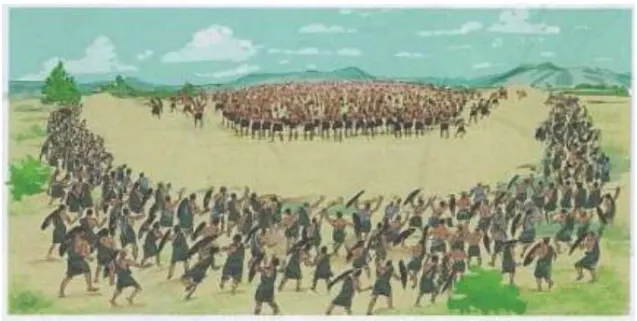
Cow-Horn formation Technique
The incorporation of war captives into their own groups
As the Ngoni fought wars with the people they met en route, they incorporated the war captives into their own groups. Those who resisted were killed. The male captives were included in the military, while the women were turned into wives. The incorporation of the war captives into the Ngoni groups increased the size of their population and strengthened the military.
Strong and efficient leadership
The leaders united their people and organised the military effectively. They also motivated their warriors by promising that they would give them rewards such as land, cattle and women. This, in turn, made the Ngoni warriors remain loyal to their leaders and fight bravely.
The disunity and weaknesses of communities they encountered
In their movement to the north, the Ngoni met people who lacked unity and had weak military capabilities. In some areas people were organised into clans and were living in small villages. Such people could not fight effectively the Ngoni intruders who were in large numbers, well organised and relatively better trained than them.
The use of the scorched-earth technique in the fights gave the Ngoni a relative advantage over communities they attacked.
The Ngoni marched in small groups and behaved ruthlessly when attacking their enemies. They plundered the areas and the people they conquered. Through this method, they took everything valuable from the defeated people, burnt their houses and destroyed farms as well as crops. The scorched-earth technique weakened invaded communities because it caused shortages of food, displacement of people and loss of weapons and other kinds of property.
The Ngoni came in big numbers and were strong
On their way they absorbed or fought off the people they encountered, capturing the young for worries and young women for wives. They had good military organization with age-regiments called “impis” (strong army).
The East African people were caught unaware and therefore did not offer much resistance.
The Ngoni were successful because the local people whom they were fighting with were so weak and lived in small groups, which could not resist/challenge the sudden and unexpected Ngoni invasion.
THE CAUSES OF THE NGONI MIGRATION
i. Dictatorial rule of Shaka
Shaka Zulu was cruel in nature as he severely tortured people and those who failed to respond to his order were killed. Due to this some people decided to seek refuge by migrating to other areas.
ii. External pressure from the British and Boers
They moved because of external pressure from the British and Boers in the South who were moving Northwards occupying their land.
iii. It was due to overpopulation in Natal
This was caused by the fertility of soils and the availability of rainfall between Drakensberg Mountains and the Indian Ocean.
iv. Pastorals’ reason
Some Ngoni people owned large herds of cattle which forced them to move northwards looking for pasture and water for their animals. So theymwanted to look for more fertile land for their cattle. They also experienced famine and drought that led to lack of food and water.
v. The influence of their leaders
Men like Zwangendaba, Mputa and Zulu Gama provided good leadership. This encouraged them to move onwards.
vi. Overstocking
It could also have been due to overstocking of their animals as they were having spirit of cattle rustling, i.e. they had great desire to steal other people’s cattle. For example they went on driving away and confiscating other people’s cattle during their conquest and expansionist wars.
vii. Increased knowledge of military tactics by the age regiments
These were powerful military forces and dedicated to professional war, which was their livelihood. They believed that they could have other territories through migration.
viii. The Mfecane war
This was the period of political instability and upheavals in South Africa, As a result of this contradiction wide warrior divided into two groups one was Under Shoshangane created Gaza Empire in Mozambique and Zwangendaba migrated northern wards through central Africa into present day Tanzania .- One group under Mputa Maseko crossed Zambezi River and passed to Eastern side of Lake Malawi (Nyasa) finally settled in present day Songea district
EFFECTS OF THE NGONI MIGRATIONS
(a) Social effects
The occurrence of frequent wars in the societies
That were previously peaceful such as those of Ufipa, Songea and Unyamwezi. The wars caused social disturbances and unrest in the societies concerned.
Death of people
Ngoni migration caused the occurrence of deaths and injuries among the Ngoni fighters and their opponents. Some people died, while others were badly wounded. The wars also caused famine as the Ngoni destroyed crops and farms, plundered food, burnt houses and destroyed granaries of societies they invaded
Intermarriage between the indigenous people and the Ngoni
Some Ngoni men, married women war captives.
Separation of families.
The Ngoni raids forced weak ethnic groups to move from their,places of origin to others. For example, the Ndendeule moved from their originalMhome in Songea to Namtumbo, where they established new settlements. Similarly, the Amang’anja of Malawi moved from their homeland on the western side of Lake Nyasa to the eastern side of the lake in response to the Ngoni raids.
Introduction of new culture
However, there was spread of Ngoni customs and culture. They enriched the cultures of the people of Southern Tanzania, for example, people copied Ngoni traditional dances and annual festivities
Introduction of new military tactics and weapons
i.e cow horn formation tactics, assegai, cowhides and shields.
(b) Political effects
Ngoni migration contributed to the rise of strong centralized states in the two regions
The societies which did not accept Ngoni domination strengthened their states militarily in order to defend themselves against the Ngoni warriors. These societies adopted new military techniques and weapons from the Ngoni. Examples of such societies were the Nyamwezi, Hehe, Sangu and Kimbu.
Ngoni migrations led to the decline of some states in Central and East Africa.
In all the areas through which they passed the Ngoni destroyed almost everything they came across, including houses, crops and cattle. This destruction weakened a number of states. For example, the Ngoni weakened the Rozwi ruling dynasty of the Mwenemutapa Empire in Zimbabwe.
Ngoni migrations disrupted societies in many parts of Central and East Africa.
They disrupted political stability and social coherence in the societies. For example, the raids weakened and disrupted many societies in western and southern Tanzania. The disruptions made it easy for some coastal slave traders to obtain slaves from those societies during the second half of the 19th century.
(c) Economic effects
Ngoni migration led to the decline of agricultural production
As a result of the Ngoni invasions, agricultural production declined as many young men were recruited into the Ngoni armies. Also, owing to prolonged wars, people became restless and therefore could not produce food. They spent most of their time hiding from the Ngoni raids.
Ngoni migration consolidated slave trade in East Africa
The Ngoni raids weakened many societies, which made it easy for slave traders to capture or buy slaves. Sometimes people sold captives to the traders so as to obtain guns which they used to fight the Ngoni. The Ngoni also sold some slaves to them.
The Ngoni disrupted and diverted trade routes
For example, the Long Distance Trade routes were frequently changed in fear of the Ngoni. The disruptions and diversion of the routes negatively affected economic development in various societies.
It led to the destruction of properties
Ngoni were moving in large groups destroying crops and other properties wherever they crossed. Villages that tried to resist were in most cases burnt down.
CLICK HERE TO GET PDF NOTES