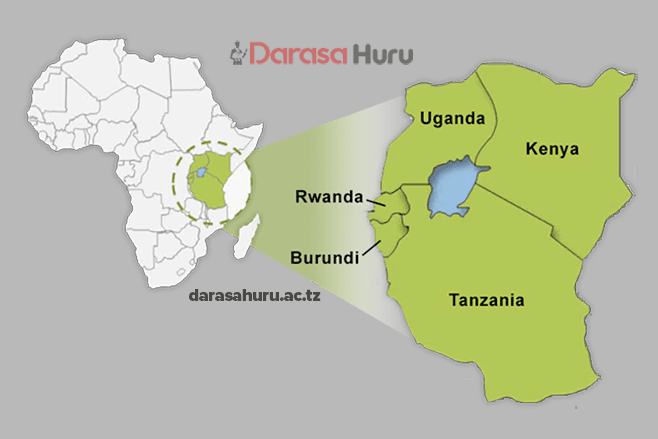
INTERACTIONS IN EASTERN AFRICA
Eastern Africa experienced interactions with other communities within and outside Eastern Africa, long before European colonialism,
Factors for interaction in Eastern Africa
Various factors shaped the interactions between and among the communities
1. Migration, in Eastern Africa
The Bantu migration, which had started centuries earlier, continued to shape the region’s demographics. Bantu-speaking communities moved across Central and Eastern Africa, introducing agricultural techniques such as iron hoes, manuring, crop rotation and intercropping, ironworking and social structures that influenced many communities.
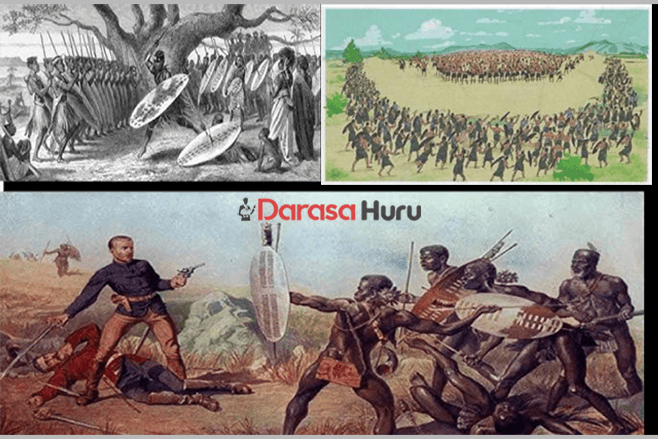
Examples of these Bantu are the Shona, Bemba, Baganda, Sukuma, Lingala, Nyamwezi, Gogo and Kikuyu. The Nilotic migration like the Lango, Kalenjin, Luo and Maasai. from Nile valley into present-day Uganda, Kenya and Tanzania is another good example which shaped Eastern Africa’s interactions, Sometimes the interactions between the Bantu and the Nilotes involved conflicts over pasture, land and fresh water.
2. Religious and cultural exchanges
This were deeply intertwined with trade and migration. The arrival of Islam on the East African coast in the 7th century led to significant cultural transformations. By the 12h century, many Swahili city-states had adopted Islam, thus integrating Islamic values and practices into their daily lives.
The interaction between Islam and local cultures led to the development of Swahili culture, which blended African, Arab and Persian elements. Kiswahili, a Bantu language heavily influenced by Arabic, became a lingua franca on the coast and beyond.
3. Intermarriage
This was also one of the social factors for interaction between the Asian merchants and local populations, particularly where Arab, Persian and African communities interacted and intermarried. This led to the development of a distinct Swahili identity that was s neither entirely purely Arab but rather a fusion of both.
4. The political and military interactions
Also shaped the history of pre-colonial Eastern Africa. The rise of centralized states such as the Buganda, and Bunyoro Kingdom, led to the forging of alliances and conflicts with neighboring groups. The Buganda Kingdom expanded its influence through military conquests and it incorporated various smaller communities into its political structure.
5. Trade
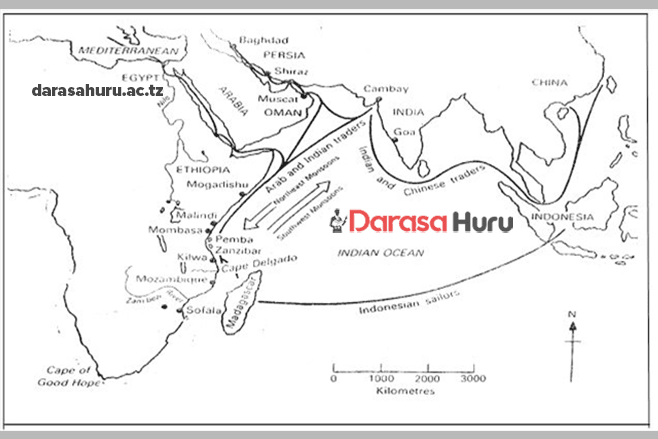
This was a significant factor in the pre-colonial interactions across Eastern Africa. The region was a center of commercial activity, linking the interior with the coast and global trade networks. The Swahili coast, stretching from present-day Somalia to Mozambique, was crucial in facilitating the long-distance trade between the Middle East
and Asia. The coastal city- states of Kilwa, Mombasa, Malindi and Zanzibar were major trading centers, where African merchants exchanged goods with Arab, Persian, Indian and later Chinese merchants.
The Participants in the Trade
The Kamba, Baganda, kikuyu, and Banyoro carried trade activities along the northern route. On the central route the Nyamwezi were out spoken providers of caravan porters, the leader of this caravan was Chief Mirambo. On the southern route The Yao became the first prominent traders, chief Mponda and Motaka were the one who mobilized them Items of trade.
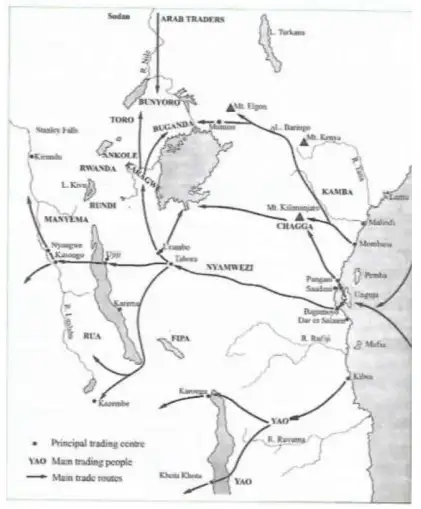
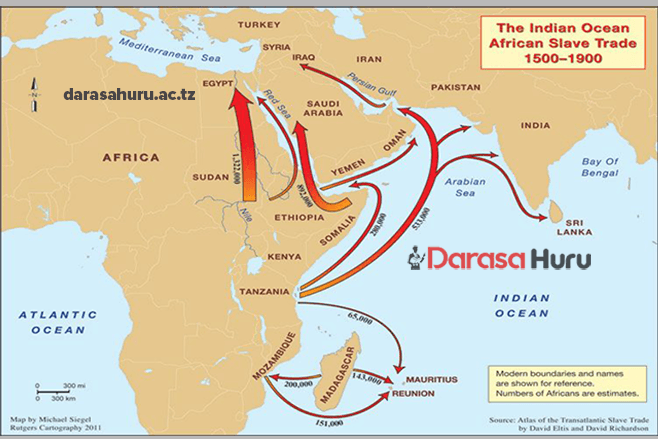
The key commodities included gold from the interior (notably from present-day Zimbabwe), ivory, anima skin, and slaves, which were highly needed in Middle Eastern and Asian markets. In return, Eastern African communities received textiles, needles, swords, glasses, beads, ceramics and luxury goods such as spices from India.
FACTORS FOR THE RISE OF THE TRADE
The commercial development occurred in East and Central Africa between 1855-1914 and was marked by the an exchange in trade items, thanks to the relationship with Asia, Arabia and Europe, trade grew up voluminously between 1855-1914 for the demands exceeded the supply, thanks to the death of local products at the coast. The Swahili and Arab traders stationed at Zanzibar migrated to the interior for they were attracted by the richness of East and Central Africa
The trade developed due to the following factors;
i. The growth of iron technology
In some tribes of theinterior of East Africa spurred the expansion of the long distance trade, like the Bunyoro and Nyamwezi were involved in blacksmithing, they made different iron equipments that included hoes, axes, pangas, and also produced salt. Tribes that were formally engaged in forming routes joined with tribes like the Bunyoro, the Nyamwezi, and the Kikuyu in the long distance trade because in doing so they obtained needed goods and because it was very profitable,
ii. The expansion of the industrial revolution from England to other European nations
Partly accelerated the development of long distance trade, local products like ivory, minerals turned out to be lucrative to the European during the second half of the nineteenth century, high demands of local products pressurized the traders to move deep in the interior of east Africa to obtain cheaply ivory and minerals.
iii. The shift of sultan sayyid said from Muscat Oman to Zanzibar in 1840
He and other Arabs traders created clove plantations in order to over satisfy the over expanding needs in the European market, in order to boost production he wanted cheap labor which could be offered by slaves who could be obtained from the interior parts of Africa.
iv. Introduction and availability of fire arms
Also was instrumental in contributing to the development of long distance trade, the presence of fire arm made it easier for Chokwe, Bisa, and Nyamwezi people to transform their traditional skills into modern ones to attract the available market and also aided those who were involved in slave trade to easily acquire captives.
v. The division of labor and specialization
Among the Chakwe and seasonal pattern of the land use among the Nyanwezi West Central Tanganyika, after preparing the land for planting men would leave the work of harvesting to women, men would travel far of hunting ivory and transacting trade for several months without checking back on their homes.
vi. High demands of imported European and Asian products
For example clothes, and fire arms.
REASONS FOR THE DECLINE OF LONG-DISTANCE TRADE IN EASTERN AFRICA
i. Inter-tribal wars
By 1880 competition for long distance trade items had come to its climax with many new East African societies interested in joining the long-distance trade business for example in Kenya the Akarnba fought with the Nandi in competition for rare products such as ivory which Arabs wanted most in Kenya.
ii. Presence of insecurity created by bandits almost in all trade routes
They had a problem of way layers for example the central route that was occupied by the Nyamwezi had a group of bandits known as Rugarugaand Mvuiwho molested traders from the central routes where as the hostile Zaramo, Ukimbu, Porkorno, molested traders from Kenya
iii. The depletion of elephant’s population
Due to over hunting indeed affected ivory products, also contributed to the decline of long-distance trade by 1890s the elephants had been forced to migrate to distance areas also they were killed in large number especially after the introduction of guns.
iv. The death of outstanding long-distance traders
Continuous assassination of African chiefs by Swahili and Arabs traders in search of trade items contributed to the decline of long-distance trade, Mirambbo, Nyungu ya mawe, and Kabaka mutesa I of Buganda all died in the same year of 1884 whose active participation and organizational abilities had led to success of long-distance trade, unfortunately their successors lacked such abilities.
v. Introduction of legitimate trade by European traders
During the period of scramble for and partition of Africa in 19th century led to the decline of long-distance trade.
THE IMPACTS OF THE LONG-DISTANCE TRADE
The integration of African economy into the world capitalist economy
Africa was producing many raw materials that were absorbed by the outside world and in return was receiving goods produced by the outside world.
There was introduction and spread of new cash crops
New cash crops introduced from the coast to the interior that helped people to get both food and cash crops, those included maize, rice, pineapple and sugar,
The use of caravan route for inland penetration
The caravan routes latter became useful for inland penetration by European explorers, missionaries and traders. In their enterprises used the routes that had been utilized by traders and without them the European colonial agents would have encountered many setbacks.
Introduction of monetary system
It created monetary system that took the place of barter system of trade, the new form of trade was introduced including cowries’ shells, coinage, and paper money
Development and growth of Some towns in East Africa
Development of towns in East Africa, for example Tabora, Bagamoyo, Tanga, and
Increased intermarriage and social interaction in East Africa
Increased intermarriage and social interaction gave rise to Afro-Asiatic, Afro-Arabic, and Afro-European culture in Africa.
Improvement of relationship among the Africans
Long distance trade helped to improve relationship between some African societies which had before, for example the Kamba and the Nandi tribes in Kenya had to ignore their traditional differences in order to trade freely as friends.
Depopulation
The trade involved itself in selling of human being who greatly depopulated most of East and Central African societies.
It led to the state formation in East Africa
This came out as the result of individuals who acquired wealth and other opportunities from long distance trade that helped them to build large political kingdoms for example Nyungu Ya Mawe, Mutesa I, Mirambo, were able to build their kingdoms as a result of opportunities from the long-distance trade.
The Increase of production of Local food stuffs
The long-distance trade stimulated the production of local food stuffs required to meet food demands of caravan traders who did not carry food supplies along the way.
CLICK HERE TO GET PDF NOTES