ENDOGENIC PROCESSES – ADVANCED PHYSICAL GEOGRAPHY
GEOMORPHOLOGY
What is the geomorphology?
Geomorphology refer to the study of earth’s landforms based on their origin, development and modification (sculpturing) as related to their underlying geological structure.
What is the landform?
Landforms refers to the features of the earth surface such as hills, valleys, basins, mountains, etc.
CLASSIFICATION OF LANDFORMS
Landforms can be classified into the following;
- Descriptive landforms.
- Genetic land forms.
1: DESCRIPTIVE CLASSIFICATION OF LANDFORMS
This classification focuses on simple characteristics of features such as size, height, location, etc. Thus, we are plains and plateaus, hills and mountains, valleys and basins, etc.
2: GENETIC CLASSIFICATION OF LANDFORMS
This is a simple classification of landforms. It is classifying earth’s landforms according to origin i.e mode of formation.
It indicates forces leading to their formation. These forces can be either;
- Exogenic forces, or
- Endogenic forces.
A: EXOGENIC FORCES (PROCESSES)
There are forces and processes of landforms formation. They operate on the earth’s surface. They are subcategorized into denudation and depositional processes, hence leading different landforms.
i. Denudational processes:
These are three types i.e weathering, erosion, and mass wasting. They lead to the development of various landforms. Examples; exfoliation domes, caves, and mudflow respectively.
ii. Depositional processes:
These leads to the depositional of materials after have been transported by natural agents like ice, waves, winds, and river. These leads to the formation of various landforms depending on the agents of deposition involved i.e river deposition, glacier deposition, wind deposition, and wave (marine) deposition. Examples of depositional landforms includes delta, esker, barchans, and spit respectively.
B: ENDOGENIC FORCES (PROCESSES)
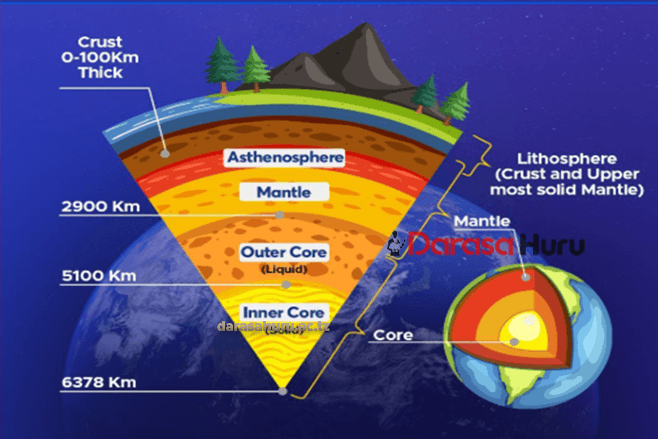
These are forces and processes which operates inside the earth i.e below the earth surface.
They are tectonic forces with processes divided into diastrophism and vulcanism.
1. Vulcanism (Vulcanic process):
These are the result of cooling and solidification of molten materials. Landforms due to the Vulcanicity includes crater, caldera, batholith, volcanic mountain, etc.
2. Diastrophism:
These are forces both horizontal movement and vertical in nature. The horizontal forces are tensional and compressional forces lead to the formation of orogenic processes. But the vertical forces lead to the formation of epeirogenic processes.
3. Orogenic processes:
These are horizontal movement leading to the formation of faulting and folding processes. The faulting process leads to the formation of different features like rift valley, block mountain, etc. while, folding process give rise to the formation of features like fold mountain, geosyncline, etc.
4. Epeirogenic processes:
These are processes caused by vertical movement as a result of warping. The warping process can be either up warping or down warping as a result of features like basins and plateaus.

THE DAVISON CONCEPT ON LANDFORMS
(DAVIS GEOMORPHIC CYCLE)
This concept of landforms explains that, “the landforms is the function of process, structure, and stage”. This concept popularly known as “Davis Geomorphic Cycle”.
The Davis concept on the landforms was provided by American geomorphologist named Willian Morris Davis in 1890.
W. M. Davis described the facts that, variation of earth’s landforms depends on the nature of process, structure of the rocks on which the landforms have been made, and the stage of landforms evolution.
The Davision concept is explained detailed as follow;
1: PROCESS
Generally, landforms were formed by either exogenic or endogenic process. For example, there are landforms formed by faulting, folding or even Vulcanicity as endogenic processes. From the faulting process lead to the formation of rift valley and block mountain. While folding process give rise to the formation of Fold Mountain and geosyncline. Warping leads to the formation of basin and plateau. Vulcanicity give rise to the formation of intrusive features like batholith, dyke, etc. and extrusive features like crater, caldera, volcanic mountain, etc.
The exogenic process are mass wasting, weathering and erosion with the various differential landforms known as denudational features. For example, weathering gives rise features like exfoliation domes, screes, karst landforms, etc. mass wasting lead to the formation of block slide, scars, etc. While, erosional depend on their agents gives rise to different features for example, erosional by river give rise features like v-shaped valley, plunge pool, canyon, etc. erosional by glacier give rise features like arete, pyramidal peak, etc. erosional by waves (marine) give rise features like cave, geo, headland, bay, etc. Wind erosion give rise to the formation of different features like rock pedestal, Yardang, zeugen, etc.
Moreover, there different features formed by depositional eg. Depositional by river, marine, wind, and glacier gives rise to different features like delta, spit, barchans, and esker respectively.
2: STRUCTURE
Structure refers to the texture, rock hardness, rock joints, etc. these properties of rocks hardness lead to the formation of various features due to differential erosion. Therefore, formation of features like Yardang, zeugen, mesas and buttes, and inselbergs.
In the coastal areas marine erosion has great impacts on differential cliff rocks enabling to formation of bays, gulfs, headlands, etc.
Moreover, structure also affect landforms maturity rates for example where the soft rocks maturity is faster than the features made by hardness of rocks.
3: STAGE
This explain the stages of evolution of landforms. For example, some landforms are young, some matured while other are old landforms.
General young landforms look differently from old landforms. For example, the young fold mountain has steeper slope and sharp summits while the old fold mountains are gentle or flate to peneplain after the long expensive of denudation.
Likewise, landforms in the upper stages of the river look differently formation to those of the middle and the old stages. In the young stage the vertical erosion is dominant and therefore lead to the formation of v-shaped valley, potholes, and waterfalls. In the middle stage the lateral erosion is dominant as a result of formation of river cliff and river bluff. While, in the old stage the depositional is dominant with features like oxbow lakes, delta, meanders, etc.
CRITICISM AGAINST DAVIS CONCEPT
There are many critics forward the Davis concept on the landforms. These includes like as follow;
i. The fact that formation of landforms is not only the function of process, structure and stage, but also the effect of climate changes for example, in the former wet climatic condition several features could be formed but when desert approaches the desert features could be formed.
ii. Davis also criticized because he ignored the role of human activities in the formation of some landforms. Example, through bombing, mining, construction, etc. human lead to the formation of features like basins, cliffs, etc.
iii. The concept also ignored the impact of Isostacy, earthquakes, etc. on the modifying of earth landforms in any time.
iv. Another critic is the role of river rejuvenation which can disrupt the Davis concept of stage. The river rejuvenation process can lead to the formation of erosional features on any stage of the river like valley within a valley, etc.
DISCUSSION QUESTION
1. “Landforms is the function of process, structure and stage”. Discuss. (NECTA, 1999)
CLICK HERE TO GET PDF FULL NOTES