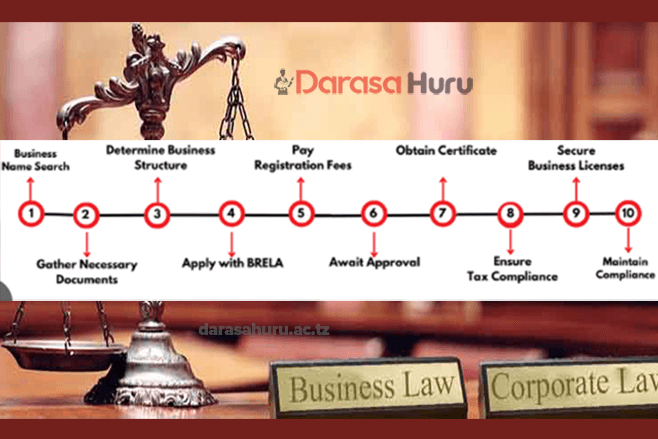
CHAPTER FIVE: BUSINESS REGISTRATION IN TANZANIA
THE CONCEPT OF BUSINESS REGISTRATION
Business registration is the process of obtaining legal authorisation to establish and operate a business within a given locality. It is also commonly referred to as business formalisation.
The process encompasses the registration of the business itself, its products, properties, documents, intellectual property, and various other elements.
Business registration is not limited to the initial establishment of a business; it also governs day-to-day business operations.
Evidence of business registration is typically presented in the form of business licences, permits, and certificates.
IMPORTANCE OF BUSINESS REGISTRATION
The following are the key benefits of business registration in Tanzania:
1. Enhances Freedom to Conduct Business
The Government of Tanzania requires all business owners operating within the country to hold a valid business licence issued by the respective authority.
Therefore, for any entity to operate freely — whether on the Tanzania Mainland or in Zanzibar — registration is essential in order to avoid the legal consequences associated with operating an unregistered business.
2. Increases Access to Credit
Many financial institutions in the country extend loan facilities to businesses that have formalised their operations.
Businesses that have undergone the formalisation process are well-positioned to secure funding from financial institutions, government bodies, or other formal lenders to expand their operations, thereby contributing to broader economic development.
3. Increases Market Access
A registered business commands a higher level of trust among its customers, channel members, and the general public. Registration signals to third parties that the relevant authorities have endorsed the business’s activities and that it is safe to transact with.
This trust enables registered businesses to penetrate diverse markets. Furthermore, it allows medium-sized businesses to bid for tenders in both the private and public sectors.
4. Enables Protection of Intellectual Property Rights
The registration of intellectual property (IP) enables companies to safeguard their core business activities, as well as their research and development efforts. Beyond protection, IP registration also helps companies build and enhance their overall value, as intellectual property is typically recognised as an asset during company valuations. Consequently, intellectual property assets may even be used as collateral when securing loans.
5. Improves Tax Administration
The exchange of information between the Business Registrations and Licensing Agency (BRELA) or the
Business and Property Registration Agency (BPRA) and the Tanzania Revenue Authority (TRA) or the Zanzibar Revenue Authority (ZRA) ensures that all registered and operating businesses fulfil their tax obligations.
Through business formalisation, the burden on tax administration is significantly reduced, as fewer resources are required to identify and pursue businesses operating informally.
6. Increases the Tax Base
A greater number of registered businesses broadens the scope for tax collection across a wider range of entities.
Every business registered with BRELA, BPRA, or any other relevant authority correspondingly increases the number of registered taxpayers with the TRA or ZRA.
As more businesses formalise their operations, the tax base expands, resulting in increased revenue collection by the relevant tax authorities.
7. Assists in the Acquisition of Property Rights
Business formalisation enables a business to acquire property in its own registered name. A registered business may, therefore, invest in substantial assets such as land or other properties — an opportunity that may be unavailable or restricted for unregistered businesses.
8. Supports the Planning Process
Business formalisation benefits both the government and the private sector during the planning process.
With a formalised business environment, the government is better able to estimate revenue projections, the cost of collection, and the appropriate allocation of social services, infrastructure, and levies.
Similarly, business owners are better positioned to forecast their annual tax liabilities and plan for timely payment.
TYPES OF BUSINESS LICENCES
Business registration for medium-sized enterprises and other forms of business in Tanzania is a multifaceted process, as illustrated in Figure 5.1.
The nature of registration depends on several factors, including the form of the business (size, organisational structure, and products), the type of sector, locality (Tanzania Mainland versus Zanzibar), ownership (local versus foreign), location (rural versus urban), and various other considerations.
Based on the Tanzania Small and Medium Enterprise (SME) Development Policy of 2003, the criteria used to determine the category of a business — including medium-sized enterprises — at the point of registration are the amount of capital invested and the number of employees.
GENERAL LICENCES
General licences refer to the broad permits, licences, or certificates issued to business enterprises by Local Government Authorities (LGAs), BRELA, or BPRA, or their respective agencies. These are typically required to be obtained after a business has applied for the relevant sectoral business licences. Examples of general licences include the following:
BUSINESS LICENCE
A business licence is ordinarily issued upon the registration of a business. It constitutes the authorisation granted by the licensing authorities to establish and operate a business. In Tanzania Mainland, business licences are classified into two categories: Class A and Class B.
Class A licences are issued by the Ministry of Industry and Trade (MIT) through the Business Registrations and Licensing Agency (BRELA), while
Class B licences are issued by Local Government Authorities (LGAs). Examples of business licences issued by BRELA are presented in Table 5.1.
Table 5.1: Business Licences Issued By Brela
| Category | Category | Category |
| Estate Agent, Estate Developer,
Property Management, Real Estate Agent |
Cargo Valuation, Cargo
Superintendence, and Pre- Shipment Inspection |
Dealers in Explosives |
| Shipping Agency | Cargo Tallying | Social Security Provider |
| Shipping Business | Harbours and Cargo
Handling |
Export and Selling |
| Commercial Traveller | Electricity Production and
Distribution |
Water Drilling and
Supply |
| Clearing and Forwarding / Freight
Forwarders |
Bureau de Change | Dealers in Broadcasting
Apparatus |
| Insurance and Assurance, Insurance
Broker, Re-insurance |
Stevedoring or Lighterage | Manufacturing and
Selling |
| Tourist Hotels, Lodges, Camps, Tour
Operations, Hunting Safaris, Travel Agents, Car Hire or Rental, Tourist Photography and Promotion |
Courier Services and Mail
Agents |
Motor Vehicle Dealers |
| Banking and Financial Institutions;
Capital Market and Credit Card Management; Stock Exchange and Stockbrokers |
Broadcasting and Television | Commission Agent or
Manufacturer’s Representative |
| Transportation of Passengers and
Goods by Air |
Ship Chandlers /
Miscellaneous Port Services |
Import and Selling |
| Postal Services | Refining of Crude Oil | — |
| Transportation of Passengers and Goods by Railway |
Night Clubs | Any Business of a National or International Nature or Governed by Policy |
| Category | Category | Category |
| Fax, Telex, Email, Internet Service
Providers, Internet Cafés, Internet Surfing, Telecommunication Services, and Sale of Telecommunications Equipment |
Dealers in Arms and
Ammunition |
Banking Brokers |
| Air Ticketing Institutions | Banking Agents | Capital Market |
| Microfinance Institutions | Micro Credits | Credit Card
Management |
| Mortgage and Hire Purchase | Credit Reference Bureau | Social Security Agent |
| Stockbrokers | Sale of Telecommunications
Equipment |
— |
| Mining and Gas Drilling | Mineral and Gas Survey /
Prospecting |
Gambling |
| Casino | Betting and Slot Machines | — |
In Zanzibar, BPRA is the authority responsible for registering companies, firms (both partnerships and sole proprietorships), civil society organisations, cooperative societies, and public corporations.
For the purposes of issuing business licences, BPRA has classified all businesses into 21 sectors (A to U), as shown in Table 5.2.
These sectors are further subdivided into various sub-sectors, business activity groups, and business activity classes.
Table 5.2: Sectors in Which Business Licences Are Grouped in Zanzibar
| Code | Sector | Code | Sector |
| A | Agriculture, Forestry, and
Fishing |
L | Real Estate Activities |
| B | Mining and Quarrying | M | Professional, Scientific, and Technical
Activities |
| C | Manufacturing | N | Administrative and Support Service Activities |
| Code | Sector | Code | Sector |
| D | Electricity, Gas, Steam, and Air
Conditioning Supply |
O | Public Administration and Defence;
Compulsory Social Security |
| E | Water Supply; Sewage and
Waste Management |
P | Education |
| F | Construction | Q | Human Health and Social Work Activities |
| G | Wholesale and Retail Trade;
Repair of Motor Vehicles and Motorcycles |
R | Arts, Entertainment, and Recreation |
| H | Transportation and Storage | S | Other Service Activities |
| I | Accommodation and Food
Service Activities |
T | Activities of Households as Employers; Undifferentiated Goods and ServiceProducing Activities of Households for Own Use |
| J | Information and
Communication |
U | Activities of Extraterritorial Organisations and Bodies |
| K | Financial and Insurance
Activities |
In addition, business licences issued by Local Government Authorities (LGAs) in Tanzania Mainland are listed in Table 5.3, while Figure 5.3 presents a sample business licence issued by LGAs in Tanzania Mainland.
Table 5.3: Business Licences Issued by LGAs in Tanzania Mainland
| Category | Category | Category |
| Insurance Agent | Cooperative Societies | Broker |
| Restaurants, Ordinary
Hotels, and Guest Houses |
Wholesale Trade | Transportation of Passengers within
the City, Municipality, and Township |
| Auctioneer | Building, Electrical,
Mechanical, and Civil Works Contractors |
Small-Scale Manufacturing and Selling |
| Itinerant Trade | Specified Professionals | Attended Telephone Services |
| General Merchandising
(Supermarkets, Departmental Stores) |
Printing and Publishing of
Books and Newspapers |
Waste Management |
| Regional Trading Companies | Spare Parts and Machine
Tools |
Entertainment Halls |
| Commercial Farming /
Animal and Fishery Husbandry |
Sale of Agricultural
Products within the Country |
Beauty Salons and Spas |
| Bars and Pubs | Bookshops and
Stationeries |
Handicrafts and Works of Art |
| Gyms | Barbershops | Public Toilets and Bathrooms |
| Cosmetics | Car Parks | Any Other Business Not of a
National or International Nature, or Not Governed by Policy |
| Private Schools | Day Care Centres | — |
| Organised Exhibitions,
Concerts, and Events |
Installation and
Maintenance Services |
— |
COMPANY REGISTRATION CERTIFICATE (CERTIFICATE OF INCORPORATION)
Companies must be registered under the Companies Act — 2002 for Tanzania Mainland and 2013 for Zanzibar. BRELA handles registration in Tanzania Mainland; BPRA handles it in Zanzibar.
1. Business Name Registration Certificate
Issued to individuals, partnerships, or corporations registering a trading name. BRELA covers Tanzania Mainland; BPRA covers Zanzibar.
2. Certificate of Compliance
Required for foreign companies wishing to operate in Tanzania. Issued by BRELA (Mainland) and BPRA (Zanzibar).
3. Taxpayer Identification Number (TIN) Certificate
A unique tax ID for individuals or businesses. In Tanzania Mainland, TIN is issued by TRA after company registration. In Zanzibar, a separate TIN application is submitted to ZRA after incorporation.
4. VAT Registration Number (VRN) Certificate
Issued by TRA (Mainland) and ZRA (Zanzibar). Required for professional service providers and businesses with annual turnover above TShs. 200 million (Mainland) or TShs. 100 million (Zanzibar).
5. Tax Clearance Certificate
Issued by TRA (Mainland) or ZRA (Zanzibar) confirming full tax compliance for a given period.
6. Incentive Certificate
Grants investment incentives. Issued by TIC in Tanzania Mainland and ZIPA in Zanzibar. Both operate one-stop centres for acquiring licenses.
7. Occupational Safety and Health Certificate
Ensures workplace safety. Issued by OSHA in Tanzania Mainland and the OSH Department in Zanzibar.
8. Fire Safety Certificate
Issued by the Fire and Rescue Services Department (Ministry of Home Affairs) to businesses meeting fire safety standards. Applies to both Tanzania Mainland and Zanzibar.
9. Pension Funds Registration
Employers must register employees with pension funds. In Tanzania Mainland: NSSF (private sector) and PSSSF (public sector). In Zanzibar: ZSSF covers both sectors.
10. Work Permit
Issued to non-citizens by the Labour Commissioner (Mainland) or Labour Commissioner of Zanzibar. Five categories exist:
- Class A – Investors/self-employed
- Class B – Prescribed professions (medical, oil & gas, science teachers)
- Class C – Other professions
- Class D – Religious/charitable activities
- Class E – Refugees
11. Residence Permit
Issued by the Commissioner General of Immigration Services for both Mainland and Zanzibar. Three classes:
- Class A – Trade, business, agriculture, manufacturing, etc.
- Class B – Foreign employees with a valid work permit
- Class C – Students, researchers, volunteers, medical patients, etc.
INTELLECTUAL PROPERTY RIGHTS
| Type | Tanzania Mainland | Zanzibar |
| Copyright | COSOTA | COSOZA |
| Patents | BRELA or ARIPO | BPRA or ARIPO |
| Trademarks | BRELA | BPRA |
| Industrial Designs | ARIPO | ARIPO |
SECTORAL LICENSES
Sector-specific licenses issued by relevant ministries or agencies, often required before obtaining a general business license. Key examples include:
Tourist Agency License (TAL) – Ministry of Natural Resources and Tourism
Insurance License – TIRA
Banking License – Bank of Tanzania (BOT)
Capital/Stock Exchange License – CMSA
Telecom & Broadcasting License – TCRA
Mining License – Ministry of Minerals
Explosives Dealers License – Ministry of Minerals
Customs Agency License (CAL) – TRA
Medicine & Medical Devices Permit – TMDA
Industrial License – BRELA
Shipping License – TASAC
Land Transport License – LATRA
Airworthiness Certificate – TCAA
Merchant License – TPA
Electricity License – EWURA
Petroleum Dealers License – EWURA
Water Dealers License – EWURA
Water Drilling Permit – Ministry of Water
Gaming License – Gaming Board of Tanzania
Ammunition Dealers License – TPDF
Crop Board Permits – Respective Crop Boards
Export Permits – Ministry of Agriculture
Professional Certificates – Respective professional boards (e.g., NBAA, CRB, ERB)
BUSINESS REGISTRATION PROCEDURES
Procedures vary by license type and location. General processes for business licenses, name registration, company registration, and TIN acquisition are similar in both Mainland and Zanzibar. Sectoral license procedures vary by sector. Most applications are done online through LGAs, BRELA, BPRA, TRA, or ZRA.
A: Business Name Registration
Steps to register a business name:
1. Create an account (ORS)
Register on the BRELA or BPRA website and select “Registration of Business Names” from the services menu. Options include registering, updating, or managing a business name.
2. Name clearance
Search existing registered names online to ensure yours is unique. This can be done without an account.
3. Fill in the application form
Provide:
- Applicant details (ID, passport for foreigners, address)
- Business name and activities
- Principal place of business in Tanzania
- Ownership details (for partnerships/corporations)
4. Upload attachments
Submit required documents.
5. Payment
A control number is generated after uploading documents. Pay the registration and annual maintenance fees.
6. Submit application
Submit after payment confirmation.
7. Decision
If corrections are needed, feedback is provided. If approved, you receive a certificate and business extract.
COMPANY REGISTRATION
Steps to register a company:
1. Create an account (ORS)
Register on BRELA or BPRA and select “Registration of Companies.” Options include registering, reserving a name, or filing returns.
2. Select company type
Choose from foreign company, private limited by guarantee or shares, public limited by shares, or unlimited private company.
3. Fill in the application form
Provide details such as company information, registered office, business activities, directors, secretary, share capital, and shareholders.
4. Upload attachments
Include directors’/shareholders’ details and certified memorandum and articles of association.
5. Payment
A control number is generated after uploading documents.
6. Submit application
Submit after payment confirmation.
7. Decision
Feedback is given if corrections are needed. If approved, a certificate of incorporation is issued.
BUSINESS LICENSE FROM LGAS (TANZANIA MAINLAND)
LGAs issue Class “B” licenses for businesses operating within a specific local area.
Steps:
1. Open an account
Use a national ID and TIN. LGAs assign a representative role upon account creation.
2. Select license type
Choose the appropriate business license.
3. Fill in the application form: Provide business details and contact information.
4. Upload attachments
Basic documents include title deed/lease agreement, birth certificate/passport, and certificate of incorporation.
5. Decision
If rejected, corrections must be made and resubmitted. If approved, a control number for payment is issued.
6. Payment
Amount depends on the business type.
7. Receive license
License is issued after payment.
8. Renewal/Transfer/Termination
Options available for annual or temporary licenses.
BUSINESS LICENSE FROM BRELA OR BPRA
BRELA and BPRA issue Class “A” licenses for businesses operating nationally or internationally.
Steps:
1. CREATE an account (ORS)
Register on BRELA or BPRA and select the relevant license type (e.g., industrial license).
2. Fill in the application form
Provide details relevant to the license type, such as owner info, location, products, and planned investment.
3. Upload attachments
Submit required documents.
4. Payment
A control number is generated for payment after uploading.
5. Submit application
Submit after payment.
6. Decision
Feedback given if corrections needed. If approved, a business license is issued.
TAX IDENTIFICATION NUMBER (TIN) CERTIFICATE
TIN services are provided online by TRA (mainland) and ZRA (Zanzibar). A director must have an individual TIN before applying for a business TIN.
Steps:
1. Obtain an individual TIN for the director
2. Fill in the Business TIN Registration Form
3. Estimate income, tax payable, and installments
4. Upload required documents:
- Certified memorandum and articles of association
- Introduction letter from LGAs
- Certificate of incorporation
- Certified lease agreement or title deed
- Power of Attorney
5. Submit to the authority for review
PENSION FUND REGISTRATION
Eligibility varies by fund and may depend on employee count or business sector.
Steps:
1. Confirm eligibility requirements
2. Gather required documents
3. Contact the relevant pension fund authority
4. Complete and submit application forms with supporting documents
5. Await approval and receive registration confirmation
6. Begin making regular contributions on behalf of employees
Required documents:
- Certificate of incorporation or registration
- TIN certificate
- Business license
- Certificate of business name
SANCTIONS FOR NON-COMPLIANCE
Sanctions apply to both registered and unregistered businesses, depending on the violation.
For unregistered businesses:
Prohibition: Businesses without a valid license cannot legally operate in Tanzania.
Fines/Penalties: Non-compliance with registration procedures results in fines.
Imprisonment: Some regulations prescribe imprisonment for serious violations.
For registered businesses:
Suspension/Revocation of License may occur if a business:
- Ceases using premises for their registered purpose
- Has an owner/manager convicted of an offence
- Owner becomes bankrupt or company goes into liquidation
- Fails to comply with registration conditions
- Submitted false information
- Violates applicable laws
Fines/Penalties may apply for:
- Changing location without notifying authorities
- Failing to file tax returns
- Operating outside the registered location
- Failing to surrender a revoked/cancelled certificate
Confiscation of Property may occur for:
- Tax evasion
- Trading counterfeit or expired products
- Trading in illegal or unregistered products
READ FULL NOTES PDF
DOWNLOAD PDF NOTES FULL