
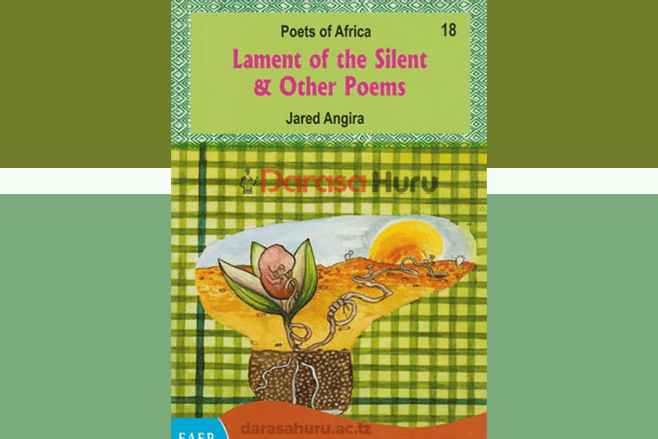
Lament of the Silent & Other Poems by Jared Angira Full Analysis
JACARANDA BLOOM
There are those
Who forever live
In the mirage
Of jacaranda blooms
Discarding seasons
Of slumber and sanity.
There are those
Who with twilight touch
Will shout hoorah
To a dawn
That hovers in the depths
Of the dark sea lanes
Discarding the dreams
Of the mirror flap.
There are those
Who believe
Rather persistently
That a soldier
Must fall at the battlefield
And a bull
Must reach the abattoir
Grazing at will
There are those
Who
At the next exhume
Will still
Have the will
To emigrate
To another field, for other feats
INTRODUCTION
“Jacaranda Bloom” is a modern African poem that explores different attitudes people have toward life, hope, dreams, determination, and destiny. The poet repeatedly refers to “There are those” to describe different groups of people with different beliefs and ways of responding to life’s challenges.
Through symbolism and figurative language, the poem encourages readers to think critically about perseverance, change, and human expectations.
FORM ANALYSIS
Type of Poem
This is a free verse poem because:
- It has no regular rhyme scheme.
- It has no fixed rhythm or meter.
- The lines and stanzas vary in length.
- The poet expresses ideas freely without following traditional poetic rules.
Structure
The poem is divided into four stanzas.
Each stanza begins with the repeated expression:
“There are those…”
Each stanza describes a different group of people and their attitudes toward life.
Persona (Speaker)
The persona is an observant and thoughtful narrator.
The speaker does not directly participate in the events but comments on different kinds of people and their beliefs.
Tone
The tone is:
- Reflective
- Philosophical
- Thoughtful
- Critical
- Hopeful
The speaker reflects on human behaviour while encouraging readers to think deeply.
Mood (Atmosphere)
The poem creates a mood of:
- Reflection
- Curiosity
- Hope
- Determination
- Seriousness
Readers are encouraged to evaluate different attitudes toward life.
Repetition
The phrase:
“There are those”
is repeated at the beginning of every stanza.
This repetition gives the poem unity and emphasizes that society is made up of people with different beliefs and choices.
Rhythm
The rhythm is irregular because the poem is written in free verse.
Instead of rhyme, the repetition of words creates a smooth flow.
CONTENT ANALYSIS
Summary
The speaker describes different categories of people.
Some people continue chasing beautiful but unrealistic dreams.
Others remain hopeful even in darkness.
Some accept that life has unavoidable realities such as death and sacrifice.
Others refuse to give up even after failure, believing that new opportunities can always be found elsewhere.
Overall, the poem celebrates determination while warning against false hopes and unrealistic expectations.
THEMES
Hope
Many people continue hoping even when circumstances appear difficult.
Example:
“Will shout hoorah to a dawn.”
The dawn symbolizes hope and a better future.
Perseverance
The last stanza shows people who never stop trying.
Example:
“Will still have the will to emigrate.”
This suggests determination to seek better opportunities.
Dreams and Aspirations
Some people pursue dreams throughout their lives.
The jacaranda bloom symbolizes attractive dreams and ambitions.
Reality versus Illusion
The poem contrasts dreams with reality.
Example:
“Forever live in the mirage.”
A mirage represents something attractive but impossible to reach.
Death
The poem reminds readers that death is unavoidable.
Example:
“A soldier must fall at the battlefield.”
This symbolizes sacrifice and the reality of life.
Sacrifice
The soldier and the bull both represent individuals who must sacrifice themselves for a purpose.
Change
The idea of emigrating to another field symbolizes beginning a new chapter in life.
The poem encourages adaptability.
Human Diversity
Different people think differently.
Each stanza introduces another group with unique beliefs and attitudes.
STYLE (Literary Devices)
Repetition
Example:
“There are those…”
Importance:
- Creates emphasis.
- Organizes the poem.
- Highlights different groups of people.
Symbolism
Jacaranda Bloom
Represents:
- dreams,
- beauty,
- hope,
- temporary success.
Dawn
Represents:
- new beginnings,
- hope,
- success.
Twilight
Represents:
- uncertainty,
- transition,
- difficult moments.
Battlefield
Represents:
- struggle,
- sacrifice,
- conflict.
Bull
Represents:
- helplessness,
- sacrifice,
- destiny.
Abattoir
Represents:
- death,
- the unavoidable end,
- fate.
Another Field
Represents:
- new opportunities,
- fresh beginnings,
- personal growth.
Metaphor
Example:
“Jacaranda blooms”
The flowers symbolize beautiful dreams rather than actual flowers.
Imagery
Examples:
- jacaranda blooms
- twilight
- dawn
- battlefield
- bull
- abattoir
These images help readers visualize the poet’s ideas.
Contrast
Examples:
- twilight ↔ dawn
- dreams ↔ reality
- battlefield ↔ peaceful grazing
- death ↔ hope
The contrasts emphasize different experiences in life.
Personification
Example:
“A dawn that hovers.”
The dawn is given the human ability to hover.
Enjambment
Many ideas continue from one line to the next without punctuation.
Example:
There are those
Who forever live
In the mirage
This creates a natural flow and encourages readers to continue reading.
DICTION (Language Use)
The language is:
- Simple but symbolic.
- Reflective.
- Philosophical.
- Rich in figurative expressions.
- Easy to understand with careful reading.
Words such as:
- bloom
- mirage
- twilight
- dawn
- battlefield
- emigrate
carry symbolic meanings beyond their literal definitions.
TITLE
“Jacaranda Bloom” is symbolic rather than literal.
The jacaranda tree produces beautiful flowers that bloom for only a short time. Therefore, the title symbolizes:
- beauty,
- hope,
- dreams,
- temporary success,
- human aspirations.
It reminds readers that some dreams are achievable, while others may be as temporary or elusive as blossoms.
MESSAGES
The poem teaches that:
- People have different attitudes toward life.
- Hope should be balanced with realism.
- Success often requires perseverance.
- Life involves sacrifice and difficult choices.
- Failure should not stop people from pursuing new opportunities.
- Change can lead to personal growth.
RELEVANCE TO TODAY’S SOCIETY
The poem is relevant because:
- Many people continue searching for better education and employment opportunities.
- Young people pursue ambitious dreams despite challenges.
- Migration in search of work or safety remains common.
- Success often requires resilience and determination.
- Society includes people with different beliefs, attitudes, and life goals.
- Individuals frequently face the need to adapt to changing circumstances.
VALUES
The poem promotes:
- Perseverance
- Hope
- Hard work
- Courage
- Adaptability
- Positive thinking
- Acceptance of life’s realities
- Determination
POETIC DEVICES AND THEIR EFFECTS (Summary Table)
| Literary Device | Example | Effect |
| Repetition | “There are those” | Creates emphasis and unity |
| Symbolism | Jacaranda bloom | Represents dreams and hope |
| Metaphor | Mirage | Symbolizes unrealistic expectations |
| Imagery | Battlefield, dawn, twilight | Creates vivid mental pictures |
| Contrast | Twilight vs dawn | Highlights opposing ideas |
| Personification | “Dawn that hovers” | Makes ideas more vivid |
| Enjambment | Lines flow into each other | Creates smooth reading |
CONCLUSION
“Jacaranda Bloom” is a reflective free verse poem that explores hope, perseverance, sacrifice, and the diverse ways people respond to life’s challenges. Through repetition, symbolism, imagery, metaphor, and contrast, the poet shows that while some dreams may be unrealistic, determination, adaptability, and resilience are essential for overcoming obstacles and pursuing a meaningful future. The poem remains highly relevant to high school students because it encourages critical thinking about ambition, personal growth, and the realities of life.
CLICK HERE TO GET PDF ANALYSIS
