
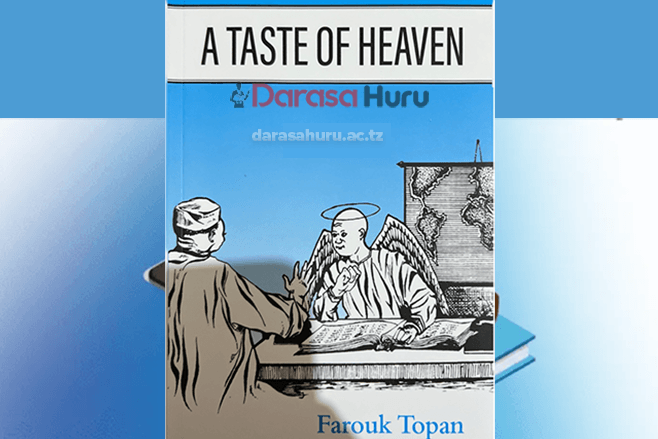
A Taste of Heaven by Farouk Topan – Play Analysis
A TASTE OF HEAVEN
Writter: Farouk Topan 1970
Translator: Martin Mkombo 1980
Publisheer: Mkuki na Nyota 2023
CHARACTERS
ZILAILI: Soul – taking angel SIRAFILI: Resurrection angel. JIBURILI: Worker angel.
MUNKARI: Record angel.
SATAN: Chief Devil.
JUMA HAMISI: Man from Bagamoyo
PLOT SUMMARY
The play is divided in three scenes and set in heaven, where Ziraili (an angel responsible for taking people’s souls) is working with records of human deaths. A serious error occurs: a man who was supposed to die (John Houghton) is still alive, while another (Juma Hamisi) has been wrongly killed. This confusion exposes weaknesses in the heavenly system and leads to tension, blame, and fear of punishment from the Master (God).
SCENE I: IN HEAVEN IN ZIRAILI’S OFFICE.
The play opens in heaven in Ziraili’s office. He is busy checking a record book containing names of people whose souls are to be taken. He becomes irritated because the records are disorganized—names from different countries and categories are mixed up. Ziraili explains how the system works. He takes people’s souls, sends death certificates to Munkari and Nakiri who record in their ledgers and process them. However, he complains that they do not do their work properly, causing confusion.
Jiburili enters, and they begin discussing work. Ziraili mentions that there are no prophets on Earth anymore, implying that Jiburili has little to do. But Jiburili tells him there are other places like Mars, Jupiter, and Neptune, suggesting that work exists beyond Earth. Jiburili brings a message from the Master. The message informs Ziraili that. He will soon have additional duties (including Mars). A seven-year plan has been prepared and he must follow it carefully. While reading further, Ziraili discovers that the Master is asking for the identity number of a man called John Houghton. This surprises him because he cannot find the name in his records.
After calling the Master, Ziraili learns that John Houghton is from England. Around the same time, another issue arises. Sirafili has called asking about Juma Hamisi from Tanzania. This raises suspicion about possible errors. Ziraili checks the records and becomes shocked. John Houghton’s name appears under yesterday’s date but his soul was not taken. This means something is wrong. Ziraili contacts Munkari and confirms that John Houghton is still alive. Therefore, a mistake has occurred. Jiburili realizes the implication. If John Houghton was not taken, then someone else must have been wrongly killed.
Ziraili investigates further and discovers the truth. They mistakenly took Juma Hamisi’s soul instead of John Houghton’s. The mistake occurred because the assistants read the wrong list. They confused this year’s records with next year’s. Ziraili becomes deeply disturbed and afraid. He decides that he must report the matter to the Master. He suspects that Satan may be responsible for the confusion. The scene ends with tension and fear about the consequences.
SCENE II: TAKES PLACE A FEW HOURS LATER IN THE SAME OFFICE.
Munkari joins Ziraili, asking what the Master said about the mistake. Ziraili explains that The Master was very disturbed so he had to beg for forgiveness. Eventually, the Master forgives him, however, Ziraili is not free from consequences. He is given an assignment of returning Juma Hamisi’s soul back to earth. Munkari is surprised and thinks of how his books will be in a mess by confusing the numbers. Ziraili begs Munkari to ask Sirafili to help him to resurrect Juma’s body since it has been buried already.
Meanwhile, they wonder whether Juma Hamisi will be willing to go back to earth, now that he is already enjoying heavenly pleasures especially in the love hall. He lifts the hand of the phone and calls heaven to ask Juma to see him immediately. They are not sure whether he will get out of the Love Hall because most people who get there never come out willingly. Munkari promises to help to get him out since he is the one who met him in his grave the day before.
SCENE III: THE SAME PLACE:
Juma Hamis has finally arrived in Ziraili’s office and explains how he has had good time in Heaven since he arrived. He explains how he enjoyed making love with any woman he wanted in the love hall. He complains that in Bagamoyo where he comes from, he could only marry the maximum of four wives. He is informed that he should not consider those women in the love hall as his wives because in heaven there is no marriage. The women are just there for merry-making for men like him and it is not counted as sin. He is also informed that those women never conceive or give birth. He is informed that the women he slept with will sleep with other men and no one feels jealous because there is no jealousy in heaven.
Then he is now informed that he was in heaven by mistake and it was supposed to be someone else’s chance. His turn was supposed to be the same date the next year. He refuses to go back to earth and says he is comfortable in heaven. He is assured that he will not go back to Bagamoyo but his soul will be installed in the body of a white man called John Houghton. He wonders how his soul can go to a white man. He sees a bottle of whiskey on the table and reads it “John Walker”. He thinks that Ziraili is a drunkard and wants to leave him. He is informed that whether he likes or not his soul will have to go to John Houghton who lives in Bournemouth – England.
He is informed that he will have to replace John on earth and do his works. John owns a bar where he sells intoxicating drinks – wine with his wife. His wife who is 35 is a singer and German by origin. Juma is surprised to hear that John also keeps a dog. For Hamis this is bad luck since as a Muslim, dogs are taboo animals. He refuses to go and plans to appeal to the higher authority but he is informed that it won’t help.
Sirafili comes in and asks him if he is ready to go. He explains the reasons why he does not what to go to the white men country. One is cultural differences including the fact that John keeps a dog something that is a taboo to him, religious differences (he is a Muslim but John is not), racial differences ( he is an African but John is a European), occupational differences (he is a fisherman but John sells wines), nationality differences (he is a Tanzanian but John is a British), political ideological differences (Tanzanians believe in Socialism and Self- reliance while John comes from a capitalist society) so on that basis he says it would be hell for him.
Sirafili agrees with him and suggests an alternative. He tells him that he will go back to Bagamoyo but in form of a cat. Sirafili calls heaven and tells the Master that Juma has agreed to go back to Earth in form of a cat. They start the journey to Bagamoyo to a grey cat with black marks like a tiger. Hamis is not given time for arguing.
On their way back to Bagamoyo, Satan is giving a long monologue speaking to himself. He shows how he turns human beings into different creature like owls, chicken, donkey, peacock, dove and fish. He praises himself for bringing Adam from heaven to earth. He boasts how he occupied a prestigious position in heaven and was told to bow before Adam and refused. He was kicked out of heaven and made a vow that Adam and his descendants will never live in peace on Earth. He believes that God loves him that’s why He has given him followers. He says that he is one with God and they both have the same aim each one completes the work of the other. The scene ends by Satan planning to go to Bagamoyo Market to the same cat.
INTRODUCTION
THE TITLE OF THE PLAY.
The play “A Taste of Heaven” is a powerful satirical work that uses humor and fantasy to address serious issues in religious sphere. Systems of power—whether earthly or divine—are flawed, and individuals often suffer because of these flaws. The title “A taste of heaven” reveals the hopes of the ultimate finality of human life – the afterlife. A beautiful place where everything is perfect and people enjoy the pleasures as a reward for their faithful conduct on earth. The title is satirically related to the content in the following ways.
1St Juma Hamis tastes heavenly pleasures. He dies accidentally and goes to heaven. It is revealed that Juma Hamis has been accidentally killed in the place of John Houghton and after tasting the pleasures of heaven he is so happy that he wishes his friend were there to enjoy with him. He says “The good time I had yesterday, I could never get on earth. My friends are missing all the good times. If people knew what it was like here there would be no one remaining on earth.” Pg 14
2nd After tasting heaven Juma refuses to come back to earth. Juma enjoys unlimited sexual freedom and wonders why this privilege is not on earth. Heaven allows free sexual relations without sin. No marriage, no jealousy, no consequences. Ziraili tells him “Goodness, where does sin come from? This is heaven. We have no sins. You and those women have no sin either.” Pg 13. When he is told to go back to earth he refuses.
3rd Symbolically “A taste of Heaven” refers to people who get political positions and taste the national cake and later they refuse to step down from power After enjoying the pleasures of Heaven Juma refuses to go back to where he came from. May politicians get political position when they are still poor but in a short time they become bourgeoisies. When their terms expire, many do not volunteer to step down for others to taste the national cake.
SETTING
The play is set in heaven. All the direct events are taking place in heaven specifically in Ziraili’s office. The office is portrayed as having things like tables, telephones and record books. We are also given a hit about events taking place in the Love Hall where Juma enjoys free and unlimited sexual pleasure.
There are indirect settings mentioned in the play such as Bagamoyo, Britain, Dar-es- Salaam, and other planets. These are not directly involved in the actions of the play but they play important part in helping us understand the current state of affairs.
STYLE AND TECHNIQUES
The play is short but it has employed several techniques.
Dialogue
He has used the conversations among characters to reveal confusion and tension in the play. This is a common feature in any play. For example,
Ziraili: I shall tell you. (Hesitant) There is a minor mistake. (again hesitant) The mistake concerns you.
- Hamisi: (Surprised) Concerns me? Ziraili: Yes, you.
- Hamisi: (Anxious) How is that?
Ziraili: I was a mistake to bring you to heaven.
The dialogue helps to develop characters and themes by showing their actions and reactions.
The use of Monologue.
The play ends with a monologue from Satan who gives a long speech speaking to himself. He shows how he works behind the scenes to turn human beings into different creature like owls, chicken, donkey, peacock, dove and fish. He praises himself for
bringing Adam from heaven to earth. He boasts how he occupied a prestigious position in heaven and was told to bow before Adam and refused.
Suspense.
The playwright creates suspense by showing that a wrong soul has been taken. The rest of the story is based on this event. It creates suspense on the part of the reader and raises important questions about what will happen next. First what will those careless angels who made a mistake do to rectify the error? Second, will Juma Hamisi – who has already tasted heaven – be willing to go back to earth?
Stage Direction.
The playwright has also included stage directions to instruct the reader how the play is to be staged/performed. The above dialogue is an example for this.
LANGUAGE USE.
The language used is simple and straight forward. It has helped the reader to get the message intended by the playwright easily. However, it is also embellished with figures of speech.
Satire
The play is highly satirical. The writer uses humor to criticize serious issues like inefficiency and poor leadership. The entire play is a satire that even a perfect place like heaven there can be errors. Heaven is like a poorly run office where angels behave like careless workers. Serious issues are handled casually. The playwright criticizes real-world systems by exaggerating them in a divine setting. This mocks real-life institutions such as governments, offices, and organizations.
Irony
There is situational irony. Heaven, is expected to be a perfect place where everything is done orderly, but it is full of mistakes. Also, the Master (God) is expected to be omniscient (all-knowing) but He is presented as depending on the information brought by angels from their record books.
Symbolism
Record book →symbolizes control of human life and That what happens to human life is like a ready-made script and man has no control over it.
Telephones → symbolize prayers of the saints as a way of communicating to God. It’s not true than in heaven there are landlines like here on earth but that is just a means of communication symbolizing prayers in the heavenly realm.
Satan→ represents rebellion, disobedience, and chaos that happen on
Juma Hamis→ symbolizes common people who have managed to get positions by luck but they have refused to step down. Or have forgotten those they left suffering in
The master→ represents God or a high government leader like the president who is feared by his subordinates.
Heaven→ symbolizes a socialist government that was thought to be perfect and without flaws but it proves to be wrong. Even the government thought to be perfect can be prone to mistakes.
Animals and birds→ symbolize dehumanization – the process of degrading human beings and treating them like animals by corrupt governments. Most leaders have acquired the heart of wild beasts and have lost a sense of humanity and they now treat their fellow human beings like animals.
Death → the door (the means) to heaven and enjoy the
Barbarism.
- I am very busy Bwana! Pg 3
- You know him better Bwana pg 12
- Hodi! Hodi! Pg 22
Simile
- It’s like a father with a spoilt child pg 28
Metaphor
- The rest of these creatures are mere dolls
- They are merely tools for carrying out our Pg 28
Anaphora.
- Now I Now I understand. Pg 28
Rhetorical questions
- Why then do I laugh at Ziraili? Don’t we belong together? Pg 29
- Me, to adore Adam who is made of dust? Pg 27
CHARACTERIZATION
JUMA HAMISI
He was a fisherman from Bagamoyo. When he was still on earth he was involved in fishing as his occupation. As he says “I was a fisherman” pg He also reports that it is at the fish market where he met his death. He says “That’s where I met with my accident. I was selling fish there” pg 24.
He is a devoted Muslim. He is a man who follows and lives according to the Islamic teachings. One of which is considering a dog as a taboo animal to a Muslim, abstaining from selling wine and marrying the maximum of four wives. He says “I am a Muslim they are not. This man keeps a dog; dogs are taboo to me. He sells wines, that’s also taboo to me.” Pg 23.
He is a man of the people. He lived his life so well that many people in his home town adored him. His death shocked many and they attended his funeral in big numbers. Munkari confirms “He was a very good man. The whole of Bagamoyo adored him. There were so many people at the burial that I was tired of waiting.” Pg 13
He is a socialist. He is one of those people who accept the philosophy of socialism and self-reliance. He believes he cannot operate properly in a capitalist society because it implies exploiting others. He says “How can I go to a place where I shall start exploiting other people? … I am for socialism. They are for capitalism. The two are immiscible. I have a socialist heart” pg 24
He is an innocent victim. He is killed accidentally because of the mistakes of others and is now forced to suffer for Finally, he is returned to earth in form of a cat for the mistake that is not his. Sirafili says “I shall come behind you with this man so that as soon as you take the soul out of the cat, I shall install this man’s soul.” Pg 26. This is not fair.
He has a firm stand. Juma is a man of stand and he defends what he believes in. He is accidentally killed before his time but he refuses to be punished for another person’s mistake. He refuses to go to England to become John and gives reasons why he refuses. He simply says “I don’t want to go” pg 20.
ZIRAILI
He is a soul-taking angel. His main assignment is to keep record of people whose souls are to be taken and implements the plan as instructed by his Master. He says “My assignment is to take people’s souls and send death certificates to Munkari and Nakiri” pg 2
He is a hardworking angel but confused and anxious. Ziraili works hard in his department but he is let down by his assistants Munkari and Nakiri. As he says “But Munkari and Nakiri don’t do things properly – each person from a particular country against assigned numbers, they mix them up” pg
He avoids accountability for his mistake. He is the one who directs his assistants what to do but later he blames them for his own mistake. He says “I didn’t give instructions on this man. I have to give instructions myself and then my assistants go and do the job” pg 8. He was supposed to crosscheck and ensure that he takes the soul of the right person. He blames both his assistants and Satan for his own mistakes.
He symbolizes leaders who panic under pressure. When a mistake is done and he takes the soul of Juma instead of John he panics a lot. He plans to cover up things before the master discovers it. He says, “Oh no! Now I am made to set the records right before my Master checks the books. Luckly, the Master does not check the books until July” pg 3.
He represents authoritarian leaders. He forces his will upon others just to cover up his failings. He convinces Juma to go back to earth and when he refuses, he uses force to drive him from heaven. He says;
Ziraili: You will go.
Hamisi: I won’t go.
Ziraili (Angrily). You must go I have decided.
JIBURILI
He is a worker angel. He is usually sent to deliver messages to different places. And he has no any prior arrangement for his assignments. He says “No there are no prior arrangements on my assignments they are given to me as they come. Pg 6
He is calm and questions situations logically. He helps Ziraili discover the mistake through logical thinking. For instance, he advices “But you said his soul was taken yesterday. Wouldn’t you find the name if you looked under yesterday’s date?” pg 8
Represents reason and critical thinking. That’s why he wonders how in the word Ziraili could have made such a silly mistake to cost someone’s life. He asks “How can you or your assistants make this mistake? It is a childish- stupid mistake.” Pg 11
MUNKARI AND NAKIRI
They are Ziraili’s assistants. They are responsible for recording and checking souls. For example, when Ziraili wants to know about John, he calls Munkari to help him check the records. And when they are instructed to return Juma to Bagamoyo he complains; “My books will be in a mess. My numbers will be confused” pg 12
They are careless and disorganized. Ziraili keeps complaining that his assistants usually mix up records and that’s why they ended up taking the soul of a wrong person. He says; “But Munkari and Nakiri don’t do things properly – each person from a particular country against assigned numbers, they mix them up” pg
They represent incompetent workers. They make silly mistakes that cost the lives of innocent people like These represent incompetent workers in the government who usually mess-up things in government offices for their laziness and cause unnecessary sufferings to innocent people.
SIRAFILI
He is a resurrection angel. His job is to deal with dead people after they are buried in order to resurrect them. Ziraili reports; “When Munkari returns these certificates to us we take them to Sirafili, one copy of each he has to know all the people who die on earth. He is the one who resurrects them with his trumpets” pg 5.
He is tricky. He pretends to agree with Juma that his reasons for not going to a white man are logical. He promises him to return him to Bagamoyo but in form of a cat. This time around he does not allow room for argument. He calls the master and reports “Yes Sir. It’s me Sirafili. I have seen them. We have solved the problem. The man will go back to Bagamoyo. But he will go back in form of a cat” pg 25
SATAN.
He is the chief Devil. Satan is presented as the devil who is responsible for all evils happening in the world. He even dehumanizes human being by turning them into animals. Ziraili reports that even the confusion in his office is the work of Satan. He says: This is his work. If I get him, he will learn a lesson. His lesson is long overdue. pg 11.
He is a source of chaos on earth and in heaven. He brings chaos in heaven and is kicked out. Then he vows to destroy human peace because of being kicked out of He decides to destroy human family and cause troubles to the descendants of Adam. He says “But I made a vow! Since I am kicked out because of Adam, then Adam and his children – the human race will never live in peace on Earth” Pg 27.
He is arrogant and boastful. He takes pride in the way he was created and the position he held in heaven. This makes him arrogant to the point of disobeying his Master (God). He says “Me the first angel in heaven, me – the most educated angel in heaven, me who worshipped by the hour, the minute at every mass; me who knew God better than any in heaven and earth. I was told Get out and I fell”. Pg 27.
He represents rebellion and disobedience. He refused to bow to Adam and consequently he was expelled from heaven. He says “I ‘me’, I said, ‘me to adore Adam who is made of dust? No’ and that’s how I erred. I was told to leave heaven.” Pg 27. That’s why he convinces humans to disobey God but God brings them back to Himself. “He gives me followers and when I mislead them, He leads them back to his flock. Pg 28
He is revengeful. Just because he is kicked out of heaven, and he knows that he cannot fight God, he revenges to God by destroying his creation. “Since I am kicked out because of Adam, then Adam and his children – the human race will never live in peace on Earth” Pg 27.
THEMATIC ANALYSIS OF THE PLAY
1. FATE AND HUMAN DESTINY.
The play presents the idea that whatever happens to human beings whether good or bad, there are supernatural powers behind it. This raises the question: Are human lives controlled by fate or choice? Traditionally, death is seen as predetermined (fate). However, the play challenges this idea.
Death is shown as controlled by officials in heaven and their mistakes can change somebody’s destiny. The fact that John Houghton survives shows that fate is not absolute—it can be disrupted by error. For example, Ziraili talking to Munkari says “Read the name again, Goodness me! He is not in the plan. No, we must have taken this soul, which is supposed to be living on earth” pg 10.
Juma’s death is accidental, not planned however his return to Earth is forced. He cannot decide his destiny. Human beings may not have full control over their lives; external forces often determine their fate and destinies. For instance, the conversation between Ziraili and Juma reveals this;
Ziraili: You will go.
- Hamisi: I won’t go.
Ziraili (Angrily). You must go I have decided.
- Hamisi: I want to appeal to a higher authority.
Ziraili: It won’t help you. He is the one who insists that your soul be returned to earth. Pg 21
This symbolically implies that in this world there are people who die due to plans by the human governments. This idea further implies that there are innocent people who are killed due to the cases of mistaken identity. Human governments plan to assassinate, abduct and kill people for their own interests before their predestined time. They keep lists of people who are supposed to be killed and they implement their plans even by using planned accidents. For example, Ziraili says “Here is the Those listed are Chopta, Gethenji (jumps- stands up with a shout) John Houghton! John Houghton!” pg 8. Showing that his death was planned he says “The fellow is still alive when he should have died yesterday. Here his death is clearly spelt out. (reads). John Houghton, Bournemouth, England – age 35. Cause for death – dies when his car collides with a horse on New Forest Road Hampshire at 10:30” pg 9
This also represents a political system where those in the government are enjoying the national cake as though they are in heaven. And when it happens that someone who is not their favorite gets into the system, they try as much as possible to bring him down at any cost.
Ziraili: You will go.
Hamisi: I won’t go.
Ziraili (Angrily). You must go I have decided.
Hamisi: I want to appeal to a higher authority.
Ziraili: It won’t help you. He is the one who insists that your soul be returned to earth.
However, it also shows that those who rise from poverty and taste the luxuries of political positions do not like to let go of their position easily. If someone shows persistence, those in power, dehumanize him by treating him less of a human being. When Juma refuses to leave heaven willingly, he is forced to return in form of a cat. Sirafili says “We have solved the problem. This man will go back to Bagamoyo. But he will go back in form of a cat” pg 25. This shows that human beings have no choice about their
2. RELIGION AND BELIEF SYSTEMS
The play presents controversial ideas about religion. The playwright has brought forth ideas that challenge traditional religious teachings. Let us look at some of these ideas.
Heaven is portrayed as a place of pleasure, especially in the Love Hall. Heaven allows free sexual relations without sin. No marriage, no jealousy, no consequences. Juma enjoys unlimited sexual freedom and wonders why this privilege is not on earth. This reduces heaven to a place of physical enjoyment rather than spiritual reward.
He portrays heaven as a place which is not perfect as religion teaches. He shows that heavenly beings can make mistakes, and cause serious problems. Additionally, he shows that heaven is not without negative emotions like anger and physical problems like diseases. He presents Sirafili as a person suffering from serious coughing. He says “Every time he speaks a few words he coughs as if something is stuck in his throat” pg 22. This is contrary to religious teachings that assure the followers that heaven is a perfect place where diseases and pain will not be experienced.
He shows that even people who are not morally upright can still make it to heaven. People like John Houghton owns a bar selling intoxicating drinks but his name is in the list of people who are supposed to be enjoying the heavenly pleasures. This contradicts religious teachings which hold that only the virtuous souls will have this privilege.
He also shows that heaven is a place where one can go and come back to earth. One of the major incidents in the play is the wrongful death of Juma Hamisi instead of John Houghton who was supposed to die. When Juma Hamisi is mistakenly killed before his time, he is forced to leave heaven despite enjoying it. This is contrary to religious teachings which assure the followers that heavenly pleasures are a reward for their lives well lived on earth. Once someone goes to heaven, they go for eternity.
He presents Satan as one with God and that he works alongside Satan believes that God loves him that’s why He has given him followers and says that he and God are one and have the same aim each one completes the work of the other. This is contrary to religious teachings which portray Satan as a complete enemy of everything that is godly. He works against God and his plans are completely focused on destroying the will of God on earth.
Another question is whether there is life in other planets. The playwright seems to believe that there are other creatures in other planets that also undergo the same lifestyles like here on earth. Science proves that only planet earth has human beings and can support life. But in religious sphere it is believed that there are other planets with
Ziraili reports “This is to inform you that as of next year – from July, your assignments will include work on Mars. Please consult with Jiburili who will acquaint you with the problems on that planet, on this assignment. A list of all beings whose souls you will take away is hereby attached” pg 4. This challenges the belief that only the planet earth sinned against God and as a punishment people die. How is it possible for Ziraili to take the souls of beings from the planets that did not sin?
So generally, the play questions and satirizes religious beliefs, encouraging critical thinking about faith and morality. The play criticizes societies that focus too much on pleasure and material satisfaction.
3. BUREAUCRACY AND INEFFICIENCY
This is a system of official rules and ways of doing things that a government or an organization has, especially when these seem to be too complicated. The play strongly satirizes administrative systems by presenting heaven as a disorganized office.
It presents heaven as a bureaucratic institution with files, records, and procedures. For example, Ziraili says “That’s what we do. When Munkari returns these certificates to us we take them to Sirafili, one copy of each he has to know all the people who die on earth. He is the one who resurrects them with his trumpets” pg 5.
Ziraili complains about mixed-up records and poor filing. Example he complains that assistants “mix up things” instead of organizing names properly. He says “But Munkari and Nakiri don’t do things properly – each person from a particular country against assigned numbers, they mix them up” pg They confuse this year’s list with next year’s, leading to a fatal mistake. Munkari worries about incorrect numbering and records.
This reflects real-life government systems where files are misplaced, duties are poorly handled, and mistakes affect innocent people. This is a criticism to real-world administrative systems where errors occur due to negligence. The play points back at the time when Tanzania was building Ujamaa hoping that it is a perfect system that will serve the people with equality. But the playwright gives us a message that even systems meant to be perfect can fail due to human negligence. Juma says “We Tanzanians have our own political beliefs which are very different from theirs. Ours is Socialism and Self-Reliance” pg 23.
The play seems to rise questions such as: Is life always fair? Can innocent people suffer due to others’ mistakes? The answer is obvious that human or institutional errors can cause serious injustice to innocent individuals.
4. IRRESPONSIBILITY AND ACCOUNTABILITY
The play is a powerful satirical critique of bureaucratic systems. By presenting heaven as disorganized and error-prone, the playwright exposes weaknesses in human institutions. The mix-up between John Houghton and Juma Hamisi highlights the dangers of negligence and irresponsibility of whose who have been entrusted with the tasks. When they fail to perform their duties effectively the results are fatal. Jiburili challenges Ziraili for his carelessness in checking records. Ziraili admits;
Ziraili: How can I tell? Either me or my assistants did not check properly. Instead of reading this
year’s they read next year’s names.
Jiburili: How can you or your assistants make this mistake? It is a childish- stupid mistake.” Pg 11 In a way, the playwright shows the importance of responsibility, accuracy, and accountability. Many people in human systems don’t like to take accountability for their own mistakes. For example; Ziraili tries to shift blame. He blames his assistants (Munkari and Nakiri) for improper record management in their offices. Eventually, he even blames Satan to be responsible for the mess up. He says;
Ziraili: …But I know who do this.
Jiburili: Who?
Ziraili: Satan. This is his work. If I get him, he will learn a lesson. His lesson is long overdue. pg 11.
This reflects human behavior—people often avoid taking responsibility for their own mistakes and in most cases, they blame the Devil for it.
5. IDENTITY CRISIS AND AWARENESS
Juma is portrayed as a person who is aware of who he is and what he wants. Although his death is accidental and there are efforts to reverse the situation, he refuses to settle for anything less than what he knows to be the best for him. Aware of his African identity he refuses to live as John Houghton because of identity differences. Juma feels that becoming John means losing his identity and living against his religious beliefs. He highlights areas of discrepancy that make it difficult for him to change his identity.
- Religion → he is a Muslim while John is a non-
- Race → he is an African while John is a European (white man).
- Nationality → he is a Tanzanian while John is a
- Occupation → he is a Fisherman while John is a bar
- Culture and Lifestyle → he rejects dogs (religious taboo) but John keeps a
All these are sufficient reasons to make him reject being John. For some people it would have been an easy task to ask them to relocate to Europe from Africa especially a place like Bagamoyo. Many Africans dream of going to Europe and spend the rest of their lives there but Juma refuses to go just for one year. Juma teaches us the fact that identity (religion, culture, race) is very important and cannot easily be changed.
5. MISUSE OF POWER AND AUTHORITY.
The playwright presents heaven as a place where there is misuse of power and authority. Juma Hamisi represents the common person, while Ziraili and others represent authority. Through the portrayal of Juma and other heavenly beings we get misuse of power in the following areas.
(a) Injustice
The wrong person (Juma Hamisi) dies before his time instead of John Houghton just because of the mistake committed in heaven. This shows injustice in the system where by innocent people can suffer due to others’ mistakes. It raises moral questions: Is the system truly fair? “Read the name again, Goodness me! He is not in the plan. No, we must have taken this soul, which is supposed to be living on earth” pg 10
(b) Lack of freedom of choice.
Juma refuses to return to Earth but he is forced to go back anyway. He is not given a real choice. This shows that the authority imposes decisions and individuals have little control over their fate. The implication is that, those in power often make decisions without considering the feelings of ordinary people.
Ziraili: You will go.
Hamisi: I won’t go.
Ziraili (Angrily). You must go I have decided.
(c) Forced transformation and dehumanization
Juma is forced to undergo transformation from a human being to an animal. First, he is forced to transform into a white man but he refuses. Then he is forced to transform into a cat and this time he has no choice to agree or disagree. Sirafil says “I shall come behind you with this man so that as soon as you take the soul out of the cat, I shall install this man’s ” Pg 26. This is not fair.
Satan also boasts about turning humans into animals. He shows how he turns human beings into different creature like owls, chicken, donkey, peacock, dove and He says “This gentleman will come back an owl, this lady a chicken, that man over there will be a donkey, and this lady peacock – the Lord have mercy on You! This old lady a dove. This man who is dozing over there – a sleeping fish. He will sleep day and night.” Pg 27
This shows loss of human dignity and lack of control over one’s existence. The implication is that powerful forces can reduce humans to objects or animals, stripping them of identity and dignity.
(d) Creation of fear and intimidation.
The “Master” represents ultimate authority and the fact that everyone fears him. All decisions depend on him and all other beings like Ziraili must report mistakes to Him. Look at this conversation between Munkari and Ziraili.
Munkari: What did the Master say?
Ziraili: He was disturbed. I had to plead with him for clemency. He finally forgave me. But he gave me a big assignment.
Out of fear for the consequences of his mistakes Ziraili goes to the Master to ask for mercy (clemency – this is a kindness shown to somebody when they are being punished or the willingness not to punish somebody so severely). This reflects hierarchical systems in society where lower officials fear those in power. They do everything to please those in power in order to safeguard their positions.
6. CONFLICT
Intrapersonal conflict.
There are several intrapersonal conflicts in the play. This happens within the minds of individuals when there are things that are not right. Let’s have a look at some of them.
Ziraili experiences intrapersonal conflict because of how his assistants (Munkari and Nakiri) mix-up records and make confusions. He says “Because for the last couple of days I have worried about the performance of my I don’t think they are working properly” pg 6. This disorganization results to a fatal mistake that makes Juma Hamisi be killed before his appointed time and causes frustration in Heaven. He is worried about the consequences if the master finds out but he comforts himself saying “Oh no! Now I am made to set the records right before my Master checks the books. Luckly, the Master does not check the books until July” pg 3.
Juma Hamisi is involved in a serious intrapersonal conflict when he is told to go back to Earth after tasting the pleasures of heaven. He wonders whether it would be best served remaining in heaven or returning to earth to wait for his right time. As a solution he decides to remain and gives reasons why he does not want to come back to earth but his excuses fail. He is taken back to earth by force.
Cultural conflict.
The differences in cultural orientations between Juma Hamisi and John Houghton also pause a conflict in this play. Juma Hamis comes from an African Culture and he is a Muslim while John comes from a European culture and he is a non-Muslim. As a result, Juma doesn’t see the possibility of how he is going to harmonize himself in a culture he is not used to. He says “Their culture my Lord!… Our culture in Bagamoyo is different from theirs.” Pg 23
Moral conflict.
There is a conflict between good (God) and evil (Satan) throughout the play. Evil exists as a force that constantly challenges order and harmony. The injustice of killing the wrong person creates ethical tension. Why should good people suffer for the mistakes of others? This is a conflict that challenges our moral standards especially in places like heaven (or religious institutions) where things are supposed to be perfect. Satan has decided to wage war with God by torturing his creation and dehumanizing them. As he says “This gentleman will come back an owl, this lady a chicken, that man over there will be a donkey, and this lady peacock – the Lord have mercy on You! This old lady a dove. This man who is dozing over there – a sleeping fish. He will sleep day and night.” Pg 27
7. EVIL AND REBELLION
Satan is presented as the source of both evil and rebellion on earth. In this play Satan is represented in these ways.
He is a source of rebellion in heaven. He refuses to bow to Adam and consequently he is expelled from heaven. He says “I ‘me’, I said, ‘me to adore Adam who is made of dust? No’ and that’s how I erred. I was told to leave heaven.” Pg 27.
He vows to destroy human peace. Because of being kicked out of heaven he decides to destroy human family and cause troubles to the descendants of Adam. He says “But I made a vow! Since I am kicked out because of Adam, then Adam and his children – the human race will never live in peace on Earth” Pg 27. This partly explains the reason why many people attribute their misfortunes on earth with the Devil.
He symbolizes pride, arrogance and disobedience. He takes pride in causing chaos on Earth and for misleading people to disobey God. This creates a continuous struggle between good and evil. He says “He gives me followers and when I mislead them, He leads them back to his flock. Its like father with spoilt child.” Pg 28
8. DEATH AND THE AFTERLIFE
The playwright presents the issue of death from a different perspective. Death is usually taken as the end of life and human history. Therefore, when many people come at the point of death they face it with fear. However, the play presents death as just another door to a better life. So for people in religious spheres, who aspire for afterlife death is not something dreadful. Juma for instance reports that; “The good time I had yesterday, I could never get on earth. My friends are missing all the good times. If people knew what it was like here there would be no one remaining on earth.” Pg 14
This shows that the afterlife is much better than the life we live This implies that we should take death as a blessing and not as a doom because it is only through death that people are capable of enjoying the afterlife. The only challenge with this concept is the fact that he fais to discriminate that those who are entitled to this privilege are only those who cportrayed good conduct on earth, but he rather shows that even those with questionale social and spiritual conduct like John who owns a bar can also enjoy the same privilege as the saints.
MESSAGE OF THE PLAY
The playwright advices that:
Government workers should be diligent in executing their responsibilities. Carelessness and irresponsibility can have serious consequences. Their mistakes usually affect innocent citizens.
People who make mistakes should be accountable for their mistakes. Most people seem to shift blames to others for their own mistakes.
The spirit of revenge is not good because it may affect wrong and innocent people. The devil revenges against God by destroying the human race.
Pride, arrogance and disobedience to authority should be It’s better to be humble and follow orders if they are genuine.
Misuse of power is a source of conflicts in the society. People should be given freedom to make their own choices and decisions rather than being forced.
People should be aware and proud of their identity. Many people wish to change their identities and look like other civilizations but Juma teaches us a lesson that its better to remain who you are.
People should live good life on earth to prepare for afterlife. In order to have a privilege of enjoying heavenly pleasures after this life one has to live a virtuous life on earth.
RELEVANCE TO SOCIETY (ESPECIALLY TANZANIA)
The play reflects real-life situations:
Government is full of incompetent and inefficient workers. They perform their duties just as business as usual and cause a lot of inconveniences. For example, poor record- keeping and misplaced files in courts, hospitals, police stations etc.
Many people make wrong decisions affecting innocent For example: Mistakes in hospitals, offices, or legal systems can harm innocent citizens.
Many people in Tanzania have no freedom of choice. Leaders force their will upon citizens. This happens especially during elections where the citizens get leaders they did not choose.
We have leaders who have lost a sense of humanity and they treat their fellow human being like animals. They kill, abduct and mistreat others with no apparent reason.
There are many deaths that occur in the world which are planned by government organs. Not all accidents occur by fate. Some are carefully planned by government official to safeguard the interest of those in power.
There are many leaders who get power and refuse to step down willingly. Those who have tasted the national cake struggle to protect their positions at all costs and forget those poor people they left in poverty.
CLICK HERE TO DOWNLOAD PDF
