CHAPTER THREE: COLD WAR POLITICS AND THE ARM RACE – HISTORY FORM SIX
The Cold War (roughly 1947-1991) was a period of intense geopolitical tension between the
United States and its allies (the Western Bloc) on one side, and the Soviet Union and its allies (the Eastern Bloc) on the other. This rivalry shaped international politics for nearly half a century and was defined by ideological, military, economic, and cultural competition between the two superpowers, both of whom sought to promote their respective systems: capitalism and democracy (US) versus communism and authoritarianism (USSR).
A major component of the Cold War was the arms race, a competitive buildup of nuclear and conventional military capabilities between the United States and the Soviet Union. The arms race became one of the most defining aspects of the Cold War, and it had profound consequences for global security, international relations, and the trajectory of human history.
Let’s break down the key aspects of Cold War politics and the arms race.
COLD WAR POLITICS: IDEOLOGICAL, ECONOMIC, AND MILITARY TENSIONS
1. Ideological Divide
The United States championed capitalism, democracy, and free market economies, which were promoted as a counter to the spread of communism.
The Soviet Union advocated Marxist-Leninist communism, where the state controlled the economy, and a single-party system was in place, with the aim of spreading communism worldwide.
This ideological divide created profound political tensions. Both superpowers viewed the other’s system as a threat to their way of life, and the competition for global influence through political alliances, economic support, and military intervention shaped much of the Cold War.
2. The Iron Curtain and the Division of Europe
The Iron Curtain symbolized the division between Eastern Europe (controlled by communist governments aligned with the Soviet Union) and Western Europe (where capitalist democracies, led by the United States, flourished). This division was starkest in Germany, where the city of Berlin was split into East (Soviet-controlled) and West (American, British, and French-controlled) zones. This split was both physical and ideological, as the Berlin Wall would later become the most famous symbol of the Cold War.
3. The Division of the World
The Western Bloc was made up of countries aligned with the United States, including Western Europe, Canada, Japan, South Korea, and later, many countries in Latin America, Africa, and Asia.
The Eastern Bloc was led by the Soviet Union, with satellite states in Eastern Europe (Poland, Hungary, Czechoslovakia, etc.) and communist governments in China, North Korea, and Vietnam.
4. Proxy Wars and Cold War Conflicts
While the United States and the Soviet Union never directly fought each other (for fear of nuclear escalation), the Cold War played out in a series of proxy wars across the globe, where both superpowers supported opposing sides in regional conflicts:
Korean War (1950-1953): The United States supported South Korea against the communist forces of North Korea, which were backed by China and the Soviet Union.
Vietnam War (1955-1975): The US supported South Vietnam in its battle against the communist North, which was backed by the Soviet Union and China.
Afghanistan (1979-1989): The Soviet Union invaded Afghanistan to support a communist government, leading to a decade-long conflict against Afghan rebels, who were funded by the United States and other Western allies.
5. Containment Policy and the Truman Doctrine
The Truman Doctrine (1947) articulated a policy of containment, aimed at preventing the spread of communism to new countries, especially in Europe and Asia.
The United States provided military, economic, and diplomatic support to governments and movements resisting communism (e.g., the Marshall Plan helped rebuild Western Europe, while the North Atlantic Treaty Organization (NATO) created a military alliance for collective defense).
The Arms Race: A Global Military Competition
One of the most defining features of the Cold War was the arms race, particularly the race for nuclear weapons.
Both superpowers sought to maintain a military edge over the other, particularly through the development and stockpiling of nuclear bombs.
This led to an everescalating cycle of military buildup, which contributed to the fear of nuclear war and the constant tension between the United States and the Soviet Union.
1. The Beginnings of the Arms Race
Atomic Bombs (1945): The United States was the first to develop nuclear weapons, with the successful detonation of the atomic bomb in Hiroshima and Nagasaki in August 1945. The bombings led to the end of World War II, but also signaled the beginning of the nuclear age.
Soviet Union’s Atomic Bomb (1949): The Soviet Union successfully tested its first atomic bomb in 1949, effectively ending the US’s nuclear monopoly. This marked the start of an intense arms race.
2. The Race for Thermonuclear Weapons
Hydrogen Bombs (1952-1953): The United States tested the first hydrogen bomb (H-bomb) in 1952, a far more powerful weapon than the atomic bomb. The Soviet Union quickly followed with its own H-bomb test in 1953. These weapons marked a terrifying escalation, as they could potentially destroy entire cities with a single strike.
3. Mutually Assured Destruction (MAD)
By the 1960s, both the United States and the Soviet Union had developed large arsenals of nuclear weapons. The policy of Mutually Assured Destruction (MAD) emerged, where both sides recognized that a full-scale nuclear war would result in the annihilation of both the attacker and the defender. The fear of total destruction kept the superpowers from directly engaging in military conflict, but it also ensured a constant arms buildup.
Ballistic Missiles: The development of ICBMs (Intercontinental Ballistic Missiles) and SLBMs (Submarine-Launched Ballistic Missiles) meant that both sides could deliver nuclear strikes at any moment, with devastating consequences.
4. The Cuban Missile Crisis (1962)
One of the most dangerous moments of the Cold War came during the Cuban Missile Crisis in October 1962, when the Soviet Union secretly placed nuclear missiles in Cuba, just 90 miles off the coast of the United States.
The U.S. discovered the missiles and demanded their removal, leading to a tense 13-day standoff. The world came very close to nuclear war, but through diplomatic negotiations, both sides agreed to remove their missiles—Soviet missiles from Cuba, and American missiles from Turkey.
5. The Space Race
The Cold War arms race also extended into space exploration. The Soviet Union launched Sputnik 1, the first artificial satellite, in 1957, marking the beginning of the Space Race. This achievement shocked the United States, leading to significant investment in NASA and the development of the Apollo program, which eventually led to the moon landing in 1969.
6. Arms Control Agreements
While the arms race continued throughout the Cold War, both superpowers also took steps toward limiting the proliferation of nuclear weapons:
Partial Nuclear Test Ban Treaty (1963): This agreement banned nuclear weapons tests in the atmosphere, underwater, and in space.
Nuclear Non-Proliferation Treaty (1968): This treaty aimed to prevent the spread of nuclear weapons and promote disarmament.
Strategic Arms Limitation Talks (SALT I and SALT II): These were a series of negotiations in the 1970s between the US and the Soviet Union to limit the number of nuclear weapons and delivery systems. The SALT I agreement (1972) and SALT II (1979) were significant, but tensions remained.
7. The Fallout and the End of the Arms Race
By the 1980s, both superpowers had tens of thousands of nuclear weapons. The arms race had become economically and politically unsustainable for both the U.S. and the USSR.
In the late 1980s, Mikhail Gorbachev, the Soviet leader, initiated glasnost (openness) and perestroika (restructuring), signaling a shift in Soviet policy that would eventually lead to the end of the Cold War.
In 1987, the Intermediate-Range Nuclear Forces (INF) Treaty was signed between the U.S. and the Soviet Union, eliminating an entire class of nuclear missiles, marking the beginning of significant de-escalation.
Conclusion: Legacy of the Cold War and the Arms Race
The Cold War and the arms race were defining features of the 20th century, shaping global politics, military strategy, and international relations for nearly half a century. While the fear of nuclear war and the competition between superpowers created tension, the eventual collapse of the Soviet Union in 1991 and the end of the Cold War led to a shift in the global balance of power.
The arms race, while deeply dangerous, also prompted significant strides in arms control and disarmament efforts. However, the legacy of the Cold War’s nuclear standoff continues to impact global security, with issues like nuclear proliferation and modern arms control remaining central to international diplomacy.
Would you like to explore any particular aspect of the Cold War further, such as specific events, the impact of nuclear weapons, or the end of the Soviet Union?
The Cold War was a prolonged period of political, ideological, and military tension between the United States (and its allies) and the Soviet Union (and its allies). It was characterized by an absence of direct military conflict between the two superpowers, but it involved numerous proxy wars, intense political rivalries, and a global arms race. The Cold War lasted from the end of World War II in 1945 to the collapse of the Soviet Union in 1991. Let’s break it down into manifestations, causes, and impacts.
MANIFESTATIONS OF THE COLD WAR
The Cold War manifested in various forms globally, affecting countries, economies, and societies in significant ways. Some key manifestations include:
1. Ideological Conflict: Capitalism vs. Communism
The most obvious manifestation was the ideological divide between the capitalist West, led by the United States, and the communist East, led by the Soviet Union. The two superpowers sought to expand their respective ideologies globally, trying to shape the political and economic systems of other countries.
2. Military Arms Race
Both superpowers, the United States and the Soviet Union, raced to develop and stockpile nuclear weapons, leading to the doctrine of Mutually Assured Destruction (MAD). This arms race saw the creation of large nuclear arsenals, testing of nuclear bombs, and the development of powerful intercontinental missiles.
3. Proxy Wars
While the U.S. and the Soviet Union never engaged in direct military conflict, they fought through proxy wars by supporting opposite sides in regional conflicts around the world:
Korean War (1950-1953): The U.S. backed South Korea, and the Soviet Union, later joined by China, supported North Korea.
Vietnam War (1955-1975): The U.S. supported South Vietnam against the communist North, which was backed by the Soviet Union and China.
Afghan-Soviet War (1979-1989): The Soviet Union invaded Afghanistan, and the U.S. supported Afghan insurgents (Mujahideen) in their fight.
4. The Space Race
The Cold War also manifested in the competition for technological and scientific supremacy, symbolized by the Space Race. The United States and the Soviet Union vied to achieve major space exploration milestones, such as:
The Soviet Union’s launch of Sputnik 1 in 1957, the first artificial satellite.
The U.S.’s successful moon landing in 1969 via the Apollo 11 mission.
5. The Berlin Wall
The Berlin Wall became a physical symbol of the Cold War’s ideological and territorial divisions. Erected by the Soviet-aligned East German government in 1961, it separated East Berlin (under Soviet control) from West Berlin (aligned with the West), physically embodying the separation between communist and capitalist Europe.
6. Formation of Military Alliances
The Cold War saw the formation of major military alliances:
NATO (North Atlantic Treaty Organization) in 1949: A collective defense pact among Western nations led by the United States.
Warsaw Pact in 1955: A collective defense alliance led by the Soviet Union, aimed at countering NATO.
7. Nuclear Diplomacy and Treaties
Nuclear weapons and the threat of their use were central to Cold War geopolitics. Several arms control treaties were signed in attempts to limit the spread and number of nuclear weapons:
Partial Test Ban Treaty (1963): Banned nuclear tests in the atmosphere, underwater, and in space.
SALT I (1972): Limited the number of nuclear missiles.
INF Treaty (1987): Eliminated an entire class of nuclear missiles in Europe.
8. Cultural and Propaganda Wars
The Cold War also manifested in propaganda wars, where each side sought to promote its ideology and demonize the other. The U.S. propagated the idea of freedom, democracy, and prosperity, while the USSR promoted class struggle, equality, and revolution.
REASON FOR THE GROWTH OF ARM RACE
The arms race during the Cold War was a critical aspect of the rivalry between the United States and the Soviet Union, as both superpowers sought to establish military superiority over each other. The arms race primarily focused on the development and stockpiling of nuclear weapons and delivery systems like intercontinental ballistic missiles (ICBMs). The reasons for the growth of this arms race were complex and intertwined with ideological, political, military, and strategic factors.
Here’s a detailed look at the key reasons for the growth of the arms race:
1. Ideological Competition
Capitalism vs. Communism: The Cold War was fundamentally a conflict of ideologies—capitalism led by the United States and communism led by the Soviet Union. Both sides viewed the other’s system as a threat to their way of life and global dominance.
U.S. Perspective: The United States believed that the spread of communism needed to be stopped, and military superiority, particularly nuclear power, was seen as crucial to defending democracy and capitalism.
Soviet Perspective: The Soviet Union viewed the U.S. as an imperialistic power bent on preventing the spread of communism. They believed that having nuclear weapons was necessary for protecting the revolution and their political system.
2. The Fear of Nuclear Annihilation and Mutual Assured Destruction (MAD)
Nuclear Deterrence: The development of nuclear weapons introduced the concept of mutually assured destruction (MAD)—the idea that both sides had enough nuclear weapons to destroy each other.
However, this also meant that if one side did not maintain a large nuclear arsenal, it could be vulnerable to a devastating first strike by the other side.
Both the U.S. and the Soviet Union felt the need to build and maintain large arsenals of nuclear weapons to ensure they could strike back if attacked.
The sheer destructive power of these weapons made the stakes higher and created a paranoia on both sides, further fueling the arms race.
3. The U.S. Nuclear Monopoly (1945-1949)
Soviet Reaction to U.S. Atomic Bomb: The U.S. was the first country to develop nuclear weapons, and its atomic bombings of Hiroshima and Nagasaki in 1945 at the end of World War II demonstrated the destructive potential of these weapons. Initially, the U.S. had a monopoly on nuclear technology, which gave it a significant military advantage.
The Soviet Union, fearing that it would be left vulnerable to U.S. nuclear power, accelerated its efforts to develop its own atomic bomb. o In 1949, the Soviet Union successfully tested its first nuclear bomb, breaking the U.S. monopoly and beginning the nuclear arms race.
4. Strategic Military Superiority
Global Influence and Deterrence: Both superpowers wanted to maintain a strategic military advantage not only in terms of nuclear weapons but also in terms of conventional forces, military alliances, and global influence. Nuclear weapons were seen as a way to ensure that they could impose their will on adversaries.
The arms race was not just about having the ability to destroy the other side, but also about demonstrating superiority in order to influence allies and deter rivals. o For example, a larger nuclear arsenal was seen as a way to deter Soviet expansion in Europe and maintain influence in Asia, and vice versa for the Soviet Union.
5. The Importance of Technology and Innovation
Technological Competition: The arms race was also driven by technological advancements. Both the U.S. and the Soviet Union viewed the development of advanced military technologies (including nuclear weapons, ICBMs, submarines, and space exploration) as vital to maintaining their military and technological dominance.
The Space Race is another manifestation of this competition, where the technological achievements in space exploration, such as the launch of Sputnik and the moon landing, were seen as direct extensions of military capabilities.
The development of ICBMs and submarine-launched nuclear missiles (SLBMs) was closely linked to technological innovation and served as a means of delivering nuclear weapons with greater accuracy and reach.
6. The Soviet Union’s Expansionism and U.S. Containment
Soviet Expansion: After World War II, the Soviet Union sought to expand its influence, particularly in Eastern Europe and Asia. This expansion was viewed as a direct threat by the United States and its allies, who feared the spread of communism.
The U.S. responded with a policy of containment, aiming to prevent the spread of communism through economic, military, and diplomatic means. The arms race was a part of this broader strategy to ensure that the U.S. could maintain a balance of power.
The Truman Doctrine and the Marshall Plan were part of the effort to contain Soviet influence by offering military and economic support to countries resisting communism. However, nuclear weapons were seen as the ultimate deterrent in this global struggle.
7. The Korean War (1950-1953) and the Expansion of Military Alliances
Proxy Wars: The Korean War was a significant early event in the Cold War that escalated the arms race. In this war, the U.S. supported South Korea and the Soviet Union, along with China, supported North Korea. It was one of the first military confrontations of the Cold War and underscored the importance of military alliances and nuclear deterrence.
After the war, both superpowers realized that having a strong nuclear arsenal was essential not only for defensive purposes but also to deter further aggression.
The formation of military alliances like NATO (North Atlantic Treaty Organization) and the Warsaw Pact reinforced the necessity for both sides to have substantial military capabilities, including nuclear weapons.
8. Psychological Warfare and the Arms Race as a Status Symbol
Psychological and Propaganda Warfare: The arms race was not just a matter of military strategy but also of psychological warfare. Both superpowers used their nuclear arsenals as symbols of strength and power, aiming to intimidate the other and bolster national pride.
The possession of nuclear weapons was seen as a demonstration of national technological superiority, making the arms race not only a military necessity but also a matter of political prestige.
Propaganda from both sides emphasized the importance of having the superior arsenal to maintain global leadership and prestige.
9. The Role of Military-Industrial Complexes
Economic Interests: The development of advanced weapons technology fueled the growth of the military-industrial complex in both the United States and the Soviet Union. These industries were not only essential for national defense but also became powerful economic and political forces within their respective countries.
The U.S. defense industry was a major driver of innovation in military technology, leading to the production of advanced nuclear weapons, missiles, and other defense systems.
In the Soviet Union, the military sector similarly played a crucial role in the economy, driving research and development in areas like nuclear science, missile technology, and aviation.
CAUSES OF THE COLD WAR
Several factors contributed to the outbreak and escalation of the Cold War, driven by both ideological differences and geopolitical concerns. Here are eight key causes:
1. Ideological Differences
Capitalism vs. Communism: The U.S. championed capitalist democracy, where private ownership and market forces drive the economy, while the Soviet Union advocated for a communist state, with central planning and a one-party system. This ideological clash was the foundation of Cold War tension.
2. Post-War Power Vacuum
After World War II, Europe and parts of Asia were left devastated, and there was a power vacuum that both the U.S. and the Soviet Union sought to fill. Each superpower wanted to spread its own system of governance and influence over war-torn regions, leading to a global struggle for dominance.
3. Soviet Expansionism
The Soviet Union sought to expand its influence in Eastern Europe and other parts of the world by supporting communist revolutions or establishing satellite states. The U.S. saw this as an existential threat to democratic ideals and sought to contain communism.
4. The Truman Doctrine (1947)
The U.S. adopted the Truman Doctrine, pledging support to countries resisting communism, marking the beginning of containment—a policy to prevent the spread of communism. This policy, along with the Marshall Plan, was aimed at stabilizing Europe and preventing communist uprisings.
5. The Atomic Bomb
The United States’ successful use of the atomic bomb against Japan in 1945 created a power imbalance. The Soviet Union, fearing U.S. military dominance, accelerated its efforts to develop nuclear weapons, leading to the nuclear arms race.
6. The Berlin Crisis (1948-1949)
The Berlin Blockade was a major flashpoint early in the Cold War. In an effort to force the Allies out of Berlin, the Soviet Union blocked all access to the Western-controlled parts of the city. The U.S. responded with the Berlin Airlift, which eventually forced the Soviets to lift the blockade, but it further solidified the divide between East and West.
7. The Soviet Invasion of Finland and the Creation of the Warsaw Pact
Soviet expansionism and the desire to spread communism in Europe (as seen in Finland, Poland, and other parts of Eastern Europe) led the U.S. and Western European nations to form NATO as a counterbalance.
The Warsaw Pact was created by the Soviet Union as a response to NATO in 1955, further polarizing Europe and intensifying the Cold War.
8. The Korean War (1950-1953)
The Korean War was a direct manifestation of Cold War tensions. The Soviet Union and China supported North Korea (a communist regime), while the United States and its allies supported South Korea (a capitalist government), leading to a proxy war that highlighted the broader ideological struggle.
IMPACTS OF THE COLD WAR
The Cold War profoundly shaped global politics, economics, military strategies, and even culture. Here are some of its major impacts:
1. Creation of NATO and the Warsaw Pact
The Cold War led to the formation of two opposing military alliances: NATO in the West (led by the U.S.) and the Warsaw Pact in the East (led by the USSR). These alliances solidified the division of Europe and the world into two military blocs.
2. The Arms Race and Nuclear Threat
The Cold War led to a dangerous arms race, with both superpowers building vast nuclear arsenals. This created a constant threat of nuclear war, leading to policies like Mutually Assured Destruction (MAD), which prevented direct conflict but created an ever-present risk of annihilation.
3. Proxy Wars
The Cold War triggered numerous proxy wars around the globe. The U.S. and the Soviet Union supported opposing sides in wars in Korea, Vietnam, Afghanistan, Angola, and others, often destabilizing regions and causing massive loss of life.
4. Economic Competition and Alliances
The United States used its economic power to promote capitalism, offering economic aid through the Marshall Plan to rebuild Europe and promote democracy.
On the other hand, the Soviet Union promoted communism and centralized planning in its satellite states and created economic networks in the Eastern Bloc.
5. Formation of the United Nations
The Cold War also saw the strengthening of the United Nations (UN), particularly the Security Council, where the U.S. and the USSR (as permanent members) often clashed in their pursuit of global influence.
6. The Berlin Wall
The Berlin Wall, constructed in 1961, became a symbol of the Cold War. It physically and ideologically separated East and West Berlin (and, by extension, East and West Germany) and symbolized the global division between the communist and capitalist worlds.
7. End of European Colonial Empires
The Cold War coincided with the decline of European colonial empires. Many countries in Africa, Asia, and the Middle East gained independence, but the U.S. and the Soviet Union often sought to align these newly independent countries with their respective ideologies.
8. Cultural and Social Impact
The Cold War influenced cultural and social life, especially through propaganda and media. Both superpowers used films, literature, and education as tools to promote their ideologies and demonize the other side. Hollywood and Soviet cinema often portrayed the opposing system as an existential threat.
The Cold War was a complex, multifaceted conflict that shaped the second half of the 20th century in profound ways. The ideological clash between capitalism and communism, combined with military, economic, and cultural rivalries, led to lasting effects on global politics, alliances, military strategy, and social life. The Cold War’s end, marked by the collapse of the Soviet Union in 1991, brought about a new world order but left behind lingering issues of nuclear proliferation, regional conflicts, and power vacuums that continue to shape global relations today.
THE CUBAN MISSILE CRISIS
The Cuban Missile Crisis, which took place in October 1962, is widely considered the closest the world ever came to full-scale nuclear war during the Cold War. It was a tense 13-day confrontation between the United States and the Soviet Union over the presence of Soviet nuclear missiles in Cuba, just 90 miles off the coast of the U.S. The crisis brought the world to the brink of nuclear conflict and had lasting implications for global diplomacy, military strategy, and the Cold War.
Let’s break down the key elements of the Cuban Missile Crisis:
BACKGROUND LEADING TO THE CUBAN MISSILE CRISIS
1. The Cuban Revolution (1959)
Fidel Castro led a communist revolution in Cuba in 1959, overthrowing the U.S.-backed dictator Fulgencio Batista. Castro’s victory and his subsequent alliance with the Soviet Union (and the establishment of a communist government in Cuba) alarmed the United States, which viewed the spread of communism in its backyard as a direct threat to its interests in the Western Hemisphere.
2. U.S. Attempts to Overthrow Castro
In 1961, the U.S. backed the Bay of Pigs Invasion, a failed attempt by Cuban exiles to overthrow Castro’s government. The invasion was a major embarrassment for the U.S., and it pushed Castro closer to the Soviet Union for protection and military support.
3. The U.S. and Soviet Tensions
By the early 1960s, the Cold War was at its height. The U.S. and the Soviet Union were locked in an intense rivalry, and both nations were developing nuclear arsenals capable of destroying each other. The nuclear arms race was well underway, and both sides were constantly seeking ways to improve their strategic positions.
4. The Crisis Unfolds
Soviet Missiles in Cuba
In summer 1962, Nikita Khrushchev, the leader of the Soviet Union, decided to deploy nuclear missiles to Cuba. This decision was motivated by several factors:
U.S. missiles in Turkey: The U.S. had stationed Jupiter nuclear missiles in Turkey, which were capable of hitting Soviet territory. Khrushchev wanted to balance this by placing Soviet missiles close to U.S. shores.
Cuba’s Strategic Importance: By stationing missiles in Cuba, the Soviets could strike at the U.S. mainland, which would significantly improve the Soviet Union’s nuclear deterrence capability.
Support for Castro: The Soviet Union wanted to support Castro’s communist regime, which had become increasingly vulnerable to U.S. pressure. The missiles in Cuba would also act as a show of strength and solidarity.
5. Discovery of the Missiles
On October 14, 1962, U.S. reconnaissance planes (specifically U-2 spy planes) took photographs that revealed the construction of Soviet missile sites in Cuba. The missiles were capable of carrying nuclear warheads, which could reach much of the eastern United States.
This discovery came as a shock to U.S. President John F. Kennedy and his administration, as the Soviet missiles placed in Cuba were far more advanced and had the potential to alter the balance of power in the Cold War.
The 13 Days of the Cuban Missile Crisis
Kennedy’s Response
President Kennedy was faced with a critical decision. The presence of Soviet missiles in Cuba represented a grave threat to U.S. security, as it would put much of the U.S. population within range of a nuclear strike.
Kennedy convened a group of his top advisers, known as the Executive Committee of the National Security Council (ExComm), to discuss the potential options. These included:
- A military strike on the missile sites.
- An invasion of Cuba to overthrow Castro.
- A blockade (termed a “quarantine”) of Cuba to prevent further Soviet shipments of military equipment.
- Diplomatic negotiations with the Soviet Union.
Kennedy’s Public Address and the Blockade
On October 22, 1962, Kennedy made a televised address to the American people, informing them of the missile sites in Cuba and announcing the U.S. would impose a naval quarantine (blockade) to prevent further shipments of Soviet military equipment to the island.
- Kennedy made it clear that any nuclear missile launched from Cuba would be treated as an attack on the U.S., and would prompt a full-scale military response against the Soviet Union.
- The quarantine was a careful strategy—while it avoided direct confrontation, it also put pressure on the Soviet Union to remove the missiles.
Soviet Response
Soviet leader Khrushchev initially responded defiantly, accusing the U.S. of aggression and refusing to back down. He sent a letter to Kennedy, demanding the removal of the U.S. missiles in Turkey in exchange for removing Soviet missiles from Cuba.
The crisis escalated to a dangerous point where both sides were preparing for military conflict. Soviet ships heading toward Cuba were nearing the U.S. blockade, and the world braced for war.
Backdoor Diplomacy and the Resolution
Despite the public rhetoric, backdoor diplomacy was taking place. Khrushchev sent a private letter to Kennedy proposing that the Soviet Union would remove its missiles from Cuba if the U.S. pledged not to invade Cuba and to remove its missiles from Turkey.
After days of tense negotiations, Kennedy agreed to the deal: the U.S. would publicly pledge not to invade Cuba and secretly agree to remove the missiles from Turkey. In return, the Soviet Union would remove its missiles from Cuba under U.N. supervision.
This agreement was confirmed on October 28, 1962, when Khrushchev publicly announced the removal of the missiles from Cuba, and the U.S. lifted the blockade.
The Aftermath and Impact
1. Nuclear De-escalation
The Cuban Missile Crisis had a profound effect on the relationship between the U.S. and the Soviet Union. Both sides realized just how close they had come to nuclear war, and this prompted an effort to reduce the risks of future conflicts.
In 1963, the Partial Nuclear Test Ban Treaty was signed, prohibiting nuclear tests in the atmosphere, in space, and underwater.
2. Hotline Between Washington and Moscow
In the wake of the crisis, both nations established the “Hotline”, a direct communication link between the White House and the Kremlin, designed to prevent misunderstandings and provide a means of rapid communication in case of future crises.
3. Shift in Global Diplomacy
The crisis underscored the importance of diplomacy in resolving Cold War tensions, and it shifted global diplomacy towards nuclear arms control. Both superpowers recognized the need for more direct communication and negotiations to avoid the catastrophic potential of nuclear conflict.
4. Impact on U.S.-Cuba Relations
While the crisis ended without direct military conflict, the U.S. and Cuba remained hostile to each other for decades. U.S. economic sanctions against Cuba were not lifted, and Cuba remained aligned with the Soviet Union until its collapse in 1991.
Fidel Castro’s leadership was solidified by the crisis, as Cuba remained a staunch opponent of U.S. influence in the Western Hemisphere.
REASONS FOR THE INSTALATION OF MISSILES IN CUBA
The installation of Soviet missiles in Cuba in 1962 during the Cuban Missile Crisis was a pivotal moment in the Cold War, with profound geopolitical consequences. Several factors led to Nikita Khrushchev and the Soviet Union‘s decision to place nuclear missiles in Cuba, just 90 miles off the coast of the United States.
Here are the eight main reasons for the installation of these missiles:
1. Soviet Desire for Nuclear Parity with the United States
Nuclear Arms Race: By the early 1960s, the United States had built up a significant advantage in nuclear weapons, particularly in the form of nuclear missiles and bombers.
The U.S. had missiles stationed in Turkey and Italy, within striking range of the Soviet Union.
Soviet Missile Gap: The Soviet Union sought to close the so-called “missile gap”. The USSR had fewer nuclear missiles compared to the U.S. and feared that the U.S. could launch a first strike with little warning. By placing missiles in Cuba, Khrushchev aimed to level the playing field and achieve nuclear parity with the United States.
2. The Strategic Location of Cuba
Proximity to the U.S.: Cuba’s close proximity to the U.S. (just 90 miles) made it an ideal location for Soviet missile deployment. Soviet missiles in Cuba would be able to strike the U.S. mainland, particularly the Eastern Seaboard, within minutes of launch.
Direct Threat to U.S. Security: Having nuclear missiles in Cuba would serve as a potent deterrent against any potential U.S. intervention in the Soviet sphere of influence. It was a way for the Soviet Union to directly challenge U.S. military dominance and assert itself in the Western Hemisphere.
3. U.S. Missiles in Turkey and Italy
U.S. Missiles in Europe: At the time, the United States had placed Jupiter missiles in Turkey and Italy, which were capable of carrying nuclear warheads and could strike deep into Soviet territory, including Moscow. This presence of U.S. missiles in close range to Soviet soil was a significant provocation.
Soviet Counteraction: Khrushchev saw the deployment of missiles in Cuba as a way to achieve retaliatory capability. By positioning missiles so close to the U.S., he hoped to balance the strategic advantage that the U.S. had in Eastern Europe.
4. Support for Fidel Castro and the Cuban Revolution
Cuban Alliance with the Soviet Union: Since Fidel Castro’s revolutionary victory in 1959, Cuba had been increasingly aligned with the Soviet Union. Castro’s communist regime was seen by the U.S. as a threat to its sphere of influence in the Americas, particularly during the height of the Cold War.
Protection of Cuba: Cuba was under constant threat from the U.S., which had attempted to overthrow Castro in the Bay of Pigs invasion in 1961. By placing missiles in Cuba, Khrushchev wanted to guarantee Cuba’s security and protect Castro’s government from any future U.S. interventions or invasions. It was also a demonstration of Soviet support for communist movements in the Americas.
5. Khrushchev’s Domestic Political Needs
Internal Pressure: Khrushchev faced significant political pressure at home, particularly from military hardliners who were pushing for a stronger stance against the U.S. The Soviet military advocated for the deployment of nuclear missiles to counter U.S. superiority.
Political Credibility: By placing missiles in Cuba, Khrushchev could bolster his political position domestically and project strength on the global stage. This decision was seen as a way for the Soviet Union to assert itself against U.S. global dominance and to rally support from Soviet citizens and the military.
6. The Strategic Importance of the Caribbean
Expansion of Soviet Influence: By positioning itself in Cuba, the Soviet Union aimed to extend its influence in the Caribbean and Latin America. The U.S. had long seen Latin America as its sphere of influence, and the Soviet Union sought to challenge this dominance. Placing missiles in Cuba was a way to counter American imperialism and support revolutionary movements throughout the region.
Strategic Gateway: Cuba provided a strategic gateway to Latin America, and the Soviet Union hoped to use its presence there as a springboard for spreading communism in other parts of the Western Hemisphere.
7. Escalating Cold War Tensions
Superpower Rivalry: The Cold War was a period of extreme tension between the U.S. and the Soviet Union, with both sides competing for global influence, military superiority, and ideological dominance. The U.S. had long placed strategic military assets in Europe, Asia, and other parts of the world, while the Soviet Union sought to counterbalance U.S. dominance.
Provoking the U.S.: The decision to place missiles in Cuba was part of a broader strategy to escalate tensions and force the U.S. to confront Soviet power. Khrushchev was testing the limits of American resolve and wanted to signal to the U.S. that the Soviet Union could assert its influence anywhere in the world, especially in the Western Hemisphere.
8. The Opportunity of the Cuban Crisis and U.S. Weakness
Crisis in Cuba: The Bay of Pigs Invasion in 1961 had been a massive failure for the U.S. and had severely weakened President John F. Kennedy’s standing on the global stage. This defeat left the U.S. vulnerable in the eyes of the Soviet Union, making it an opportune time for Khrushchev to place missiles in Cuba.
Perceived U.S. Weakness: The U.S.’s inability to intervene successfully in Cuba or contain communism in the Western Hemisphere made the Soviet Union more confident in taking bold action. Khrushchev believed that the U.S. would be reluctant to confront the Soviet Union directly in Cuba, knowing that it would risk nuclear escalation.
PROXY WARS AND REGIONAL CONFLICTS
Proxy Wars and Regional Conflicts (Cold War Era)
During the Cold War (1947–1991), the United States and the Soviet Union avoided direct military war because of the fear of nuclear destruction (Mutually Assured Destruction). Instead, they fought indirectly through proxy wars and regional conflicts.
A proxy war is a conflict where major powers support opposing sides without directly fighting each other. These wars became the main way the Cold War was “fought” across Asia, Africa, Latin America, and the Middle East.
1. Meaning of Proxy Wars
Proxy wars are conflicts where:
- Superpowers support rival groups or governments
- They provide money, weapons, training, or troops
- The actual fighting is done by local forces
In simple terms: the U.S. and USSR fought “through others” instead of fighting directly.
2. Reasons for Proxy Wars
1. Avoiding Nuclear War
Direct war could lead to global nuclear destruction, so both sides used indirect conflict.
2. Ideological Competition
USA supported capitalism and democracy • USSR supported communism
Each side wanted to spread its system globally.
3. Power and Influence
Both superpowers wanted to control strategic regions, resources, and governments.
4. Decolonization
After 1945, many countries in Africa and Asia became independent, creating power vacuums where superpowers intervened.
5. Containment Policy
The USA followed the policy of containment to stop communism from spreading.
6. Soviet Expansion Policy
The USSR supported communist revolutions worldwide to expand its influence.
7. Military Alliances
- NATO (USA)
- Warsaw Pact (USSR)
These alliances increased global tension and indirect conflicts.
8. Strategic Geography
Regions like Vietnam, Korea, Afghanistan, and Cuba were important for military and political control.
KOREAN WAR (1950–1953)
The Korean War was a major Cold War proxy war fought between North Korea (supported by the Soviet Union and China) and South Korea (supported by the United States and the United Nations forces). It began on 25 June 1950 when North Korea invaded South Korea and ended with an armistice on 27 July 1953, leaving Korea still divided today.
The war was the first major armed conflict of the Cold War and showed how the ideological struggle between communism and capitalism could lead to large-scale war in other regions.
CAUSES OF THE KOREAN WAR
1. Division of Korea after World War II
After Japan’s defeat in 1945, Korea was divided at the 38th parallel:
- North: Soviet occupation → communist system
- South: American occupation → capitalist system
This division created two rival governments.
2. Ideological Conflict (Capitalism vs Communism)
- North Korea: Communism (Kim Il Sung)
- South Korea: Capitalism (Syngman Rhee)
Each side believed it should rule the whole country.
3. Cold War Rivalry between USA and USSR
The war was part of the global struggle between superpowers.
The USSR supported communist expansion, while the USA followed containment policy.
4. Withdrawal of Foreign Troops (1948–1949)
Both USA and USSR withdrew troops from Korea.
This left both governments unstable and encouraged aggression.
5. North Korean Desire for Unification
Kim Il Sung wanted to reunite Korea under communism.
He believed South Korea was weak and would fall quickly.
6. Soviet and Chinese Support
USSR provided weapons, planning, and approval.
China later supported North Korea with troops.
7. Weak South Korean Military
South Korea had a poorly equipped army.
It was not fully prepared for a large-scale invasion.
8. Perceived US Inconsistency in Asia
The USA initially did not strongly defend all Asian territories.
This encouraged North Korea to believe the USA would not intervene strongly.
IMPACTS OF THE KOREAN WAR
1. Division of Korea Continues
Korea remains divided into:
- North Korea (communist)
- South Korea (capitalist)
The border is still the Demilitarized Zone (DMZ) today.
2. Massive Loss of Life
About 2.5 to 3 million people died, including civilians. Cities and infrastructure were heavily destroyed.
3. Strengthening of the Cold War
The war intensified hostility between USA and USSR. It confirmed the Cold War had become a global conflict.
4. Expansion of US Military Presence in Asia
The USA increased troops in South Korea, Japan, and the Pacific. It created permanent military bases in Asia.
5. Rise of China as a Major Power
China’s involvement showed its strength in global politics. It gained influence in communist movements worldwide.
6. Formation and Strengthening of Alliances
USA strengthened NATO and Asian alliances. Communist countries strengthened ties with the USSR and China.
7. Militarization of the Cold War
Both sides increased weapons production. The war pushed the world deeper into the arms race.
8. Long-Term Tension in East Asia
Korea remains one of the most militarized borders in the world. North Korea continues to develop nuclear weapons, causing ongoing global tension.
VIETNAM WAR (1955–1975)
The Vietnam War was a long and violent Cold War proxy conflict fought between:
- North Vietnam (communist, led by Ho Chi Minh, supported by the USSR and China)
- South Vietnam (anti-communist, supported by the United States and allies)
The war became one of the most significant conflicts of the Cold War and ended in 1975 with the fall of Saigon and the unification of Vietnam under communism.
CAUSES OF THE VIETNAM WAR
1. Division of Vietnam (Geneva Conference 1954)
- After France was defeated at Dien Bien Phu, Vietnam was divided at the 17th parallel:
- North Vietnam → communist (Ho Chi Minh) o South Vietnam → anti-communist government
- The division was meant to be temporary, but elections were never held.
2. Failure to Hold National Elections
- The Geneva Agreement (1954) promised elections in 1956 to reunify Vietnam.
- The South (backed by USA) refused, fearing communism would win.
3. Cold War Ideological Conflict
- USA supported capitalism and democracy
- USSR and China supported communism
- Vietnam became a battleground for these ideologies.
4. U.S. Containment Policy
The USA followed the Domino Theory:
- If Vietnam fell to communism, other Asian countries would follow.
- This pushed the USA to intervene.
5. Rise of Communist Guerrilla Movement (Viet Cong)
- The Viet Cong fought in South Vietnam to overthrow the government.
- They were supported by North Vietnam.
6. Weak South Vietnamese Government
- South Vietnam had unstable leadership and corruption.
- It lacked strong public support.
7. Foreign Involvement by Superpowers
- USSR and China supplied weapons and aid to North Vietnam.
- USA increased military aid and later sent troops.
8 Gulf of Tonkin Incident (1964)
- Alleged attack on U.S. ships by North Vietnam.
- Led the U.S. to escalate military involvement massively.
IMPACTS OF THE VIETNAM WAR
1. Victory for North Vietnam
- In 1975, Saigon fell.
- Vietnam became a unified communist state.
2. Massive Loss of Life
About 3–4 million Vietnamese died • Thousands of American soldiers also died.
3. Destruction of Infrastructure
- Cities, farms, and industries were destroyed.
- Use of chemical weapons like Agent Orange caused long-term damage.
4. Defeat and Withdrawal of the USA
- The U.S. withdrew troops in 1973 (Paris Peace Accords).
- It was seen as a major U.S. foreign policy failure.
5. Rise of Anti-War Movements
- Massive protests in the USA and Europe.
- Public opposition influenced U.S. politics.
6. Refugee Crisis
- Millions of Vietnamese fled the country (“boat people”).
- Many settled in other countries.
7. Weakening of U.S. Global Image
- The war damaged America’s reputation.
- Reduced trust in U.S. military power.
8. Strengthening of Communist Influence in Southeast Asia
- Communism spread in Laos and Cambodia.
- Increased Soviet and Chinese influence in the region.
CUBAN REVOLUTION & CUBAN CRISIS (1959–1962)
The Cuban Revolution (1953–1959) and the Cuban Missile Crisis (1962) are closely linked events that turned Cuba into a key Cold War hotspot between the United States and the Soviet Union.
The Cuban Revolution (1959) brought Fidel Castro to power and made Cuba a communist state.
The Cuban Missile Crisis (1962) was the result of Soviet nuclear missiles being installed in Cuba, bringing the world close to nuclear war.
CAUSES OF THE CUBAN REVOLUTION & CRISIS
1. Dictatorship of Fulgencio Batista
- Batista ruled Cuba as a corrupt, authoritarian dictator.
- His government was supported by the United States.
2. Economic Inequality
- Wealth was controlled by a small elite and foreign companies (especially American).
- Most Cubans lived in poverty despite Cuba’s rich resources.
3. U.S. Dominance in Cuba
- The USA controlled many Cuban industries (sugar, railways, mining).
- Many Cubans saw this as economic exploitation and neo-colonialism.
4. Rise of Fidel Castro and Revolutionary Movement
- Fidel Castro led opposition against Batista.
- He formed revolutionary groups like the 26th of July Movement.
5. Failure of Batista’s Government
- Batista’s army was weak and unpopular.
- Widespread corruption weakened state authority.
6. Inspiration from Nationalism and Social Justice
- Cubans wanted independence, equality, and land reform.
- Revolutionary ideology gained strong public support.
7. U.S. Interference and Support for Batista
- The U.S. supported Batista to protect its economic interests.
- This increased anti-American sentiment in Cuba.
8. Cold War Rivalry (USA vs USSR)
- After Castro’s victory, Cuba aligned with the Soviet Union.
- This brought superpower rivalry directly into the Caribbean.
IMPACTS OF THE CUBAN REVOLUTION & CRISIS
1. Establishment of a Communist State in Cuba
- In 1959, Castro declared Cuba a socialist/communist state.
- Cuba aligned with the Soviet Union.
2. Breakdown of U.S.–Cuba Relations
- The U.S. cut diplomatic ties and imposed economic sanctions.
- Cuba became hostile toward the United States.
3. Bay of Pigs Invasion Failure (1961)
- The U.S. attempted to overthrow Castro.
- The invasion failed badly and strengthened Castro’s power.
4. Cuban Missile Crisis (1962)
- USSR placed nuclear missiles in Cuba.
- It led to a 13-day confrontation with the USA and almost nuclear war.
5. Creation of Nuclear Fear and Arms Control Efforts
- The crisis led to the Hotline (Washington–Moscow).
- It encouraged future arms control agreements.
6. Strengthening of Cold War Alliances
- Cuba became a strong ally of the USSR.
- The USA strengthened NATO and anti-communist policies.
7. Economic Isolation of Cuba
- U.S. sanctions severely damaged Cuba’s economy.
- Cuba relied heavily on Soviet aid.
8. Long-Term Cold War Tension in the Caribbean
- Cuba remained a symbol of communist resistance in the Western Hemisphere.
- It became a permanent Cold War flashpoint.
MIDDLE EAST CONFLICTS (ARAB–ISRAELI WARS)
The Arab–Israeli conflicts are a series of wars and tensions between Israel and Arab countries (and later Palestinian groups) mainly from 1948 onward. These conflicts are deeply rooted in territory, religion, nationalism, and Cold War rivalry, especially between the USA and USSR.
Major wars include:
- 1948 Arab–Israeli War
- 1956 Suez Crisis
- 1967 Six-Day War
- 1973 Yom Kippur War
CAUSES OF THE ARAB–ISRAELI CONFLICTS
1. Creation of Israel (1948)
- Israel was created in 1948 in Palestine.
- Arabs rejected its creation, leading to immediate war.
2. Competing Nationalism
- Jewish Zionism: desire for a Jewish homeland • Arab nationalism: desire for Arab control of Palestine
- Both claimed the same land.
3. Palestinian Displacement
- Hundreds of thousands of Palestinians were displaced in 1948.
- This created long-term anger and resistance.
4. Religious Importance of Jerusalem
- Jerusalem is sacred to:
- Jews
- Muslims
- Christians
Control of the city caused major conflict.
5. British Withdrawal from Palestine
- Britain ended its mandate in 1948.
- No clear political solution was left, causing chaos.
6. Cold War Rivalry (USA vs USSR)
- USA supported Israel.
- USSR supported Arab states.
- The conflict became part of Cold War politics.
7. Territorial Disputes
- Borders were unclear and disputed after each war.
- Israel expanded its territory after victories.
8. Formation of Palestinian Resistance Groups
- Groups like PLO (Palestine Liberation Organization) emerged.
- They fought for Palestinian independence.
- However, full peace has not been achieved.
YOM KIPPUR WAR 1973
The Yom Kippur War, also called the October War or Ramadan War, was fought in October 1973 between:
- Israel
- Egypt and Syria (supported indirectly by Arab allies and the USSR)
It began with a surprise attack on Israel during a major Jewish religious holiday (Yom Kippur). The war was a key Cold War-linked conflict in the Middle East involving USA and USSR rivalry.
CAUSES OF THE YOM KIPPUR WAR
1. Israeli Occupation of Arab Territories (1967 War)
After the Six-Day War (1967), Israel occupied:
- Sinai Peninsula (Egypt)
- Golan Heights (Syria)
- West Bank and Gaza
- Arab states wanted to recover lost land.
2. Failure of Peace Negotiations
- Diplomatic efforts to return territories failed.
- Israel refused full withdrawal without security guarantees.
3. Egyptian Desire to Regain Sinai
- Egypt under President Anwar Sadat wanted to recover Sinai.
- It became a national priority.
4. Syrian Desire to Recover Golan Heights
- Syria wanted to reclaim territory taken by Israel in 1967.
5. Arab Humiliation After 1967 Defeat
- Arab states felt deeply humiliated by Israel’s quick victory in 1967.
- They prepared for revenge and recovery.
6. Israeli Military Strength and Confidence
- Israel believed it was militarily superior.
- This created a sense of complacency.
7. Cold War Rivalry (USA vs USSR)
- USA supported Israel.
- USSR supported Egypt and Syria with weapons and training.
- The conflict became part of Cold War competition.
8. Strategic Planning for Surprise Attack
- Egypt and Syria coordinated a surprise attack.
- They chose Yom Kippur when Israel was least prepared.
IMPACTS OF THE YOM KIPPUR WAR
1. Heavy Casualties and Destruction
- Thousands of soldiers died on both sides.
- Large-scale destruction of military equipment.
2. Initial Arab Military Success
- Egypt and Syria achieved early victories.
- Israel suffered heavy losses at the beginning.
3. Israeli Counterattack and Recovery
- Israel later regained lost ground.
- The war ended in a military stalemate.
4. Oil Crisis of 1973
- Arab oil-producing countries reduced oil exports.
- Caused global fuel shortages and economic inflation.
5. Increased US Involvement
- USA provided massive military aid to Israel.
- Strengthened US role in Middle East politics.
6. Strengthening of Soviet Support for Arab States
- USSR supplied weapons to Egypt and Syria.
- Cold War tensions increased.
7. Shift Toward Peace Negotiations
- Egypt later moved toward peace with Israel.
- Led to the Camp David Accords (1978).
8. Recognition of Arab Military Capability
- Arab states proved they could challenge Israel.
- Restored Arab confidence after 1967 defeat.
SIX-DAY WAR (1967)
The Six-Day War, fought from 5–10 June 1967, was a short but highly significant conflict between Israel and neighboring Arab states (Egypt, Syria, and Jordan), with support involvement from the Cold War superpowers (USA and USSR indirectly).
Israel launched a pre-emptive strike and won a decisive victory in just six days, dramatically changing the map and politics of the Middle East.
CAUSES OF THE SIX-DAY WAR
1. Rising Tension Between Israel and Arab States
- After 1948 and 1956 wars, hostility between Israel and Arab countries remained very high.
- No permanent peace agreement existed.
2. Egyptian Blockade of the Straits of Tiran
- Egypt closed the Straits of Tiran, blocking Israeli access to the Red Sea.
- Israel saw this as an act of war.
3. Withdrawal of UN Peacekeeping Forces
- UN troops were removed from the Sinai region at Egypt’s request.
- This increased military tension between Egypt and Israel.
4. Military Alliances Among Arab States
- Egypt, Syria, and Jordan formed a military alliance.
- Israel felt surrounded and threatened.
5. Arab Nationalism and Calls to Destroy Israel
- Arab leaders made strong statements against Israel.
- This increased fear and insecurity in Israel.
6. Border Clashes and Guerrilla Attacks
- Frequent attacks by Palestinian groups and border clashes increased tension.
- Israel responded with military force.
7. Cold War Rivalry (USA vs USSR)
- USSR supported Arab states with weapons.
- USA supported Israel politically and militarily.
- The conflict became part of global Cold War tensions.
8. Israel’s Pre-emptive Strategy
- Israel believed Arab states were preparing to attack.
- It decided to strike first to avoid being destroyed.
IMPACTS OF THE SIX-DAY WAR
1. Massive Israeli Victory
- Israel defeated Arab forces in just six days.
- It became the dominant military power in the region.
2. Territorial Expansion of Israel
Israel captured:
- Sinai Peninsula (from Egypt)
- Gaza Strip
- West Bank (from Jordan)
- Golan Heights (from Syria)3
3. Palestinian Refugee Crisis Intensified
- More Palestinians were displaced from newly occupied areas.
- Refugee problem worsened.
4. Arab Humiliation and Political Shock
- Arab states suffered a major defeat.
- It weakened Arab unity temporarily.
5. Rise of Palestinian Resistance Movements
- Groups like PLO (Palestine Liberation Organization) became stronger.
- Armed struggle increased.
6. Increased Cold War Tensions in the Middle East
- USA increased support for Israel.
- USSR increased support for Arab states.
7. United Nations Resolution 242
Called for:
Israeli withdrawal from occupied territories o Recognition of Israel’s right to exist
Became basis for future peace talks.
8. Long-Term Instability in the Region
- Occupied territories remained disputed.
- Led directly to later wars, especially the Yom Kippur War (1973).
SUEZ WAR (SUEZ CRISIS) 1956
The Suez War (1956), also called the Suez Crisis, was a major international conflict involving
Egypt, Britain, France, and Israel. It was triggered when Egypt’s President Gamal Abdel Nasser nationalized the Suez Canal, a vital waterway linking Europe and Asia.
The crisis is important in Cold War history because it showed the decline of European colonial power and the rising influence of the USA and USSR.
CAUSES OF THE SUEZ WAR (1956)
1. Nationalization of the Suez Canal
- In July 1956, Egypt nationalized the Suez Canal Company.
- This angered Britain and France, who controlled it earlier.
2. Strategic Importance of the Canal
- The Suez Canal was vital for oil transport and trade between Europe and Asia.
- Losing control meant economic and strategic loss for Britain and France.
3. Rise of Egyptian Nationalism (Nasser)
- President Gamal Abdel Nasser promoted Arab nationalism.
- He wanted Egypt to be fully independent from Western influence.
4. Decline of British and French Imperial Power
- Britain and France were losing their global influence after WWII.
- The crisis was partly an attempt to regain control.
5. Cold War Rivalry
- Egypt received support from the Soviet Union.
- Western powers feared spread of Soviet influence in the Middle East.
6. Arms Deal between Egypt and Czechoslovakia (1955)
- Egypt bought weapons from the USSR bloc.
- This alarmed Britain, France, and the USA.
7. Israeli Security Concerns
- Israel had conflicts with Egypt over borders and trade restrictions.
- Israel joined Britain and France in attacking Egypt.
8. Failure of Diplomatic Negotiations
- Talks over canal control failed.
- Britain and France decided to use military force.
IMPACTS OF THE SUEZ WAR
1. Defeat of Britain and France
- They were forced to withdraw under international pressure.
- Marked the end of their dominance as global powers.
2. Rise of US and USSR Influence
- The USA and USSR became dominant superpowers.
- Britain and France became less influential in global affairs.
3. Strengthening of Egyptian Nationalism
- Nasser became a hero in the Arab world.
- Egypt gained full control of the Suez Canal.
4. Increased Cold War Tension in the Middle East
- The region became a key Cold War battleground.
- USA and USSR competed for influence.
5. United Nations Peacekeeping Role
- UN intervened and demanded withdrawal of invading forces.
- Strengthened the role of the UN in peacekeeping.
6. Closure and Reopening of the Canal
- The canal was temporarily closed during fighting.
- It later reopened under Egyptian control.
7. Improved Soviet Influence in the Arab World
- USSR gained popularity by supporting Egypt.
- Many Arab states leaned toward the Soviet bloc.
8. Growth of Arab Nationalism
- Inspired unity movements across Arab countries.
- Increased opposition to Western intervention.
CAUSES AND IMPACTS OF PROXY WARS IN LATIN AMERICA (COLD WAR ERA)
During the Cold War (1947–1991), Latin America became a key region for proxy wars, where the United States and the Soviet Union supported opposing sides without fighting directly. Conflicts in Cuba, Nicaragua, Guatemala, Chile, El Salvador, and others were heavily influenced by this rivalry.
CAUSES OF PROXY WARS IN LATIN AMERICA
1. Cold War Ideological Rivalry
- USA promoted capitalism and democracy • USSR promoted communism
- Both sides wanted to spread their ideology in Latin America.
2. U.S. Policy of Containment
- The USA aimed to stop the spread of communism.
- This led to military and political intervention in Latin American states.
3. Cuban Revolution (1959)
- Cuba became a communist state under Fidel Castro.
- This increased U.S. fear of communist expansion in the region.
4. Weak and Unstable Governments
- Many Latin American countries had weak political systems.
- This made them vulnerable to revolutions and foreign interference.
5. Social Inequality and Poverty
- Extreme inequality between rich elites and poor majority.
- This created conditions for revolutions and rebel movements.
6. U.S. Economic and Political Interests
- The USA had strong investments in agriculture, mining, and industries.
- It intervened to protect its economic interests.
7. Formation of Leftist Guerrilla Movements
- Groups like Sandinistas (Nicaragua) and others emerged.
- They sought socialist reforms and opposed dictatorships.
8. Soviet and Cuban Support for Revolutionaries
- USSR and Cuba provided weapons, training, and funding to leftist groups.
- This intensified conflicts across the region.
IMPACTS OF PROXY WARS IN LATIN AMERICA
1. Civil Wars and Widespread Violence
- Countries like Nicaragua, El Salvador, and Guatemala experienced long civil wars.
- Thousands of civilians died.
2. Political Instability
- Many governments were overthrown by coups or rebellions.
- Democracy was weak or suspended in many states.
3. U.S. Military Intervention
- The USA supported coups and military regimes.
- Example: support for anti-communist forces in Nicaragua (Contras).
4. Human Rights Violations
- Torture, killings, and disappearances were common.
- Both governments and rebel groups committed abuses.
5. Economic Destruction
- Wars destroyed infrastructure and slowed development.
- Many countries became heavily indebted and poor.
6. Refugee and Migration Crises
- Millions fled violence to neighboring countries or the USA.
- Long-term displacement issues emerged.
7. Rise of Authoritarian Regimes
- Military dictatorships increased in several countries.
- Democracy was often replaced by authoritarian rule.
8. Strengthening of Cold War Tensions
- Latin America became a key Cold War battleground.
- Events like the Cuban Missile Crisis increased global tension.
PROXY WARS IN AFICA
Proxy Wars in Africa (Cold War Era)
Proxy wars in Africa were conflicts during the Cold War (1947–1991) in which the United States and its allies and the Soviet Union (and Cuba) supported opposing sides in African civil wars and liberation struggles—without fighting each other directly.
Africa became a major battleground because many countries were gaining independence and had weak political systems.
Angolan Civil War (1975–2002)
The Angolan Civil War was a long and destructive conflict that began immediately after Angola gained independence from Portugal in 1975 and lasted until 2002. It became one of the most important Cold War proxy wars in Africa, involving both African and global superpower interests.
The war was mainly between:
MPLA (Popular Movement for the Liberation of Angola) → supported by the Soviet Union and Cuba
UNITA (National Union for the Total Independence of Angola) → supported by the United States and apartheid South Africa
CAUSES OF THE ANGOLAN CIVIL WAR
1. Independence from Portugal (1975)
- Angola became independent after a long liberation struggle.
- Power vacuum emerged immediately after independence.
2. Rival Liberation Movements
- Three main groups fought for control: o MPLA o UNITA o FNLA
- They failed to form a united government.
3. Ideological Differences
- MPLA → Marxist/communist ideology
- UNITA & FNLA → anti-communist and pro-West • This turned Angola into a Cold War battlefield.
4. Cold War Superpower Rivalry
- USSR and Cuba supported MPLA.
- USA supported UNITA.
- Angola became part of global USA–USSR competition.
5. Weak Post-Colonial Institutions
- After independence, Angola lacked strong political structures.
- This led to instability and conflict.
6. Ethnic and Regional Divisions
- Different groups represented different ethnic and regional interests.
- This increased internal tensions.
7. Foreign Military Intervention
- Cuba sent thousands of troops to support MPLA.
- South Africa intervened to support UNITA.
8. Control of Natural Resources
- Angola is rich in oil and diamonds.
- Control of these resources fueled the war.
IMPACTS OF THE ANGOLAN CIVIL WAR
1. Massive Loss of Life
-
- Over 500,000 to 1 million people died.
- Many more were injured or displaced.
- Widespread Destruction
- Infrastructure such as roads, schools, and hospitals was destroyed.
- Economic development was severely delayed.
- Refugee Crisis
- Millions fled to neighboring countries.
- Created long-term humanitarian problems.
- Economic Collapse
- Oil and diamond industries were disrupted.
- Angola remained dependent on foreign aid for years.
- Long-Term Political Instability
- MPLA remained in power, but instability continued.
- Civil conflict weakened governance.
- Cold War Proxy War in Africa
- Angola became a key battleground of USA–USSR rivalry.
- Showed how African conflicts were globalized.
- Militarization and Landmines
- Large-scale use of weapons and landmines.
- Civilians lived under constant threat.
- End of War and Reconstruction (2002)
- War ended after the death of UNITA leader Jonas Savimbi.
- Angola began rebuilding but recovery has been slow.
EFFORTS TO OVERCOME THE THREATS CAUSED BY THE COLD WAR
The Cold War (roughly 1947–1991) created major global tensions between the United States and its allies on one side and the Soviet Union and its allies on the other.
These tensions included the risk of nuclear war, regional proxy wars, ideological conflict, and political instability. Despite this, several important efforts were made to reduce or overcome the threats caused by the Cold War.
1. Diplomacy and Dialogue
One of the main ways tensions were reduced was through direct communication between the superpowers. After crises such as the Cuban Missile Crisis (1962), both sides realized the danger of nuclear escalation. This led to the establishment of the “hotline” between Washington and Moscow, allowing leaders to communicate quickly in emergencies and reduce misunderstandings.
2 Arms Control Agreements
- Efforts were made to limit nuclear weapons and reduce the risk of war. Key agreements included:
- Partial Test Ban Treaty (1963): banned nuclear tests in the atmosphere, outer space, and underwater.
- Nuclear Non-Proliferation Treaty (1968): aimed to prevent the spread of nuclear weapons.
- SALT I and SALT II (1970s): Strategic Arms Limitation Talks that limited the number of ballistic missiles and nuclear weapons.
These agreements helped reduce the arms race and improved global security.
3. Détente (Relaxation of Tensions)
During the 1970s, both superpowers adopted a policy known as détente, meaning reduced hostility. This period saw increased trade, cultural exchange, and diplomatic visits between the East and West. A major achievement was the Helsinki Accords (1975), where countries agreed to respect borders, promote human rights, and improve cooperation in Europe.
4. Role of the United Nations
The United Nations played an important role in preventing conflicts from escalating. It provided a platform for negotiation, peacekeeping missions, and conflict resolution in regions affected by Cold War rivalries.
5. Non-Aligned Movement (NAM)
Many newly independent countries in Asia, Africa, and Latin America did not want to be drawn into the Cold War rivalry. The Non-Aligned Movement, formed in 1961, promoted neutrality and peaceful coexistence. Leaders like Jawaharlal Nehru (India), Gamal Abdel Nasser (Egypt), and Josip Broz Tito (Yugoslavia) encouraged countries to avoid alignment with either bloc, reducing global polarization.
6. Resolution of Proxy Conflicts
Efforts were made to end or reduce indirect wars fueled by Cold War rivalry, such as in Korea, Vietnam, and Afghanistan. Peace agreements and withdrawals of foreign troops gradually reduced direct confrontation between superpowers in these regions.
7. Economic and Scientific Cooperation
Despite political rivalry, cooperation continued in areas such as space exploration. A notable example is the Apollo–Soyuz Test Project (1975), where American and Soviet spacecraft docked in space, symbolizing peaceful cooperation. Trade and scientific exchanges also helped ease tensions.
8. End of the Cold War Reforms
In the late 1980s, Soviet leader Mikhail Gorbachev introduced reforms such as glasnost (openness) and perestroika (restructuring). He also reduced military involvement in Eastern Europe and improved relations with the West. These actions significantly reduced Cold War tensions and eventually led to its end in 1991.
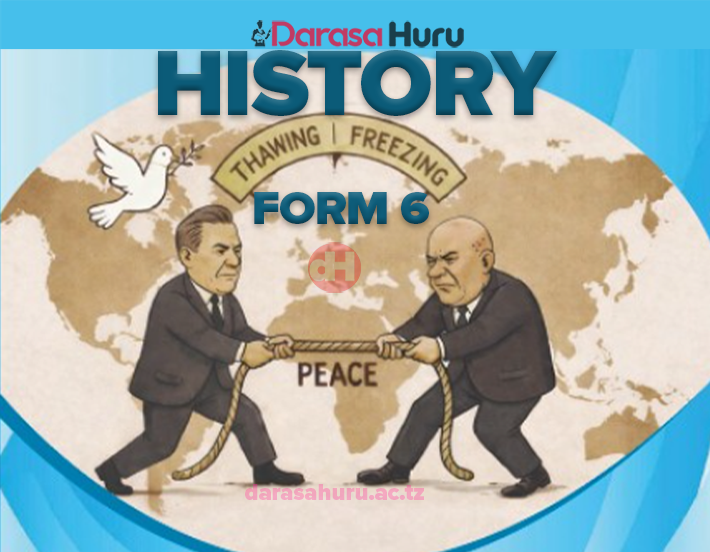
THAWING AND FREEZING OF TH COLD WAR.
The terms “thawing” and “freezing” of the Cold War refer to the changing levels of tension between the United States and the Soviet Union during the Cold War period (1947–1991). These phases show how relations sometimes improved (“thawed”) and sometimes became very hostile again (“froze”).
Freezing of the Cold War (Periods of High Tension)
The “freezing” refers to times when relations were extremely hostile and dangerous.
Key features:
1. Strong hostility between East and West
2. Arms race (especially nuclear weapons buildup)
3. Formation of military alliances: NATO (West), Warsaw Pact (East)
4. Direct and indirect conflicts (proxy wars)
5. Little or no communication between superpowers
Examples of freezing periods:
Berlin Blockade (1948–1949): first major crisis between the superpowers
Korean War (1950–1953): proxy war between communist and capitalist blocs
Cuban Missile Crisis (1962): closest point to nuclear war
Vietnam War (1955–1975): major Cold War conflict
THAWING OF THE COLD WAR (REDUCTION OF TENSIONS)
The “thawing” refers to periods when relations between the USA and USSR improved and tensions reduced.
Key features:
1. Improved diplomatic relations
2. Arms control agreements
3. Increased communication between leaders
4. Reduced risk of war
5. Cooperation in some areas
Major periods of thawing:
Khrushchev Thaw (1953–1964)
After Stalin’s death, Soviet leader Nikita Khrushchev relaxed some policies:
- Reduced repression inside the USSR
- Improved relations with the West temporarily
- Geneva Summit (1955) improved dialogue
However, tensions still existed (e.g., Berlin Crisis, Cuban Missile Crisis).
Détente (1970s)
This was the most important “thawing” period.
Features:
- Better relations between USA and USSR
- Arms control agreements like: SALT I (1972)
- Helsinki Accords (1975) promoting cooperation and human rights
- Cultural and scientific exchanges (e.g., Apollo–Soyuz mission)
This period significantly reduced Cold War tension.
Final Thaw (1985–1991)
Under Mikhail Gorbachev, relations improved greatly:
- Policies of glasnost (openness) and perestroika (reform)
- Withdrawal from Afghanistan
- Reduced control over Eastern Europe
- Fall of the Berlin Wall (1989)
- End of Cold War (1991)
CLICK HERE TO GET FULL NOTES PDF