BAM Scheme of Work Form Five (Basic Applied Mathematics)
BAM Scheme of Work Form Five (Basic Applied Mathematics) is a teacher’s planning document that shows how the Form Five Basic Applied Mathematics syllabus will be taught during a term or academic year. It organizes topics, learning activities, teaching methods, resources, assessments, and time allocation to ensure effective teaching and learning.
Components of a BAM Scheme of Work
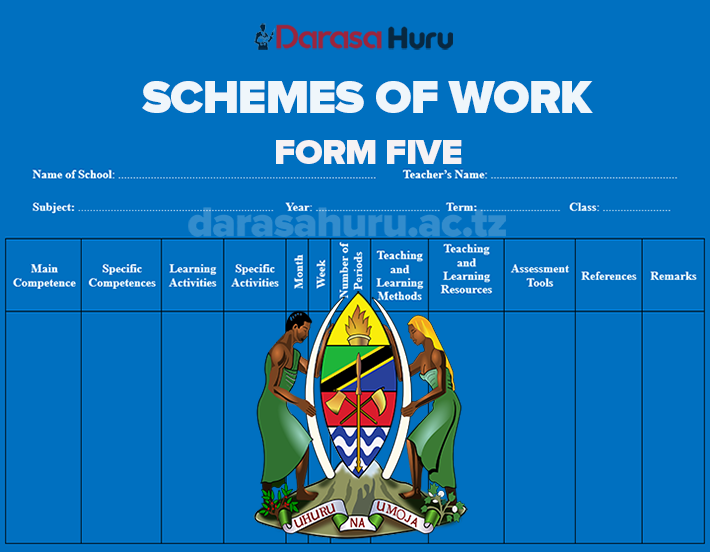
A typical Form Five BAM Scheme of Work contains:
- Competence
- Specific objectives
- Month and week
- Topic and subtopic
- Number of periods
- Teaching activities
- Learning activities
- Teaching and learning materials
- Assessment methods
- Remarks and evaluation records
Importance of BAM
- Develops logical and analytical thinking.
- Strengthens problem-solving abilities.
- Supports studies in science, business, economics, and related fields.
- Prepares students for further education and careers that require mathematical applications.
Purposes of the BAM Scheme of Work
- To guide teachers in teaching Basic Applied Mathematics systematically.
- To ensure all syllabus topics are covered within the school calendar.
- To help teachers prepare lessons, teaching materials, and assessments.
- To monitor students’ progress in acquiring mathematical knowledge and skills.
- To develop problem-solving and analytical abilities needed in science, business, and everyday life.
BAM SCHEME OF WORK FORM FIVE (BASIC APPLIED MATHEMATICS)
READ FULL SCHEME OF WORK
CLICK HERE TO GET SCHEME OF WORK