TOPIC 4 CHEMICAL REACTIONS – CHEMISTRY FORM TWO
Introduction
Chemical reactions are an integral part of daily life, constantly occurring in and around us, often unnoticed. For example, everyday activities such as burning charcoal and wood, cooking food, respiration in living organisms, fuel combustion in engines, rusting of metals, and digestion involve transforming substances into new ones.
These transformations result from chemical reactions. In this chapter, you will learn the concept of chemical reactions, including chemical equations, and types of chemical reactions. The competencies developed will enable you to accurately present chemical equations and analyse various chemical reactions that yield products essential to daily life.
Think: The impact of chemical reactions on natural and industrial processes
CONCEPT OF CHEMICAL REACTIONS
Task 1
Use library books and reliable online resources to search for any five chemical reactions that occur in daily life. For each response, include the name of the chemical reaction, a brief explanation of how it happens, the chemical equation (if applicable) and an example of where this reaction is frequently observed.
A chemical reaction is a process in which one or more chemical substances are converted to one or more different substances.
Chemical reactions take place when bonds between atoms in the reacting substance(s) are broken, atoms rearrange, and new bonds between the atoms are formed to make new substance(s).
The chemicals that begin the reaction process are called reactants and the new substances formed are called products.
The products have properties that are different from their respective reactants. Features that indicate a chemical reaction has taken place include one or more of the following: evolution of a gas; formation of precipitates; and change in colour, temperature or state.
A chemical reaction is either reversible or irreversible. A reversible reaction proceeds in both forward and backward directions.
In the forward reaction, the reactants are converted into products, whereas in the backward reaction, the products become the reactants. An irreversible reaction proceeds in one direction from reactants to products.
CHEMICAL EQUATIONS
Task 2
1. Use library books and reliable online resources to explore various molecular equations.
2. Use chemistry software step by step to represent the molecular equations identified in 1.
A chemical reaction is expressed in the form of a chemical equation. A chemical equation is a symbolic or words representation of a chemical reaction. A chemical equation written in words is referred to as a word equation. For example, when calcium metal reacts with chlorine gas to form solid calcium chloride, the word equation is written as:
Calcium + Chlorine gas⟶Calcium chloride
A chemical equation written in symbols is referred to as a formula equation. For example, the formula equation for a reaction between calcium metal and chlorine gas is:
Ca(s) + Cl2( g )⟶CaCl2( s )
The formula equation is more useful than the word equation. However, it is advantageous to write the equation in word form first. Formula equations provide useful information, including compositions, amounts, formulas, and the physical states of substances that are involved. Formula equations may also state the conditions for the reactions to take place.
The reactants and products in the formula equations are either solids, liquids or gases. These states of matter are represented in a chemical equation by using symbols, such as (s) for solid, (l) for liquid, and (g) for gas.
When the substances that are involved in a reaction are dissolved in water, the word aqueous (aq) is used. These symbols should be included when writing the chemical equations and are stated in parentheses ( ), after the chemical symbol.
In a chemical equation, a headed arrow is used to separate the reactants and products.
A full-headed arrow is used to separate reactants and products for an irreversible reaction.
For example:
Reactants⟶Products
Double half-headed arrows pointing in the opposite directions are used to separate reactants and products for a reversible reaction. For example:

The arrows show the direction of a reaction; thus, it means ‘produce’ or ‘yield’. Each individual substance is separated from the other by a plus sign (+). Note that the number of reactants and products are not necessarily the same.
A chemical equation has the following key characteristics:
(a) Reactants and products: It lists the substances involved in the reaction, with reactants on the left side and products on the right side.
(b) Chemical formulas: Each substance is represented using its chemical formula (for example H2O for water).
(c) Direction of reaction: An arrow points from the reactants to the products, indicating the direction of the reaction.
(d) Balanced equation: A chemical equation follows the law of conservation of mass, ensuring that the number of atoms for each element is the same on both sides of the equation.
(e) States of matter: The physical state of each substance is often indicated.
(f) Energy changes: If applicable, energy changes such as heat or light may be noted.
(g) Reaction conditions: Temperature, pressure or catalysts may be noted above or below the arrow.
Molecular equations
A molecular equation is an equation representing a reaction showing the reactants and products in undissociated form. In molecular equations, reactants and products are considered neutral regardless of their exact physical states. The following are examples of molecular equations:
PbO2(s)+SO2(g)⟶PbSO4(s)
2Na(s)+2H2O(l)⟶2NaOH(aq)+H2(g)
In principle, when writing molecular equations, the reactants and products should be balanced.
Balancing chemical equations
All chemical equations must be written in accordance with the law of conservation of mass. This law states that, in a chemical reaction, the total mass of the products equals the total mass of the reactants.
This means, when balancing a chemical equation, the number of each atom on both sides of the equation must be equal because atoms do not varnish during a reaction, but are reorganised.
The following steps are followed when writing and balancing simple chemical equations:
1. Write the equation in a word form.
2. Write the unbalanced equation including correct chemical formulas for reactants and products.
3. List the number of atoms of each element on both sides of the equation.
4. Balance one element at a time. Usually start with metals or more complex elements, and complete by balancing hydrogen and oxygen if present.
5. Use coefficients (whole numbers) to balance atoms. Never change subscripts in a chemical formula.
6. Count atoms of all elements on both sides to make sure they are equal.
7. Simplify coefficients if necessary. The final equation should use the smallest whole-number coefficients and should include the state symbols.
|
Example 1 |
Hydrogen chloride gas is formed when hydrogen gas burns in chlorine gas. Write a balanced chemical equation for the reaction.
Step 1: Write the equation in word form
Hydrogen gas+Chlorine gas⟶Hydrogen chloride gas
Step 2: Write the unbalanced chemical equation using symbols
The reactants are hydrogen gas (H2) and chlorine gas (Cl2), and the product is hydrogen chloride gas (HCl):
H2+Cl2⟶HCl
Step 3: List the number of atoms on both sides
Reactants (left side):
H2: 2 hydrogen atoms
Cl2: 2 chlorine atoms
Products (right side):
HCl: 1 hydrogen atom and 1 chlorine atom per molecule.
There are two hydrogen atoms and two chlorine atoms on the left but only one of each on the right.
Step 4: Balance the equation
The HCl molecule contains one hydrogen atom and one chlorine atom on the right side. Thus, two HCl molecules are required to balance for both hydrogen atoms and chlorine atoms on the left.
H2+Cl2⟶2HCl
Step 5: Verify the balancing
Count atoms of all elements on both sides to make sure they are equal.
Reactants (left side):
H2: 2 hydrogen atoms
Cl2: 2 chlorine atoms
Products (right side):
2HCl: 2 hydrogen atoms and 2 chlorine atoms.
Since the number of atoms is equal on both sides, the equation is balanced.
Steps 6: Write a balanced chemical equation
Write a balanced chemical equation with its state symbols.
H2(g)+Cl2(g)⟶2HCl(g)
| Example 2 |
Zinc dissolves in dilute hydrochloric acid to form zinc chloride solution and hydrogen gas. Write a balanced chemical equation for this reaction.
Step 1: Write the equation in word form
Zinc+Dilute hydrochloric acid⟶Zinc chloride+Hydrogen gas
Step 2: Write the unbalanced chemical equation using symbols
The reactants are zinc (Zn) and hydrochloric acid (HCl), and the products are zinc chloride (ZnCl2) and hydrogen gas (H2):
Zn+HCl⟶ZnCl2+H2
Step 3: List the number of atoms on both sides
Reactants (left side):
Zn: 1 zinc atom
HCl: 1 hydrogen atom and 1 chlorine atom per molecule
Products (right side):
ZnCl2: 1 zinc atom and 2 chlorine atoms
H2: 2 hydrogen atoms
There are two chlorine atoms in ZnCl2 but only one chlorine atom from HCl on the left. Also, there are two hydrogen atoms in H2 but only one hydrogen atom from HCl on the left.
Step 4: Balance the equation
To balance the equation, two HCl molecules are required to produce two chlorine atoms and two hydrogen atoms:
Zn+2HCl⟶ZnCl2+H2
Step 5: Verify the balancing
Count atoms of all the elements on both sides to make sure they are equal.
Reactants (left side):
Zn: 1 zinc atom
2HCl: 2 hydrogen atoms and 2 chlorine atoms
Products (right side):
ZnCl2: 1 zinc atom and 2 chlorine atoms
H2: 2 hydrogen atoms
Since the number of the atoms is equal on both sides, the equation is balanced.
Step 6: Write the balanced chemical equation with its state symbols
Zn(s)+2HCl(aq)⟶ZnCl2(aq)+H2(g)
Activity 1
Aim: To verify the law of conservation of matter (mass) and precipitation reaction
Requirements: Conical flasks, analytical balance, 100-mL measuring cylinders, 1 M barium chloride solution, and 1 M zinc sulfate solution
Procedure
1. Weigh the mass of two empty conical flasks and record the results.
2. Put about 50 cm3 of 1 M barium chloride solution in one of the flasks and another 50 cm3 of 1 M zinc sulfate in the second flask.
3. Weigh the flasks to get the mass of their solutions and flasks and record the results.
4. Pour the weighed solution of barium chloride into a flask containing zinc sulfate. Swirl the mixture.
5. Weigh the mixture after the reaction and record the results.
Questions
1. What is the total mass of the solutions before the reaction?
2. What is the mass of the mixture after the reaction?
3. What is the colour of the mixture after the reaction?
4. Write the balanced chemical equation for the reaction.
Ionic equations
An ionic equation is a chemical equation in which compounds in aqueous solutions or in molten state are written as dissociated ions. Ionic equations are commonly used in displacement reactions in aqueous solutions.
In these equations, spectator ions are omitted to give a net ionic equation. Spectator ions are the ions that do not change their valence states in the reaction since they remain unchanged in a chemical reaction.
The following steps are followed when writing an ionic equation:
1. Write the balanced chemical equation in symbols; ensure all formulas are correct.
2. Split all soluble ionic compounds into individual ions to get the total ionic equation.
Note:Insoluble ionic compounds, gases, and liquids should not be split into ions.
3. Cancel out ’spectator’ ions (ions that appear unchanged on both sides).
4. Write the net ionic equation.
| Example 3 |
Write a net ionic equation for the reaction between aqueous solutions of silver nitrate and calcium chloride.
Steps to write the net ionic equation
1. Write the balanced formula equation:
2AgNO3(aq)+CaCl2(aq)⟶2AgCl(s)+Ca(NO3)2(aq)
2. Write the complete ionic equation:
2Ag+(aq)+2NO3−(aq)+Ca2+(aq)+2Cl−(aq)⟶2AgCl(s)+Ca2+(aq)+2NO3−(aq)
3. Identify and remove spectator ions:
4. Write the net ionic equation:
2Ag+(aq)+2Cl−(aq)⟶2AgCl(s)
| Example 4 |
Write a net ionic equation for the reaction of barium chloride with sodium sulfate aqueous solutions.
Steps:
1. Write the balanced formula equation
BaCl2(aq)+Na2SO4(aq)⟶BaSO4(s)+2NaCl(aq)
2. Write the complete ionic equation:
Ba2+(aq)+2Cl−(aq)+2Na+(aq)+SO42−(aq)⟶BaSO4(s)+2Na+(aq)+2Cl−(aq)
3. Identify and remove spectator ions:
4. Write the net ionic equation:
Ba2+(aq)+SO42−(aq)⟶BaSO4(s)
| Example 5 |
Write a net ionic equation for the reaction between dilute hydrochloric acid and an aqueous sodium hydroxide.
Steps:
1. Write the balanced formula equation:
HCl(aq)+NaOH(aq)⟶NaCl(aq)+H2O(l)
2. Write the complete ionic equation:
H+(aq)+Cl−(aq)+Na+(aq)+OH−(aq)⟶Na+(aq)+Cl−(aq)+H2O(l)
3. Identify and remove spectator ions:
4. Write the net ionic equation:
H+(aq)+OH−(aq)⟶H2O(l)
EXERCISE 1
1. Balance the following chemical equations:
(a) Na(s)+Cl2(g)⟶NaCl(s)
(b) P(s)+O2(g)⟶P2O5(s)
(c) Zn(s)+CuSO4(aq)⟶ZnSO4(aq)+Cu(s)
(d) C(s)+CO2(g)⟶CO(g)
(e) CaCO3(s)+HCl(aq)⟶CaCl2(aq)+H2O(l)+CO2(g)
2. With reasons, state whether the following chemical equations are balanced:
(a) Na(s)+H2O(l)⟶NaOH(aq)+H2(g)
(b) CaCl2(aq)+AgNO3(aq)⟶AgCl(s)+Ca(No3)2(aq)
3. Balance each of the following chemical equations and write its net ionic equation:
(a) Na2CO3(aq)+HCl(aq)⟶NaCl(aq)+H2O(l)+CO2(g)
(b) H2SO4(aq)+KOH(aq)⟶K2SO4(aq)+H2O(l)
(c) Ca(s)+HCl(aq)⟶CaCl2(aq)+H2(g)
(d) Pb(NO3)2(aq)+Na2SO4(aq)⟶PbSO4(s)+NaNO3(aq)
TYPES OF CHEMICAL REACTIONS
Task 3
Use library books and reliable online resources to explore various chemical reactions which occur in everyday life, and classify each one based on its reaction type.
Chemical reactions drive numerous everyday processes, such as cooking, energy production, plant growth, and digestion. These reactions convert raw materials into essential products that support life and modern living. The following are the types of chemical reactions, along with their real-life applications.
Combination (synthesis) reactions
A combination reaction is a chemical reaction in which two or more chemical species combine to form a single product. Combination reactions are also referred to as synthesis reactions. This type of reaction is expressed in the form of:
A+B⟶AB
Generally, there are three types of combination reactions, namely a reaction between two or more elements, reaction between elements and compounds, and reaction between two compounds.
Combination reaction between two elements
This reaction occurs when two elements combine to give a single compound. An example of a combination reaction between two elements is when magnesium burns in air (oxygen) with a bright white flame to form white solids of magnesium oxide. Figure 4.1 shows the burning of magnesium in oxygen.
Magnesium+Oxygen gas⟶Magnesium oxide
2Mg(s)+O2(g)⟶2MgO(s)
Activity 2
Aim: To burn magnesium in oxygen
Requirements: A pair of tongs, heat source (Bunsen burner), gas jar, lighter, magnesium ribbon, oxygen source, and steel wool
Procedure
1. Clean about 0.1 g of a piece of magnesium ribbon by using steel wool.
2. Hold the ribbon by using a pair of tongs and heat it over a Bunsen burner or any heat source flame.
3. When it starts to burn, lower it into the gas jar of oxygen as shown in Figure 4.1. Do not drop it into the jar.

Magnesium burning in oxygen
Questions
1. What is the colour of flame when magnesium is burned?
2. What is the balanced chemical equation associated with this experiment?
Combination reaction between elements and compounds
This occurs when an element reacts with a compound to form another compound. For example, carbon monoxide gas reacts with oxygen gas to form carbon dioxide gas.
Carbon monoxide gas+Oxygen gas⟶Carbon dioxide gas
2CO(g)+O2(g)⟶2CO2(g)
Combination reaction between two compounds
Two compounds may react with each other to form a new compound. For example, calcium oxide (quicklime) reacts with carbon dioxide gas to form calcium carbonate (limestone).
Calcium oxide+Carbon dioxide gas⟶Calcium carbonate
CaO(s)+CO2(g)⟶CaCO3(s)
Another example of a combination reaction is the reaction between lead(IV) oxide and sulfur dioxide. If lead(IV) oxide is slightly heated and then lowered into a gas jar of sulfur dioxide, the two compounds combine to form one new compound, lead(II) sulfate.
Lead(IV) oxide+Sulphur dioxide gas⟶Lead (II) sulfate
PbO2(s)+SO2(g)⟶PbSO4(s)
Combination reactions play crucial roles in various biological, environmental, and industrial processes.
Some of these processes include:
(a) Formation of water:
Formation of water relates to the combination reaction whereby hydrogen and oxygen gases combine to form water as shown in the following reaction:
2H2(g)+O2(g)⟶2H2O(g)
(b) Rusting of iron
Rusting is a slow chemical process in which iron reacts with oxygen and water to form hydrated iron(III) oxide (rust). It is an example of a combination reaction and a type of corrosion that weakens iron objects over time. The chemical reaction for rusting is:
4Fe(s)+3O2(g)+6H2(l)⟶4Fe(OH)3(s)
The iron hydroxide (Fe(OH)3) further transforms to a more stable form, hydrated iron(III) oxide which is reddish-brown (rust).
4Fe(OH)3(s)⟶2Fe2O3 ∙ 6H2O(s)
Rusting is a major issue in construction, transportation, and machinery, leading to structural damage and economic losses.
(c) Formation of calcium hydroxide (slaked lime)
Calcium oxide (quick lime) reacts with water to form calcium hydroxide (slaked lime) an essential material in construction that is frequently used for setting cement and plaster. The reaction equation is:
CaO(s)+H2O(l)⟶Ca(OH)2(s)
(d) Photosynthesis
In plants, carbon dioxide gas combines with water in the presence of sunlight to form glucose and oxygen.
6CO2(g)+6H2O(l)→sunlightC6H12O6(s)+6O2(g)
(e) Formation (synthesis) of ammonia
In industry, ammonia gas is manufactured from a combination reaction between nitrogen and hydrogen gases as represented in the following reaction:
N2(g)+3H2(g)⟶2NH3(g)
Decomposition reactions
A decomposition reaction is a chemical reaction in which a compound breaks down (decomposes) into its components. This reaction can be expressed in the form of:
AB⟶A+B
The decomposition reaction is the opposite of a combination reaction. Generally, decomposition reactions are classified into three main types, namely catalytic, electrolytic and thermal reactions. In a catalytic decomposition reaction, an agent called a catalyst is introduced that alters the rate of a chemical reaction but remains unchanged at the end of the reaction. For example, potassium chlorate readily decomposes when heated in the presence of manganese(IV) oxide (catalyst) to produce oxygen gas and potassium chloride.
Potassium chlorate→heatMnO2Potassium chloride+Oxygen gas
2KClO3(s)→heatMnO22KCl(s)+3O2(g)
An electrolytic decomposition reaction is achieved by exposing an aqueous solution or molten compound to an electric current. An example of an electrolytic decomposition reaction is the electrolysis of water, which is represented by the following chemical equation:
2H2O(l)⟶2H2(g)+O2(g)
Thermal decomposition occurs when a compound is exposed to direct heat or radiation. For example, when lead(II) nitrate crystals are heated, they decompose with a cracking sound to produce lead(II) oxide, nitrogen dioxide gas, and oxygen gas.
Lead (II) nitrate→heatLead(II) oxide+Nitrogen dioxide gas+Oxygen gas
2Pb(NO3)2(s)→heat2PbO(s)+4NO2(g)+O2(g)
Some decomposition reactions are caused by light. For example, white silver chloride breaks down when exposed to light to give tiny black crystals of silver and chlorine gas.
Silver chloride→lightSilver+Chlorine gas
2AgCl(s)→light2Ag(s)+Cl2(g)
Decomposition reactions are common in daily life.
Some important processes that are related to decomposition reactions include:
(a) Digestion of food
This is a biological decomposition reaction in which Complex food molecules (carbohydrates, proteins, and fats) break down into simpler substances in the body through enzymatic reactions. The body absorbs and uses simpler substances for energy, growth, and repair. For example, starch in food is broken down into simple sugars by the amylase enzyme as shown in the following equation:
(C6H10O5)n+nH2O→amylasen(C6H12O6)
This reaction occurs in the stomach and intestines during digestion.
(b) Spoilage of food
Organic matters in food decompose over time because of activities of microorganisms such as bacteria and fungi, leading to decay and fermentation. For example, when milk spoils, lactose breaks down into lactic acid due to bacterial actions, resulting in a sour taste. The following equation shows its decomposition reaction.
C12H22O11(aq)+H2O(l)→bacteria4C3H6O3(aq)
(c) Thermal decomposition of limestone: In the cement industry, limestone (calcium carbonate) is heated to form lime (calcium oxide) and carbon dioxide as shown in the following reaction:
CCaCO3(2)⟶CaO(s)+CO2(g)
Combustion reactions
A combustion reaction is a chemical process in which a substance reacts with oxygen to produce heat and light. For example, burning of fuels such as wood, coal, diesel and petrol is a combustion reaction.
General formula: Fuel+O2(g)⟶CO2(g)+H2O(g)+Energy
Combustion reactions are essential for energy production, heating, and transportation, making them indispensable in everyday life. These reactions release energy by burning fuels or materials, driving many practical applications.
Some processes related to combustion reactions include:
(a) Burning of fuel
Burning fuel such as coal, oil, and natural gas is a combustion reaction, where hydrocarbons react with oxygen to produce carbon dioxide, water, and energy. For example, in the combustion of coal, carbon reacts with oxygen to form carbon dioxide and heat energy.
C(s)+O2(g)⟶CO2(g)+Energy
(b) Cooking with gas stoves using natural gas (methane): Methane reacts with oxygen to produce carbon dioxide, water and heat energy. Its combustion reaction equation is:
CH4(g)+2O2(g)⟶CO2(g)+2H2O(l)+Energy
The energy released heats the food during cooking.
(c) Candle burning
When a candle burns, the wax, usually made of paraffin (a hydrocarbon), reacts with oxygen from the air, resulting in the production of carbon dioxide, water, and heat.
(d) Respiration in living organisms: Cellular respiration is a slow combustion reaction where glucose reacts with oxygen to release energy needed for body functions.
C6H12O6(aq)+6O2(g)⟶6CO2(g)+6H2O(l)+Energy
Displacement reactions
A displacement reaction is a chemical reaction in which a more reactive element displaces a less reactive element from its compound (Appendix 3). This reaction is expressed in the general form as:
A+BC⟶AC+B
Two reactants yield two different products. For example, when zinc reacts with hydrochloric acid, it displaces hydrogen to produce zinc chloride and hydrogen gas.
Zinc+Hydrochloric acid⟶Zinc chloride+Hydrogen gas
Zn(s)+2HCl(aq)⟶ZnCl2(aq)+H2(g)
Another example of a displacement reaction is when solid iron reacts with copper(II) sulfate. In this reaction, iron displaces copper from copper(II) sulfate.
Iron+Copper (II) sulfate⟶Iron (II) sulfate+Copper
Fe(s)+CuSO4(aq)⟶FeSO4(aq)+Cu(s)
Displacement reactions have various practical applications in real life across different industries and fields.
Here are a few examples:
(a) Extraction of metals
More reactive metals displace less reactive metals from their compounds. For example, iron is extracted from its ore (iron(III) oxide) using aluminium:
F2O3(s)+2Al(s)⟶2Fe(s)+Al2O3(s)
This is a highly exothermic reaction and is used in welding, like in railway tracks.
(b) Purification of metals
Less reactive metals are displaced from their solutions by more reactive metals. For example, impure silver is purified by displacing it with a more reactive metal, such as copper.
Cu(s)+2AgNO3(aq)⟶2Ag(s)+Cu(NO3)2(aq)
(c) Rust prevention
In rust prevention treatments, displacement reactions are involved through a principle called sacrificial protection. A more reactive metal like zinc is coated onto iron or steel. When both are exposed to air and moisture, zinc reacts (oxidises) first, sacrificing itself to protect the iron from rust. During the process, zinc acts as a sacrificial anode, forming a protective layer of zinc. This is called galvanisation.
(d) Treatment of wastewater
Metals like aluminium or zinc displace harmful substances or ions from wastewater. For example, zinc is used to remove copper ions from industrial waste solutions.
Zn(s)+Cu2+(aq)⟶Zn2+(aq)+Cu(s)
The copper metal is easily recovered as solids from wastewater.
Precipitation reactions
A precipitation reaction is a chemical reaction in which two soluble substances (typically in aqueous solution) combine to give a soluble substance and an insoluble substance known as a precipitate. This reaction is expressed in the general form of:
AB(aq)+CD(aq)⟶AD(s)+CB(aq)
This type of reaction is also referred to as a double displacement reaction. An example of a precipitation reaction is the reaction between an aqueous solution of silver nitrate and an aqueous solution of sodium chloride to form white precipitates of silver chloride.
Silver nitrate+Sodium chloride⟶Silver chloride+Sodium nitrate
AgNO3(aq)+NaCl(aq)⟶AgCl(s)+NaNo3(s)
Another example is when an aqueous solution of sodium sulfate is mixed with an aqueous solution of barium chloride to form solid barium sulfate.
Na2SO4(aq)+BaCl2(aq)⟶BaSO4(s)+2NaCl(aq)
Precipitation reactions are common in various everyday activities.
Some of the activities that relate to precipitation reactions include:
(a) Formation of soap scum
When soap is used in hard water (which contains calcium and magnesium ions), it reacts with these ions to form insoluble soap scum.
(b) Curdling of milk
When lemon juice or vinegar (acid) is added to milk, the casein proteins in the milk precipitate out, causing it to curdle.
(c) Rainwater formation
In cloud seeding, silver iodide (AgI) is introduced into clouds, where it reacts with water droplets to form solid ice crystals, leading to rainfall.
(d) Treating wastewater
In water treatment, chemicals like aluminium sulfate Al2(SO4)3 and lime Ca(OH)2 are added to wastewater to precipitate out harmful substances.
(e) Formation of kidney stones (calcium oxalate crystals)
In some individuals, excess calcium and oxalate in the urine combine to form calcium oxalate precipitates, which develop into kidney stones.
Redox reactions
A redox reaction is a chemical reaction in which the oxidation number or oxidation state of the participating chemical species changes by losing or gaining one or more electron(s). Redox is a short form for reduction-oxidation reaction. Redox reactions are common and important to some of the basic functions of life including photosynthesis, respiration, combustion, bleaching, digestion, and corrosion or rusting. In a redox reaction, oxidation and reduction reactions occur simultaneously.
A chemical reaction is said to be an oxidation reaction when its reacting substance combines with oxygen, or hydrogen is removed from it. It can also be a loss of electrons from that substance, or increase in oxidation state of that substance. On the other hand, a chemical reaction is said to be a reduction reaction when its reacting substance combines with hydrogen, or when oxygen is removed from that substance. It can also be a gain of electron(s) leading to the decrease in the oxidation state of that substance.
Oxidation and reduction reactions are opposite types of reactions. During a redox reaction, if one substance is oxidised by either gaining oxygen, losing hydrogen or losing one or more electrons, another substance must at the same time be reduced by losing oxygen, gaining hydrogen or gaining one or more electrons. For example, when copper(II) oxide is heated in hydrogen gas, it is reduced to copper metal, while the hydrogen gas is oxidised to water. In this reaction, copper(II) oxide gets reduced because hydrogen takes away the oxygen. Hydrogen is thus a reducing agent. Hydrogen gas gets oxidised because copper(II) oxide gives out its oxygen to it, thus copper(II) oxide is an oxidising agent.
Copper(II) oxide+Hydrogen gas→heatCopper+Steam

Another example of a redox reaction is when iron metal is heated in chlorine gas to form iron(III) chloride.
2Fe(s)+3Cl2(g)⟶2FeCl3(s)
In this reaction, iron metal is oxidised, while chlorine gas is reduced.
Fe(s)⟶Fe3+(aq)+3e−
Cl2(g)+2e−⟶2Cl−(aq)
Iron is the reducing agent since it loses electrons to chlorine atoms. Chlorine gas is the oxidising agent since it accepts or gains electrons from iron.
Neutralisation reaction
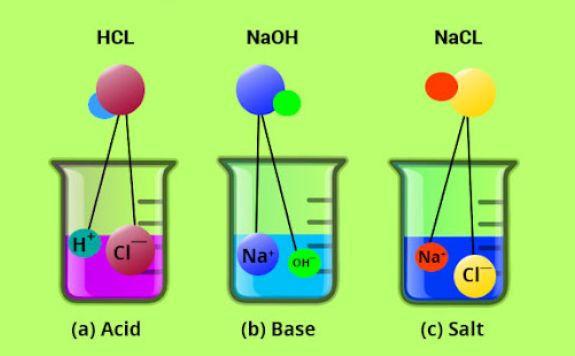
A neutralisation reaction is chemical reaction between an acid and a base to give salt and water as the products. For example
HCl(aq)+NaOh(aq)⟶NaCl(aq)+H2O(l)
Neutralisation reactions are common in everyday life, particularly in personal care, medicine and agriculture. For example, toothpaste neutralises acid produced by bacteria in the mouth. Antacids neutralise stomach acid.
EXERCISE 2
1. Differentiate oxidation from reduction in terms of electron transfer and changes in oxidation states.
2. Write a balanced chemical equation for each of the following reactions:
(a) Zinc reacts with silver nitrate solution to produce zinc nitrate and silver.
(b) Aqueous potassium iodide reacts with aqueous solution of lead(II) nitrate to produce potassium nitrate and lead(II) iodide.
3. Identify the type of reaction in each of the following chemical equations: Explain your answer.
(a) CuCO3(s)⟶CuO(s)+CO2(g)
(b) CaO(s)+H2O(l)⟶Ca(OH)2(aq)
(c) Zn(s)+CuSO4(aq)⟶ZnSO4(aq)+Cu(s)
(d) Zn(NO3)2(aq)+2NaOH(aq)⟶Zn(OH)2(s)+2NaNO3(aq)
4. A student mixed lead metal with a solution of magnesium chloride but observed no reaction. However, when magnesium metal was added to lead(II) nitrate solution, a reaction occurred. Explain why one reaction occurred while the other did not.
5. The school laboratory has solutions of barium chloride (BaCl2), sodium sulfate (Na2SO4), and potassium nitrate (KNO3).
(a) Which pair of solutions will produce precipitates when mixed?
(b) Describe a simple experiment to confirm the presence of a precipitate.
6. Explain how corrosion is related to redox reactions. Suggest one way of preventing iron from rusting.
Chapter summary
1. Chemical equations are short forms of chemical reactions. The reactants are placed on the left hand side of the equation, while the products are placed on the right hand side of the equation.
2. Chemical equations are written by using the chemical symbols or formulas. The state of each of the reactants and products is indicated in parentheses and the equations are balanced.
3. An ionic equation is a chemical equation in which compounds in aqueous solutions or in molten states are written in terms of dissociated ions.
4. Spectator ions are ions that do not change their valence states in a reaction.
5. The net ionic equation is the result of an ionic equation without the spectator ions.
6. There are different types of chemical reactions. These include combination, decomposition, displacement, precipitation, neutralisation and redox reactions.
Revision exercise
Choose the correct answer for Questions 1−5. For other questions, provide the answers as per the demands indicated.
1. Which of the following statements describes chemical reactions?
(a) Occur only in living organisms.
(b) Occur in water only.
(c) Produce new substances.
(d) Only occur outside living organisms.
2. A certain metal hydroxide reacts with hydrochloric acid to produce salt and water only. What type of reaction is this?
(a) Precipitation
(b) Displacement
(c) Neutralisation
(d) Combination
3. Which of the following is false regarding the decomposition of a simple binary compound?
(a) The products are uncertain.
(b) The elements of the compound become the products.
(c) The reactant is a single substance.
(d) Can have either an ionic or a molecular compound as the reactant.
4. The following processes are applications of neutralisation reactions, except?
(a) Rubbing baking powder on the bee sting.
(b) Adding quicklime in the acidic soil.
(c) Applying vaseline to the burn wound.
(d) Brushing teeth with toothpaste.
5. Why is it important to understand chemical equations in cooking?
(a) To balance the temperature of the ingredients.
(b) Chemical reactions prevent food overcooking.
(c) It helps measure cooking time accurately.
(d) To understand how ingredients behave when heated.
6. Analyse the following types of chemical reactions by writing simple balanced chemical equations and explaining at least three real-life applications:
(a) Combination
(b) Decomposition
(c) Displacement
(d) Precipitation
(e) Redox
7. Write the word equation for each of the following reactions:
(a) Burning calcium in oxygen gas.
(b) Dissolving zinc in dilute sulfuric acid.
(c) Reacting sodium with water.
8. Balance each of the following chemical equations that involve acids and hypothetical compounds:
(a) MCO3(s)+HCl(aq)⟶MCl2(aq)+H2O(l)+CO2(g)
(b) MOH(aq)+H2SO4(aq)⟶M2SO4(aq)+H2O(l)
(c) MO(s)+HCl(aq)⟶MCl2(aq)+H2O(l)
9. Complete and balance each of the following chemical equations:
(a) Zn(s)+Cl2(g)⟶
(b) Fe(s)+O2(g)⟶
(c) MgCl2(aq)+AgNO3(aq)⟶
10. Write the net ionic equation for the reaction between hydrochloric acid and potassium hydroxide solutions.
11. (a) Differentiate between ionic equations and molecular equations and provide their significance in reaction analysis.
(b) Compare total ionic equations and net ionic equations, illustrating their importance in predicting reaction outcomes and identifying spectator ions in chemical processes.
12. Study the following chemical equation of a reaction and answer the questions that follow.
3KOH(aq)+FeCl3(aq)⟶3KCl(aq)+Fe(OH)3(s)
(a) What type of the reaction is represented by the chemical equation?
(b) Write a net ionic equation for the chemical reaction.
13. Explain the uses of balanced chemical equations in improving efficiency, safety, and cost-effectiveness in chemical manufacturing industries.
14. Describe the effect of heat on the decomposition of the following compounds and represent these reactions using balanced chemical equations:
(a) Iron(II) sulfate
(b) Calcium hydrogencarbonate
(c) Ammonium nitrate
(d) Copper(II) carbonate
15. Why combustion reactions are considered exothermic? Use an example to support your explanation.
16. A student placed a strip of zinc metal in copper(II) sulfate solution. After a while, the blue colour of the solution faded, and a reddish-brown deposit formed on the zinc strip.
(a) Explain the observations made and identify the type of reaction that occurred.
(b) What would happen if a silver plate replaced zinc in the same solution?
17. A farmer wants to remove calcium ions from hard water using a precipitation reaction.
(a) Suggest the chemicals that can be added to precipitate calcium ions.
(b) Write the balanced chemical equations for the reactions involved.
TOPIC 4 CHEMICAL REACTIONS – CHEMISTRY FORM TWO
CLICK HERE TO GET PDF NOTES