CHAPTER 1 ACTING – ARTS AND SPORTS STD 5
Acting is a powerful tool in the performing arts, capable of conveying important messages to audiences for the purpose of inspiring change in society.
In this chapter, you will learn about the concept of drama and acting, and types of acting.
The competencies developed will enable you to act skillfully while following the principles of acting.
Concept of drama and acting
What is dram?
Is type of performing art that aims to convey a message to a live audience.
There are two types of drama performed on stage
- Written scripts
- Improvised drama
The scripted dram differs from improvised drama because it requires long time to study and memorise the lines; while improvised drama depends on creativity of the actors
What is acting?
Is a way of conveying a message to the audience through actions and word
The main performers are human beings who use their bodies and voices in a play to convey the message to the audience in a way that is engaging and easy to understand.
Performers are required to be creative in various areas, including
1. Using the body and voice creatively and skillfully
2. Learn the audience and create the message according to their culture interests and needs
3. Selecting costumes that are in line with the theme and
4. Preparing a performance space that aligns with the theme
TYPES OF ACTING
There are various types of acting such as
- Acting with actions and voice
- Mime
- Image theatre and dance-drama
I. ACTING WITH ACTIONS AND VOICE
This is a type of acting that involves the use of words and actions to convey a message to the audience.
A successful performance relies on the actor’s ability to balance actions and voice

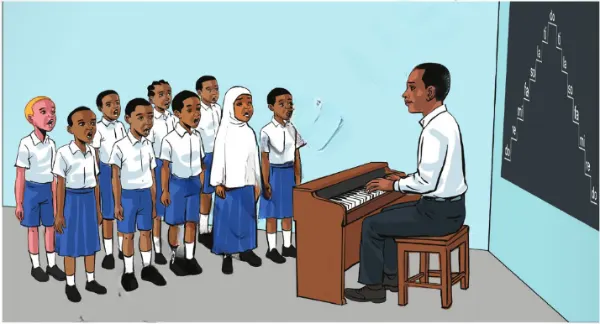
pupils performing on a stage
ASPECTS TO CONSIDER WHEN ACTING WITH ACTIONS AND VOICE
Acting that involves both actions and voice requires careful attention and thorough preparation.
The following are some important aspects to consider in this type of acting
1. Understanding the character, you are portraying
It is essential to understand the character’s personality, background and goals. Additionally, develop an awareness of the character’s emotions in each scene and how they can be expressed through actions and voice. It is important to know how the character walks, speaks and struggles to achieve their objectives.
2. Mastering the use of body language
Ensure that your body movements match the emotions you are intending to portray. Your movements must be purposeful. Avoid unnecessary movements on stage. Use your hands and facial expressions to convey different emotions such as happiness, sadness, surprise, or anger, rather than relying on words only.
3. Proper use of voice
To perform effectively on stage, control your voice by adjusting tone, speed and volume according to the context in reflecting the character’s emotions. Ensure that your voice and pronunciation are clear and audible to the audience.
4. Be realistic in acting
Make sure you portray the character you are acting realistically. Avoid repetitive habits or uses of the same emotions in each scene.
5. Collaborating with other actors
Make sure that you listen and respond appropriately to the conversation initiated by your fellow performers during rehearsals. Make an attempt of maintaining good communication with them as you perform on stage in front of the audience.
6. Manage the stage
To perform well on stage, make sure you are confident and seen by your audience. Learn to manage the stage.
Do not stay in one area for the entire time of your performance on stage. Engage the audience through your creative use of body and voice while acting.
7. Practice regularly to improve your voice and appearance on stage
Develop a habit of improving your acting skills. Read scripts of plays or watch films that showcase stage performances and imitate the characters using your gestures and voice.
8. Balance your voice and actions
The actor should make sure that the voice and actions match. For example, a performer portraying sadness should not use a strong voice or show signs of excitement while on stage.
Activity
In a group of not more than ten people, act out the following scene by using actions and voice while applying the principles you have learned


Activity
1. Choose a theme such as gender equality, the importance of education, globalization, sustainable development, or the environment. Then, create an improvised dram with at least five characters. Rehearse and act the dram at school by adhering to principles of acting
2. Discus the benefits and challenges of performing an improvised drama
II. MIME
It is a form of performing arts in which performers use actions without words to convey a message to the audience
It is a powerful type of acting that relies entirely on body language, such as postures and facial expressions to convey message without using words.
The origin of mime can be traced back to early human history when the first human began to struggle with their lives.
They used body language to communicate at a time when spoken language had not yet been discovered.
For this reason, body language is considered an ancient form of communication that human beings used in the earliest stages of interaction as a form of performing arts, mime became popular in the 20th century.
It was widely used in theatre and become a key element in early films, before the invention of sound technology. This early silent film relied completely on the actor’s ability to express themselves through mime to tell stories and engage viewers emotionally.
Despite the advancements of technology and the development of sound in media, mime continues to hold an important place in both film and theatre. It is still used today in stage performances, movies and other forms of artistic expression.
Mime also goes beyond the stage. People use gestures and body language in everyday situations to communicate when words are not available or necessary

The pupils performing a mime on stage
KEY ELEMENTS OF MIME
Mime depends on the body to convey messages. This means performers must develop skills to use their body parts to communicate with the audience without relying on words.
This type of acting incorporates key elements such as
1. Body movements
2. Music
3. Emotions
4. Facial expressions
5. Symbols
6. Sound effects and
7. Pantomime to convey a message
Examples of pantomimic movements include closing an imaginary door or holding an imaginary cup.
All pantomime performances are accompanied by music or narration. These terms are very important in the field of acting.
Therefore, building an understanding of their meanings and uses is crucial for the success of this type of acting.
The terms are key factors to consider when performers use mime to convey a message to the audience
IMPORTANT THINGS TO CONSIDER IN MIME
There are several important aspects to consider in mime, including
1. Body movements.
The body is the primary tool in mime. It is used to express thoughts and emotions using the body to reflect the intended message to the audience through the character you are portraying.
2. Express emotions
Use your body to express the emotions of your character, such as confidence, sadness, anxiety, or joy. For example, you might jump or laugh to show great happiness.
3. Communication through facial expressions
The face is an important part of showing various emotions because it has many muscles that can be used to express different emotions such as happiness, sadness, anger, fear or surprise. Ensure that the facial expressions you display are clear and easily visible to the audience.
4. Pantomime
Make sure actions involving invisible objects are realistic by considering their size, weight, and direction. This includes using body movements, posture, and gestures when interacting with imaginary objects, such as opening a door, carrying a heavy load, or holding a light ball.
5. Coordination of movements
Ensure that the pace of your acting movements matches the scene’s context. For example, if you act as if you are climbing a steep mountain, do not walk at a normal pace as if you are on flat ground.
6. Audience engagement
Maintain eye contact with the audience to keep them involved in the performance. Body postures and positioning in facing the audience are the main tools that will help you ensure your audience is watching and following the performance. Develop the skill to communicate with your audience using your eyes.
7. Organisation and flow of the performance
Ensure the performance has a smooth and logical flow from beginning to end. The sequence should be easy to follow, even without sound or words.
8. Regular exercise and flexibility
Mime requires physical strength and flexibility. Regular stage exercises can help improve body movements and performance.
9. Use of music and sound effects
In mime, music and sound effects can be used to enhance emotions and guide the story. They help the audience understand the scene more effectively.
IMPORTANCE OF MIME
i. Promoting the traditions and customs of the nation both locally and internationally
ii. Helping actors and other understand how to use their bodies to convey messages effectively
iii. Fostering creativity as it requires significant creativity to express emotions and events through body movements and gestures
iv. Serving as a teaching tool, especially for children and people with hearing impairments
v. Entertaining as is unique and captivating form of performing art;
vi. Touching deeply the emotions of the audience because it compels people to understand the message by observing gestures and movements only and
vii. Developing acting talent in mime, whereas actors learn to channel their emotions without relying on words. This makes them better performers in other forms of acting
CHALLENGES OF MIME
Although it is very important form of acting, mime faces several challenges, including
1. It is difficult for actors to convey a message to the audience if they do not have sufficient skill
2. Mime requires a long time of practice and rehearsal to convey a message to the audience
3. Limited understanding of the audience, as not everyone has the ability to interpret performances that do not use words to convey the message, making some messages not easily understood.
Despite these challenges, mime as a form of acting remains an important art form that requires patience, creativity and dedication to make it more engaging and effective
Exercise
- Why is voice an important element in acting, and how does it contribute to expressing a character’s emotions?
- What are the main techniques used in mime to convey emotions and themes?
Vocabulary ON CHAPTER 1 ACTING – ARTS AND SPORTS STD 5
Dance acting: A type of performance where the intended message is conveyed to the audience through dance movements
Facial expression: Emotions that are expressed using the face
Image theatre: A type of acting where the performer remains still, does not speak, and does not use their voice
Movement: The manner of leaving or the way of going
Pantomime: A form of theatrical performance that conveys a story or message using only gestures, facial expressions, and body movements, without spoken words
Play: A theatrical performance acted by a group of people, reflecting real-life situations in society