EARLY CONTACTS BETWEEN AFRICA AND EUROPE
Before the colonialism in the 19th century Africans had contact with some countries from Europe, some of them are like, particularly the Portuguese, the Dutch and the
British.
EARLY CONTACT BETWEEN AFRICANS AND THE PORTUGUESE 1500 – 1700 A.D
The Portuguese were the first Europeans to have contacts with the people of African, from 15th century up to 17th century. Their contacts were preceded by the sailors
who visited African coasts as they searched for the sea route to India. The explorers’ search for a sea route to India was supported by PRINCE HENRY THE NAVIGATOR, the son of KING JOHN of Portugal. Prince Henry the Navigator
financed the early Portuguese journeys because they were intended to benefit Portuguese traders and the government.
Initially, in 1470 the Portuguese visited and established relations with West African coastal societies. They established a number of trading centers along the West African coast; one of them was Sao Jorge Elmina in Ghana (Gold coast) where they built ELMINA CASTLE a fort which was important for trade in gold between Africa and Europe also the fort was used for protection.
Later they established relations with some societies in southern and eastern Africa. For example, in 1483 Portuguese explorer Diogo Cao reached the coast of Kongo kingdom and took Kongo nobles to Portugal who remained in Europe for four years studying Christianity learning reading and writing.
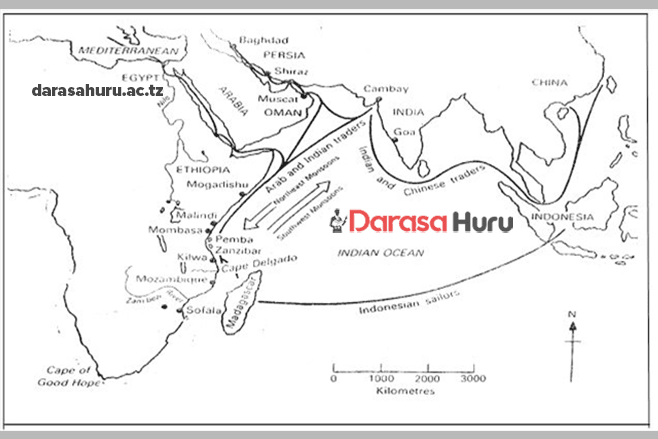
In 1488 Bathromew Diaz was the first Portuguese to sail around the Cape of Good Hope, thus proving that there was a way round South Africa to the Indian Ocean. With this information In 1498, the Portuguese under Vasco da Gama reached the East African coast especially in Kilwa and Mozambique and one year later in 1499 he reached in India, on his journey back from India Vasco da Gama stopped at Malind before he sailed down the coast to Europe.
After Vasco da Gama had discovered the sea route to India, the Portuguese began to establish their control in East Africa and the Far East. The Portuguese conquest of East Africa was led by Francisco D’ Almeida in 1505. They started by conquering Sofala and started to rule Mozambique in 1507. From Sofala they moved northwards and conquered Kilwa.
The fall of Kilwa was followed by the fall of Zanzibar, Pemba, Malindi and Mombasa. In all these areas, the Portuguese established military forts/ garrisons for example FORT JESUS which was the headquarters of the Portuguese in East Africa was built in Mombasa in 1595,. The forts were used as military barracks to protect Portuguese commercial ships, trade routes and sailors. They were also used to store trade goods, especially ivory and gold.
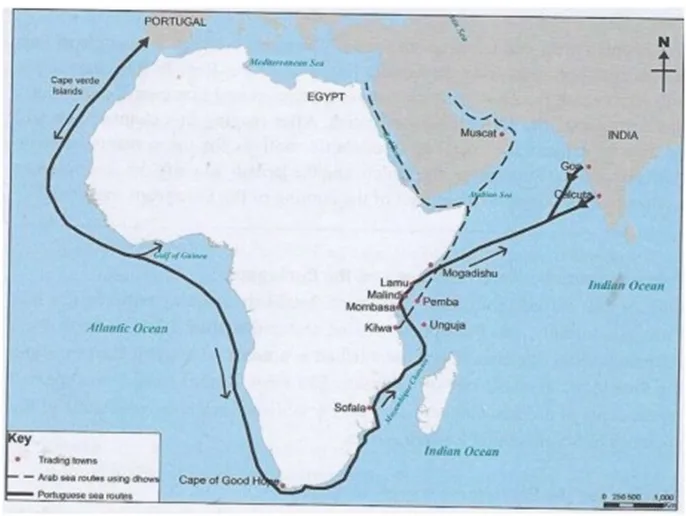
Portuguese sea routes and areas of control on the East African coast from to 17th century
WHY THE PORTUGUESE DEFEATED THE EAST AFRICAN COASTAL TOWNS,/REASONS FOR THE SUCCESS OF THE PORTUGUESE IN EAST AFRICAS
i. They had well trained soldiers with superior skills of fighting compared to the coastal people who had no permanent organized army e.g. Vasco da Gama, Francisco D’Almeida were ruthless army commanders which helped them to defeat the coastal people.
ii. The Portuguese had superior weapons e.g. common guns which made terrible noise and threw people in panic as compared to the poor musket guns of the coastal Arabs.
iii. They had better and faster ships (carracks) well equipped for naval warfare. The Portuguese soldiers wore Armor on their bodies and helmets on their heads, which protected them from the weapons of the coastal people.
iv. The coastal towns were disunited which gave chance to the Portuguese to fight isolated enemies e.g. there was traditional hostility between Mombasa and Malindi since Vasco da Gama was turned away by Mombasa, MalindI welcomed him wormy and supported the Portuguese to defeat Mombasa.
v. Some coastal towns like Kilwa were caught unaware. The Portuguese employed cruel methods of fighting like burning down towns and surprise attacks.
vi. The Portuguese were well informed about the nature of Arabs at the coast e.g. Vasco da Gama had visited the coast and he advocated for the use of force to defeat the Arabs
vii. The Portuguese controlled harbors which they used as bases for their soldiers and ships, Fort jesus for example was so built in Mombasa for defense.
viii. The Portuguese soldiers were financially supported by their home government and the rich Portuguese merchant and therefore they had enough food, ships and weapons
ix. The Portuguese used the divide and rule policy to ensure that the coastal people would lose e.g. the Portuguese allied with Malindi to fight against Mombasa
x. Some coastal states were further weakened by famine and diseases, attacks and slave trade which reduced their population, therefore could not put up any resistance against the Portuguese, The constant attacks on the coastal towns by the Galla, Zimba and Turkish e.t.c had weakened their defense.
THE MOTIVES FOR THE CONTACT BETWEEN EAST AFRICA AND THE PORTUGUESE
The motives for the contact can be categorized as economic and social motives
Economic motives for the contact between East Africa and the Portuguese
Finding the sea route to India
In the 15th century Otto man (Turks) had occupied a large part of the middle east blocking the overland trade route between Europe and India, therefore Europeans could not get much valued silk, spice and gold from Asia, the Portuguese came to Africa as they attempted to find a sea route through which they could trade with Indians.
Trade
The Portuguese wanted to trade with Africans to replace the Arab middlemen who took African goods like ivory, gold, and gum from Africa and sold them profitably in Europe, the Portuguese wanted to conduct trade in east Africa in order to strengthen their economy in the 15th c.
Establishment of strategic forts
The Portuguese wanted to establish forts along the east African cost that could serve as stop over points for the Portuguese ship and sailors while on their way to and from India. Their trading ships could therefore be repaired and refilled with fresh water and food supplies at the stations located along the East African coast.
The need to establish commercial empire
This was for the aim of getting the products of east Africa like ivory copper, gold etc, which were controlled by the Arabs merchants, to achieve this, the Portuguese had to overcome the Arabs traders who dominated the trade.
Exploitation of African’s wealth
Portugal was a poor country, the Portuguese were in search of resources that could bring them wealth and recognition in Europe, for example they discovered the gold mines of Akan in west Africa and exported the gold to Europe.
The Portuguese wanted to acquire land for agriculture. The Portuguese started plantations which produced pineapples and cassava.
Social motives for the contact between East Africa and the Portuguese
Adventure
Some Portuguese explorers visited Africa in search of adventure, through their advanced ship building and navigation skills enabled them to travel everywhere in search of new land to explore, Prince Henry the Navigator financed the early Portuguese journeys because they were intended to benefit Portuguese traders and the government
Search for the king Prester john
The Portuguese wanted to find Prester john whose kingdom was believed to be somewhere in Ethiopia in north east Africa, the Portuguese wanted to find this king and find alliance with him against the Muslims.
Spreading Christianity
The Portuguese wanted to revenge on the Muslim Arabs who had conquered Portugal in 711AD and changed many of the Portuguese into Islam. From 1085 the portug8uese succeeded to chase out the Arabs later they had to establish contact with the African coast in order to spread Christianity by converting the people of east Africa to Christianity and stopping the spread of Islam
EFFECTS OF PORTUGUESE RULE IN EAST AFRICA
The Portuguese controlled the East African coast for two hundred years, from around 1500 up to 1700. During this period, their control had a number of economic, political and social effects on the East African coast
ECONOMIC IMPACTS
Change of direction of the major trade routes
The trade routes which existed between East Africa and the Middle East and the Far East changed in terms of direction.
During Portuguese rule, the trade routes were directed towards Europe through the Atlantic Ocean. This happened because of the sailing permits which the Portuguese had imposed on the Arab and Indian traders. Therefore, only a few ships continued to sail from East Africa to the Far East and the Middle East.
Occurrence of conflicts between African gold miners and the Portuguese
These conflicts occurred because the Portuguese wanted to control the trade centres. For example, the conflicts led to the fall of the trade centres which prospered in Kilwa, Bagamoyo, Sofala and Lamu before the coming of the Portuguese.
Introduction of new crops
New crops such as cassava, groundnuts, guavas, pineapples, maize, tobacco and pawpaws were introduced into East Africa by the Portuguese. Some of these crops, including maize and cassava, became the staple food crops among African societies.
Destruction of property
Many kinds of valuable property were looted and peoples’ houses were destroyed by the Portuguese soldiers in Mombasa, Zanzibar,
Kilwa and other places along the East African coast.
Exploitation of East African resources
East African natural resources such as gold, ivory, animal skins and hides were extracted and exported to Europe in return for much less valuable goods such as wine. In addition, slave trade developed in some of the places where the Portuguese settled. Slaves were taken to Europe and the Americas.
Decline of local industries
This was due to the importation of manufactured goods from Portugal which destroyed the market of traditional goods, Decline of Indian Ocean trade, the control of Indian Ocean trade shifted from being under the Arabs to the Portuguese, the Portuguese took over trade in gold at Sofala and Kilwa, due to absence of peace along the coast caused by the Portuguese rule Indian ocean trade declined.
The Portuguese improved on farming by encouraging the use of cow dung as manure.
SOOCIAL IMPACTS
Building of forts To defend themselves against their enemies
The Portuguese built forts and garrisons on the East African coast. The important forts were Kilwa Fort, which was built in 1505 in present-day Tanzania, and Fort Jesus, which was built from 1592-1596 in Mombasa, Kenya. Fort Jesus was captured by some Oman Arabs in 1698. The remains of this building serve as a tourist attraction and as an important source of knowledge and pleasure for historians and other people.
Decline and fall of coastal city states
Most of the coastal city states which flourished before the arrival of the Portuguese in East Africa fell during this period. Examples of such city states were Kilwa and Sofala.
Occurrence of wars
Portuguese contact with East Africa involved wars of conquest and resistance. These wars claimed many lives of Africans, Arabs and even of some of the Portuguese.
Development of Swahili language
This was because some of the Portuguese words were incorporated into the Swahili language, for example
It led to the development of relationship between east Africa and India
The Portuguese also provided strong links between East Africa and India because their main headquarters were in India (GOA)
The Portuguese presence at the coast also opened up East Africa to other
European countries e.g. Britain, France, and Holland. These European countries started to compete against the Portuguese for the control of east Africa.
Spread of Christianity
The Portuguese introduced Christianity although it failed to take root at the coast because most people hated the Portuguese
Increase of poverty
The Portuguese rule resulted into widespread poverty at the coast because they introduced heavy taxes which made the coasted people poor
THE DECLINE OF THE PORTUGUESE RULE AT THE COAST OF EAST AFRICA
The Portuguese rule at the coast of East Africa was marked by frequent rebellions, the rebellions alongside with the decline of trade greatly weakened the hold of the
Portuguese at the coast of East Africa, and the Portuguese rule in East Africa came to an end specifically after the destruction of fort Jesus by the Oman Arabs in 1698
FACTORS FOR THE DECLINE OF PORTUGUESE RULE IN EAST AFRICA
i. Tropical diseases
The climatic condition of east African coast favored the existence of malaria disease, Portuguese soldiers and administrators in the east African coast were attacked and affected by this disease, they were physically weakened and failed to tolerate for long period in fight.
Shortage of man power
Portugal was a small country that could not provide enough administrators and officials for such a large coastline that extended from Sofala in the south to Mogadishu in the north. The territory was too big and long
for effective control and administration.
There was decline of trade
Due high taxes on imports and other restrictions hence smuggling of goods, which affected the Portuguese economy. Due to decline in trade, the people became poor and dissatisfied and they continuously rebelled.
The Capture of Fort Jesus in 1698 by the Omani Arabs
The Portuguese rule over East Africa ended in 1698 when Portuguese witnessed the fall of Fort Jesus in Mombasa which was their headquarters and one of the strongest Portuguese garrisons
Portugal had been forced into a union with Spain between 1580-1640
This weakened her control of the trading colonies as she was no longer interested in the overseas empire
The Portuguese were cruel, harsh and brutal
They always punished the coastal people whenever they attempted to rebel and made them to be hated Portugal was challenged by other European powers, which began competing with the Portuguese in the Indian Ocean Trade e.g. Dutch, English, French, Turks and others.
There was a problem of communication
The Portuguese refused to learn the African languages and these made their administration difficult.
The capture of fort Jesus in 1698
The Portuguese rule over east Africa ended in 1698 when the Portuguese witnessed the fall of fort Jesus in Mombasa which was their headquarters and one of the strongest Portuguese garrison.
Attack by the Zimba and the Segeju warriors from Zambezi region.
The Zimba moved from the lower Zambezi river and killed the people they met on the way in 1687, they attacked Kilwa and killed many people including the Portuguese to the extent that some Portuguese called them CANNIBALS or MAN EATERS, They went all the way to Mombasa, Ged, and Malind in Kenya where they were supported by
the Nyika people from eastern Kenya.
The Segeju moved south wards from Somalia due to frequent attacks on the pasture land by the Galla, the Segeju raided towns like Mogadishu, and Merca and killed many Portuguese. All these contributed to the collapse of the Portuguese rule in east Africa,
East African people got support from the Turkish
The Arabs and the Swahili received military support from the Turkish and Oman Arabs from middle east, in 1585, a Turkish soldier called Amir Ali Bey arrived on the East Africa coast. His king sent him to Mogadishu, Brava (Barawa), Pate, Lamu and Mombasa, where he promised the subjects that he would drive out the Portuguese. His visit
encouraged the people of the city states to fight the Portuguese. While at the coast Amir Ali Bey mobilized Muslim Arabs between Mogadishu and Mombasa to start a holy war against Christian Portuguese.
IMPACTS OF THE FALL OF PORTUGUESE RULE IN EAST AFRICA
Increase of European exploration in east Africa
The English, French, and Dutch visited the east African coast without fearing Portuguese resistance; this
laid the foundation of east Africa in the late years especially in the 19th c.
Consolidation and spread of Islam
With the Christian Portuguese gone, the Arabs seized the opportunity to consolidate their religion in the coat of east Africa by building mosques and school to teach Islam, The few Africans who had converted to Christianity reconverted to Islam after the fall of Portuguese rule.
Shifting in the control of trade
The fall of Portuguese rule gave room to Oman Arabs to control the Indian ocean trade, Portuguese buildings were left in ruins over time, these ruins have ended up becoming historical sites, eg Fort Jesus of Mombasa in Kenya, it is now a tourist attraction in east Africa.
The Sultan shifted his capital from Muscat Oman to Zanzibar
The fall of fort Jesus made it possible for Oman Arabs under sultan Seyyid Said to shift their capital to Zanzibar in 1840.
DUTCH SETTLEMENT AT THE CAPE, 1652
The Dutch came from Holland (Netherland) and settled at the cape in Table Bay in April 1652 under the leadership of JAN VAN RIEBEECK the Dutch sometimes are called BOERS a term which refers to the Dutch farmers, when they settled at the cape they called themselves by the name of AFRIKANERS which means the whites of Africa. And over the years they developed language known as AFRIKAANS
The Dutch who settled at the cape owned a trading company which had been trading with Indians and other parts of Asia. The name of the company was DUTCH EAST INDIA COMPANY (DEICO) which was under the leadership of JAN VAN RIEBEECK. On arrival at the cape DEICO traded with the Khoikhoi exchanging tobacco and alcohol for cattle.
MOTIVES FOR THE DUTCH SETTLEMENT AT THE CAPE.
The following were the reasons for the Dutch decision to settle at the Cape of Good Hope in South Africa.
i. They wanted to use the Cape as a convenient place for resting after their long journey to and from the Far East.
ii. The Cape had a good climate and fertile soil for white settlement and for growing vegetables, fruits and other kinds of food crops.
iii. They wanted to use the Cape as a source of fresh water and a convenient place for refueling their ships.
iv. In the Cape they would be able to control the trading ships from Europe. This would enable them to collect dues and control the trade.
v. They wanted to make the Cape the supply base for other European sailors. The descendants of the Dutch-speaking settlers of South Africa are also known as Boers or Afrikaners.
The impact of Dutch settlement at the Cape of Good Hope
i. Loss of land by the Africans
As a result of Dutch settlement in the Cape, the local people lost their land and cattle. The white settlers needed land for agriculture, cattle raising, and settlement. But the Cape was under the occupation of the local people called the San and Khoikhoi (sometimes referred to as the Khoisan). In order to get the land, the settlers expelled the local people from their areas and they also forcibly took their cattle.
ii. Introduction of apartheid policy in South Africa
Dutch settlement in the Cape sowed seeds for the future emergence of apartheid in South Africa. The Dutch believed that blacks were inferior and Europeans were superior. This belief resulted in the introduction of racism or color bar, which led to the establishment of discriminatory laws ..
iii. The introduction of a New culture in South Africa.
This culture comprised the Afrikaans language, the Dutch dressing style and the Dutch Reformed Church.
iv. Expansion of Europeans settlement
In 1652 Jan Van Riebeek arrived at the cape with just a few people about 120, in 1685the population had increased to 150 people. Dutch activities also caused other Europeans to come to South Africa, including the British and the French.
v. Enslavement of Africans
The Boers established large plantations were they kept animals and grew crops such as potatoes, pumpkins, pineapples, Africans were forced to provide labor in these farms.
vi. Introduction of new diseases
The Europeans bought with them foreign diseases to which the Africans had no natural immunity, eg small pox reduced the khoikhoi population from 200,000 in 1652 to 20,000 by 1767
vii. Increase of warfare
Dutch settlement at the cape resulted in conflicts and a series of wars between the Dutch and the local people. The Dutch called these wars Kaffir wars. There were three Kaffir wars. The first one was fought between 1779 and 1781. The second one was fought between 1789 and 1793 and the last one was fought between 1799 and 1803. These wars caused insecurity, loss of human lives, the destruction of property and the displacement of some of the local people, especially the Xhosa.
THE BRITISH AT THE CAPE
The British were the second Europeans to settle at the cape of South Africa after the Dutch. The British came from Britain under the leadership of FRANCIS DRAKE., Their occupation came twice, first in 1795 to 1802 and second occupation was in 1806 after the collapse of the Dutch Batavian government.
REASONS FOR THE BRITISH TO OCCUPY THE CAPE
i) British had to compensate their loss of American colonies after American independence of 1776 by occupying South Africa
ii) The South Africa cape was strategically located, it was an appropriate place for British ships to stop during their voyages to or from India, they could get fresh supplies and water for the remainder of their journey
iii) The British wanted to reduce unemployment in Britain. Some of the unemployed people in Britain were sent to and settled in the Cape. The British government gave them capital to open farms in the Cape.
iv) The British wanted to contain/avoid French influence in South Africa. The French had shown a great desire to drive the Dutch out of the Cape. By controlling the Cape, the British hoped that they would take full control of the Indian Ocean trade, especially the cotton from their colonies in India.
v) The military and strategic significance of the Cape region. The region had some economic, military and strategic potential.
vi) The British wanted to end Dutch monopoly on the Cape region. By the end of the 18th century, the Dutch East India Company had imposed exclusive trade restrictions on non-Dutch European merchants, thus establishing a complete monopoly on trade in the area at the expense of other European nations. The British wanted to end these restrictions.
vii) The request made by king Willium IV of Holland for British intervention made the
British to occupy the cape.
viii) They wanted to protect the British settlers/ nationals eg traders and farmers who had settled at the cape by 1806.
ix) Favorable climatic condition the cape. The Mediterranean type of climate favored European settlement.
TACTICS USED BY THE British TO OCCUPY THE CAPE
The British used various techniques to occupy the Cape
i) The British introduced a new land law in 1812
This law was intended to limit the size of the land which an individual could own. The law was aimed at discouraging the Dutch from acquiring and owning more land. The Dutch opposed this law because the amount of land it provided for was insufficient for their livestocks
ii) The British introduced the black circuit court in 1811
This was introduced in order to reduce acts of violence committed by European employers against African employees, According to this law, the Dutch and Africans were to be treated equally in court. This irritated the Dutch, who considered themselves to be superior and natural masters to Africans and therefore could not be treated in the same way as them.
iii) The British used military force to occupy the Cape
Because the Cape was rich in natural resources, the Dutch were not ready to surrender it to the British. Hence, the British used military force to occupy it.
iv) The British established and maintained a large garrison at the Cape
This was established and maintained so as to maintain peace and order, which were necessary for conducting trading activities and administering the territory.
v) Abolition of slave trade and slavery in 1807
The British government abolished slave trade in all their colonies and offered compensation for slaves but the money was only paid in London as a result the majority did not get their compensation. However, freeing slaves endangered the economic survival of the Boers as they depended much on slave labor.
vi) Imposition of the English language
Imposition of the English language as the official language, of administering the law and justice and the medium of instruction in schools in 1822. Hence, English language replaced the Dutch as he official language.
vii) Abolition of internal trade restriction
Abolition of internal trade restriction imposed by the Dutch company officials on the farmers and other settlers at the cape. This created more trade opportunities as they could now trade freely without strictly control from the administration.
viii) Introduction of the pass law in 1809
Introduction of the pass law in 1809, to reduce the exploitation of African labor as the system required African workers to carry passbooks which indicated their residence and employment, and those who did not carry them were regarded as criminals. The pass prevented the Africans from moving from district to district or moving into areas occupied by Europeans.
ix) Introduction of contract system
Through this the Boers were to sign contracts with their workers. In those contracts, they were to mention the wages and other fringe benefits that they gave to their workers. Therefore, the Boers regarded the contract system as British interference in the traditional Boer-Africans relationship of master-servant.
x) Influx of the whites at the cape
The British government encouraged more of its citizens to immigrate to the cape, in 1820 some 300 British settlers arrived in south Africa, increasing the total white population by almost 12% within weeks, the British government gave financial aid to these settlers
xi) Introduction of English laws
Introduction of English laws as the basis of the legal system in South Africa.
EFFECTS OF THE BRITISH ADMINISTRATION AT THE CAPE
Abolition of slavery
The British abolished slavery that was introduced by the Boers who were forcing the Khoikhoi to work as slaves in their farms to produce fruits and vegetables.
Growth of English culture at the cape
The British imposed English language as the official medium of communication at the cape; English had to be spoken by all people including the Dutch
Land alienation
British took land at the cape for their settlement.
Introduction of new manufactured goods
The British imported a lot of manufactured goods from Europe, these goods changed the consumption pattern of the Khoikhoi, African industries and hand craft lost markets.
Introduction of circuit court system
This was for the aim of creating equality at the cape between the Africans and the whites including the Dutch.
African reactions against the British began in South Africa
For example Anglo Zulu war in 1879. This was a war fought between the Zulu and the British. It occurred in 1879 and was characterized by two battles i.e. the battle of Isandhlwana and the battle of Ulundi. In this war, the Zulu were led by Cetshwayo while the British were led by Bartle Frere.
Boer trek
The Boers never trusted the British administration, they saw the British as enemies to their interest, thus they moved from the cape to the interior of South Africa escaping the British rule at the cape.
THE BOER TREK/ GREAT TREK
The Great Trek/Boer trek/Afrikaner exodus was a massive movement of the Boers/Afrikaners from the cape colony into the interior of South Africa between 1835 and 1852.
The movement was a reaction of the Boers to the coming of the British at the cape more particularly to the British reforms; the movement involved more than 10,000 Boers who identified themselves as VOORTREKERS meaning pioneers/ pathfinders (those who go ahead) using ox-wagons carrying all their movable property to the interior. The Boers moved and settled in natal, Transvaal and orange free state in the interior of South Africa.
REASONS/FACTORS FOR THE Boer TREK
i. Change of the official language
Before the start of British rule in the Cape the official language in the region was Afrikaans. After the British had taken over, English became the official language of the Cape. This disappointed the Boers; as a result, they decided to migrate to the north and north-eastern parts of South Africa
ii. Change of the legal system in 1811
The legal system in the Cape changed from Dutch to British. This Led to the extension of legal freedom to all the inhabitants of the Cape. This meant that the Boers were not allowed to enslave Africans. The Africans were also given the right to sue the Boers in court. This also annoyed the Boers and was one of the factors for their moving from the Cape
iii. Change of labour policy
The Boer trek was also caused by the abolition of the slave trade by the British. The abolition of the trade angered the Boers. This was because many freed Africans left Boer farms and went to towns, leaving the Boers without enough labour.
iv. Ordinance 50 In 1838
The British government at the Cape announced and ordered the “Ordinance 50” which treated all natives at the Cape equally regardless of their colour. The philosophy behind this argument was that “All people are equal before God”. This ordinance was very opposed by the Afrikaners on how the slaves could be equal with their masters. For the Afrikaners, it was difficult for them to bow before the Europeans.
v. Land question
Before the coming of the British, the Boers had access to the land (they were getting nominal free land). In 1813 the British introduced land law which forced the owners to pay rent to the British. The Afrikaners were not happy because the rent was too high for them to pay to the British government. The Boers needed the vast amount of land for pastoralism. The immigration of British settlers (about 5000) and the natural increase of black population put more pressures on land. They expected to get more and getter free land in the interior.
vi. Loss of Political autonomy at the cape
The British forces established the British East Indian Company (B. E. I. Co.). They dominated all colonies & abolished the council which was formerly headed by the Afrikaners. All this implied the loss ofNpolitical autonomy at the Cape by the Boers, so they started to move away from the British rule.
vii. Changes in the Legal System
The British government decided that all local courts & magistrates to be under the British. These changes were seen by the Afrikaners as the domination by the foreign British control.
viii. Reducing the influence of the Dutch Reformed Church Before the British came
to South Africa
The Dutch Reformed Church was the official church there. The Boers did not allow other Christian denominations, especially the Roman Catholic Church, to operate in the region in 1820. The British gave the Roman Catholics the freedom to worship and paid their priests. The Boers were annoyed and this was one of the reasons for the Boer trek.
AFRICAN REACTIONS TO THE DUTCH/ BOERS INVASION
Africans did not sit back to watch their land and cattle being taken by the Boers, instead they waged series of wars against the Boers’ invasion of their land, some of the wars against the Boers were,
a) The kaffir wars of the war of dispossession.
These were the series of wars waged by the Xhosa against the Boers from 1779 up to 1846 after the Boers had extended their settlement to the great fish river, the Boers named this war as kaffir wars as they believed that they were fighting with non-believers while the Xhosa named the war as the war of dispossession because it involved the confiscation of their land by the Boers.
The Xhosa fought a maximum of seven kaffir wars between 1779 and 1846, the war aimed at preventing the Boers from further occupation of the Xhosa land. The first three kaffir wars were fought in 1779, 1789 and 1803, the fourth war was known as Ndhalambi which broke out in 1812, the fifth war was known as Makanda and it was fought in 1834, the seventh war occurred in 1846 due to the plight of locust and poor harvest in the Xhosa land.
b) The battle of Vegkop 1836.
This was the war which started by the Ndebele under Mzilikazi against the Boers in the orange free state, it was when the Dutch (Boers) were moving northwards from the cape. The Ndebele were defeated because their weapons were crude and their warriors lacked skills to combat the trained and equipped Dutch soldiers.
c) The battle of the blood river on 1837.
It was the war waged by the Zulu under. Dingane against the Boers in natal. The Zulu were defeated and their land was taken by the Dutch.
EFFECTS OF THE GREAT TREK
i. Occurrence Wars
The Boer trek caused wars between the migrating Boers and the Africans who lost their land to them. As mentioned earlier, the Boers called these wars Kaffir wars. During these wars, many Africans were killed and the Boers confiscated Africans’ cattle and other kinds of livestock.
ii. Formation of Boer republics
The Boers who moved northwards finally established the Transvaal Republic and the Orange Free State.
iii. Discovery of gold and diamond
The discovery of diamond and gold was also a product of the Boer trek. Diamond was discovered at Kimberley in the Orange Free State in 1867, and gold was discovered in Witwatersrand in the Transvaal Republic in 1886.
iv. Loss of property
The Boer trekkers forcibly took African property such as cattle and land. They also burnt Africans’ houses and villages.
v. Enslavement of Africans
As the Boers trekked northwards, they enslaved Africans in the states they established. They used these slaves as domestic workers and as labourers on the new farms they opened. The Boers also used foreign workers known as UITLANDERS in their economic investments.
vi. Intensification of the hostilities between the Boers & the British
This reached climax during the Anglo-Boer war, this was because the British extended their power beyond the Cape colony to the areas occupied by the Boers in the interior. The first Anglo- Boers war was in 1880-1881, and the second Anglo -Boers war was in 1899 – 1902.
vii. The stablished institutions which favored Boers interests
The Boers established institutions which favored their interests in the interior like the Dutch Reformed Church (DRC) became the official church and
viii. Dutch became the official language
The Boers lost touch with their homeland, their movement to the interior of South Africa developed a new language and culture known as AFRIKAANS and referred to themselves as AFRIKANERS meaning the whites of Africa.
ix. Introduction of apartheid policy in South Africa in 1948
Apartheid policy was the policy of racial segregation introduced by the Boers in South Africa to discriminate Africans because of their black race. This segregation was practiced in schools, hospitals, churches and other public places.
x. The Great trek opened the interior of South Africa for European settlement.
xi. Ngoni migration
The Boer trek contributed to the migration of the Ngoni from natal to other areas in central and east Africa. As the trek caused shortage of land in Zulu land
Qn: Discuss the early contacts between Africans and the French
Early contacts between Africans and the French
The early contacts between Africans and the French began in the 17h century, primarily through trade, exploration and religion. These contacts were crucial in shaping the relationship between France and various African regions, especially West and Central Africa.
The French first engaged with Africans through trade along the West African coast, particularly in present-day Senegal, Ivory Coast and Benin. They established trading posts such as Saint-Louis (1659) and Gorée Island (1677), exchanging European goods like firearms, textiles and alcohol for African products such as gold, ivory and slaves.
This trade strengthened France’s economic ties with Africa and laid the foundation for later expansion into the African territories. Like other European powers, France played a significant role in the Trans-Atlantic Slave Trade.
Enslaved Africans were transported from West Africa to the French colonies in the Caribbean regions of Haiti, Guadeloupe and Martinique to work on sugar and coffee plantations. This trade led to the exploitation and displacement of millions of Africans, while contributing to France’s economic development.
The French also spread Christianity through Catholic missionaries, particularly the Spiritans and the Society of African Missions. They built churches and schools, thereby introducing European education and religious teachings to African communities. While some Africans converted to Christianity, many retained their traditional beliefs or practised Islam. The latter maintained their beliefs through cultural resistance.
French explorers such as René Caillié and Paul Soleillet travelled across Africa to map territories and establish diplomatic relations with African leaders. These explorations helped France expand its influence, particularly in the interior regions of West and Central Africa.
As France sought greater control, conflicts occurred between French forces and African leaders. Figures like Samori Touré (Guinea), Al-Hajj Umar Said Tall (Mali and Senegal) and Behanzin (Dahomey, now Benin) resisted French expansion through military campaigns. Despite strong resistance, France’s superior weapons and military strategies led to the conquest of many African territories.
By the late 19th century, the French-African relations had shifted from trade to direct colonial rule. Following the Berlin Conference (1884-1885), France officially claimed large parts of Africa, leading to the establishment of French West Africa (AOF) and French Equatorial Africa (AEF). This marked the beginning of formal colonisation and the imposition of French laws and administration.
Besides, the French-African relation was also evident in the Indian Ocean islands. France was a latecomer to the Indian Ocean among European powers. After some trial initiatives by private merchants, the first French East India Company was founded in 1664 by a French monarchy eager to expand the French influence in the Indian Ocean areas.
Competing with the English and Dutch to replace the Portuguese in the Indian Ocean, France gradually established a network of “colonial” holdings that included the island areas of the Mascarenes in the southwestern Indian Ocean (Réunion and Mauritius).
In the 18th century, French involvement in the Indian Occan involved establishing economic centres, primarily on the Mascarene Islands (Île de France (Mauritius) and Bourbon (Réunion), which quickly became centres for sugar production and a source of wealth for the French. In the same period, the French actively participated in the Indian Ocean slave trade.
This trade, particularly with Madagascar and other parts of East Africa, fueled the growth of the French sugar industry and the development of these islands as important trade hubs. Thus, the French developed extensive trade networks in the Indian Ocean, connecting the Mascarene Islands with Africa, Asia, and Europe, leading to the growth of Port Louis as a major trading post.
The early interactions between Africans and the French had long-term effects, which shaped Africa’s political, economic and social structures in Africa. For instance, the early contacts resulted in cultural exchanges, particularly in language, religion, education and governance. The French language spread across African regions and elements of French culture were adopted in urban centers.
Generally, these early contacts were characterized by cooperation, resistance and transformation, setting the stage for the beginning of the colonial era and its lasting effects on Africa.
Activity
Peruse various sources of information, including online sources, about the contacts between Africa and Europe. Then, draw a horizontal timeline divided into three sections: before the European interactions, during the interactions and after the interactions. In each section, draw simple illustrations representing the key events and changes over time.
1. Choose the most correct answer.
(i) The main reason for the Portuguese’s interest in the East African coast during the 15th and 16th centuries was to:
A. spread Christianity among East African coast communities.
B. establish permanent settlements and rule over African kingdoms.
C. control the Indian Ocean trade routes and access valuable goods.
D. promote and link the African trading system to the Atlantic Ocean trade.
(ii) One of the following best describes the impact of Portuguese rule on the East African coastal trade:
A. strengthening local economies by increasing trade opportunities
B. disrupting the trade network by diverting it to the Atlantic Ocean
C. increasing African control over international commerce
D. eliminating all African merchants from the trade system
(iii) In which year did the Dutch establish their settlement at the Cape?
A. 1652
B. 1562
C. 1820
D. 1867
2. Arrange the following historical events in a chronological order:
(i) The Boers established the Transvaal Republic and the Orange Free State.
(ii) The British abolished slavery and the slave trade in the Cape colony.
(iii) The Boers migrated from the Cape colony to avoid British policies.
(iv) The Boers introduced segregation policies in their new territories.
(v) The discovery of gold in Witwatersrand attracted the British to the Boer republics.
3. For each of the following statements, write True for a correct statement and False for an incorrect statement. Justify your answer with at least one sentence supported by historical evidence or explanation.
(i) Portuguese control of the East African trade did not face any resistance.
Justification:
(ii) African unity could have stopped Portuguese rule.
Justification:
(iii) The Portuguese developed the Indian Ocean trade further.
Justification:
(iv) Fair treatment of Africans could have extended Portuguese rule.
Justification:
(v) Portuguese control of the East African coast declined due to African resistance alone.
Justification:
4. Mention the goods that the French exchanged with Africans.
5. List the reasons for the Dutch settlement at the Cape.
6. Describe the techniques used by the Portuguese to gain control of the East African coast.
7. Explain the effects of the Boer Trek on both Boers and Africans.
8. Analyse the reasons for the decline of the Portuguese rule in East Africa.
9. Evaluate the reasons for the British occupation of the Cape in the late 18t century.
10. Explain how the early contacts between Africans and Europeans affected African communities’ social and economic structures.