Early contacts between Africa, the Middle East and the Far East
- Early contacts between Africans and people of the Middle and Far East
- Motives for the early contacts
- Conditions that facilitated the early contacts
- Major commodities exchanged
- Effects of the early contacts
- Revision exercise
Early contacts between Africa, the Middle East and the Far East
The contact between East Africans and the people from Middle East and Far East started as early as 200 BC, the contact was developed through trade relation, the African people who experienced this contact were those found along the coast of east Africa which acted as an intermediate between foreigners and the hinterland. such commercial contact is evident from archaeological findings such as china, coins, beads, and foreigners’ tombs in areas like Kilwa Kisiwani and Old Bagamoyo
PHASES OF THE EARLY CONTACT WITH THE MIDDLE EAST AND FAR EAST
The early contact between the people from East Africa and those from middle and far east can be divided into two phases,
A. The contact from the 2nd c BC to 7th c AD
This was the first phase of the contact in which the traders the traders from Greece and Rome came to obtain local products like ivory from coastal areas of East Africa and the horn of Africa. The activities done in this period was mentioned in the Periplus of the Eritrean sea which was a hand book for commercial guide which was produced in the 10th c AD by Greek Egyptian sailor to show the goods found across Indian ocean during the 2nd C BC and 7th C AD. This phase had no intensive trading contacts.
B. The contact from 8th c AD to 15th c AD
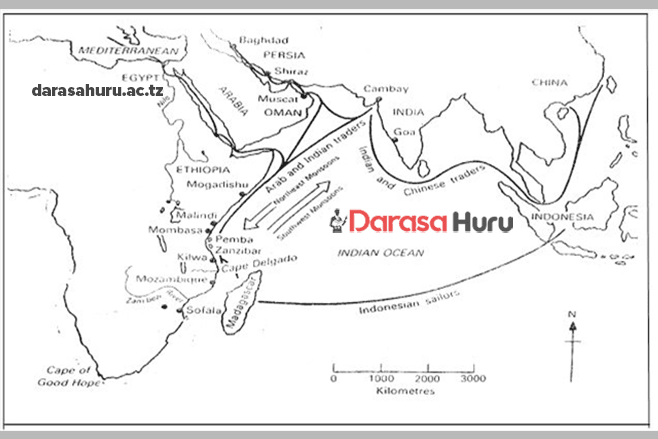
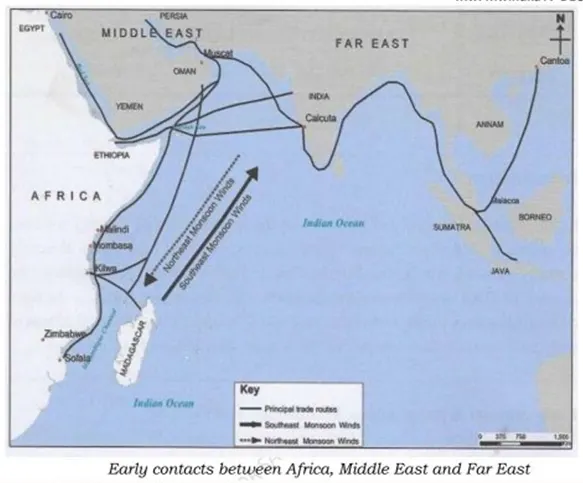
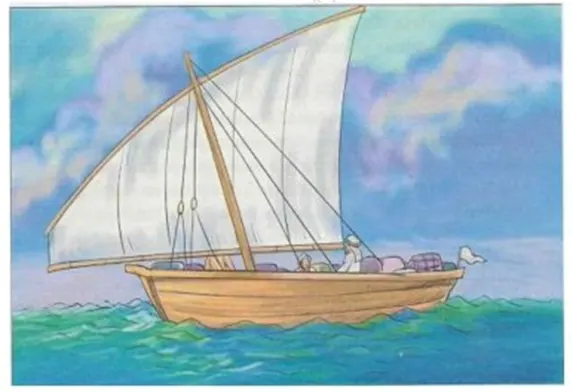
This was a phase in which there was intensive and frequent trade contacts between the east African coastal areas and the middle East countries such as Persia (Iran), Iraq, Oman and Saud Arabia as well as far east countries such as India, china, Malaysia, Indonesia and Sri Lanka, traders from far and middle travelled in dhows which were driven with the help of Monsoon winds.
The winds which blew to the East African coast from the north-east are called North-East Monsoon winds. They blew from November to April every year. These
winds brought traders from Asia to the East African coast. The south-east Monsoon winds blew in the opposite direction.
They blew from the East African coast between May and October. Therefore, the dhows belonging to the sailors from Asia were blown straight to the coast of East Africa by the Monsoon winds between November and April. They were later blown back to Asia by the same winds between May and October.
Evidences of existence of the trade
1. Archaeological findings such as China porcelains, coins, and foreigners tombs in areas like Kilwa Kisiwani and Old Bagamoyo.
2. Written documents; There are three main Greco-Roman documents. The first is known as the Periplus of the Erythrean Sea, which was written by a Greek commercial agent in the 1th century CE. The second document is known as Ptolemy’s Geography, which was written between the 2nd century CE and the 4th century. The third document is called Christian Topography, written in the 6th century CE.
These three Greco-Roman documents reveal the following information.
First, they show the economies of people who had settled on the coast of East Africa by the 1st century CE. The people’s major economic activities were agriculture, fishing and the making of dug-out canoes or dhows.
Second, they reveal the existence of international commercial contacts between the East African coast, the Middle East and the Mediterranean world.
Third, they show the integration of the East African coast into the Roman economic system. Romans called the coast of East Africa Azania, which possibly meant a series of market towns.
Fourth, they reveal possibilities of the emergence of towns along the coast.
Information about these early contacts has also been documented in the early Arab, Chinese and Portuguese travellers’ accounts ..
Factors that enabled the contact
Discovery of compass direction. With this device, the sailors sailed long distance without getting lost easily.
Security. The traders prepared their voyage with escort of armed and trained men to safeguard their commodities. Also the East African societies were not aggressive ensuring existence of peace.
The Monsoon winds helped some people from the Middle East and the Far East to sail their vessels across the Indian Ocean to East Africa and back to their
homelands
Availability of trade goods such as ivory, gold, animal skins and slaves made the traders come to Africa
Accessibility of the coastal areas of Africa made them easily accessible to traders and travellers from both the Middle East and the Far East.
Advancement in maritime technology. The use of sea vessels known as dhows made it easier for sea transport to and from Africa
Exercise
1.Outline three documents that provide evidence of the early contacts between East Africa, the Middle East, Europe and the Far East.
2.Explain the conditions that facilitated the early contacts between East Africa, the Middle East and the Far East.
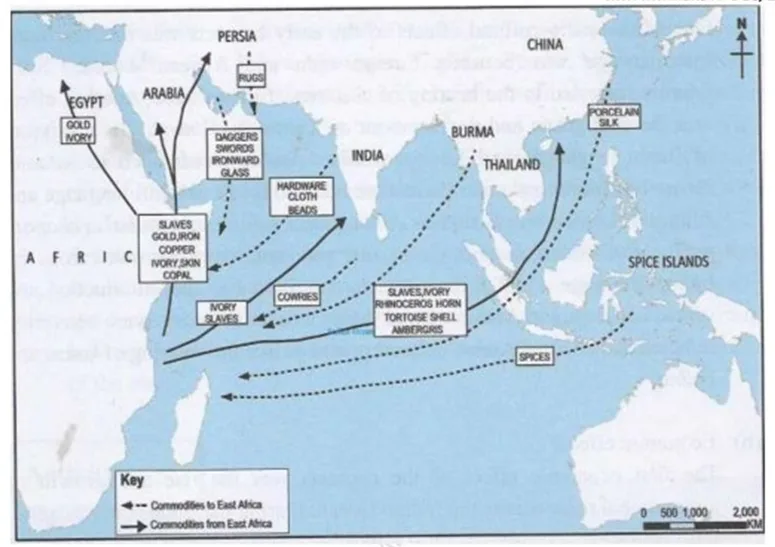
Trade route during the early contact with Asia
MOTIVES OF THE CONTACTS BETWEEN AFRICA, THE MIDDLE EAST AND FAR EAST
I. Social Motives
i. Spreading the Islamic religion, I slam began in the middle east in the 7th century AD from there it spread to many parts of Asia. This resulted in strong Islamic kingdoms in the Arab word. These kingdoms wanted to spread their religion to new parts of the word including Africa
ii. Seeking refuge, some visitors to Africa were fleeing religious and political persecution in their own countries. They therefore came to search peaceful place to settle. iii. Exploration, some came to explore the land of zanj(blacks) people and to see their culture, to explore the accessibility of various parts of African coast and the commodities available and then took their finding back to their home countries.
iv. Establishment of settlements, some visitors decided to live permanently in Africa. Settlements were established by different groups of visitors especially along the coast.
II. Economic motives OF THE CONTACTS BETWEEN AFRICA, THE MIDDLE EAST AND FAR EAST
1. Trade, Trade was the main motive for the contacts between Africans and people from the Middle East and the Far East. The early trade contacts started in about the 2 century bc and continued up to the 7th century when they increased in volume. Traders came to take ivory from the land of Zanj (East Africa) in the early 10th century to Oman and then onto India and China.
Gold from Sofala, tortoise shells and mangrove poles were also exported from the East African coast to the Middle East and the Far East. Other exports included rhinoceros’ horns, ivory and slaves. The items of trade from the Middle East and the Far East included swords, glass, beads,
cotton clothes, silk and porcelain. These items were imported into East Africa from Arabia, Persia, China and India.
2. Commercial exploration, some visitors came to explore Africa and assess its resources, they wanted to know the climatic conditions, mineral resources, wild life resources, and economic activities found in the continent. This way could help them to plan how to exploit resources available, eg sultan Sayyid said of Oman.
EFFECTS OF THE EARLY CONTACTS BETWEEN AFRICA AND MIDDLE AND FAR EAST
A. positive effects
The rise of coastal city States
These states included Mogadishu, Zanzibar, Mombasa, Kilwa and Sofala, they were once small unimportant coastal villages
but they grew into cities due to settlement by foreigners.
Development of Swahili language
Swahili language and culture developed as a result of intermarriage between the people of East Africa Coast towns. Swahili language consists of roughly 65% of Bantu words, 30% of Arabic words and other few Indian words. It provided a common language for the African and Arabs on East Africa coast to use in trade.
Spread of Islam
Arabs and Persians who settled along the Coast of East Africa spread Islam along the coastal state of East Africa. It also extended into the interior. Arabs built Mosque wherever they settled. This was alongside with the introduction of Islamic laws in order to maintain justice and order and these laws were taken from the Muslim Holy book (Quran) and they were administered by the Kadhi (Judge).
New Architectures designs were introduced
The Coastal city-states adopted new style of building. For example, the Persian traders who settled along the coast introduced building using stone style similar to that found in Persia. Evidence of buildings seen in Historical sites such as ruins of Kilwa-Kisiwani and Zanzibar.
Introduction of new style of dressing
The people of Africa adopted new style of dressing from the foreigners. Examples those who were converted to Islamic religion adopted the Islamic mode of dressing. This included the baibui (a long black rob for women), kanzu (a long while robe for men), vails for women and barghashia (a small cap) for men.
Intermarriage
The foreigner intermarried with African, creating a new race of half-castes.
Introduction of new crops
New crops such as rice, wheat, cloves, sugarcane and orange were introduced to the African continent from the Middle East and Far East. Their crops improved the diet of African. In fact, some grew so well the many people adopted them as their staple foods. For example, rice is a staple food among many people along the Coast of East Africa.
Exposing Africa to the outside world
African contacts with the Middle and Far East exposed this continent to the rest of the World. Visitors who came to Africa also travelled to other parts of the world. Africa became involved in the world economy, African products such as Ivory, Gold, Leopard skin and copper became popular and were sold all over the World and in turn African got access to products from outside the continent.
Introduction of money economy
Foreigners introduced the use of currency in trade. This was more convenient and replaced barter trade as the method of exchange. Coins begun to be used in the East African city-states.
Introduction of new technology
People from the Far East and Middle East brought new technology to Africa. For example, they introduced advanced navigation techniques and the art of keeping records by writing. These things helped Africans along the Indian Ocean shoreline to travel further. Fishermen could also sail into deeper, get larger catches and dhows, and still used in some fishing communities.
B. Negative effects
Unequal Exchange
Traders from the Far and Middle East traded with African using goods with unequal values. They took goods of high value such as slaves, gold, ivory and animal skin in exchange of low value items such as beads, cowries’ shells and colored clothes. These commodities from Africa were then sold at great profits in foreign markets; this means that the foreigners gained a lot of expenses of the African.
Introduction of Slave Trade
Oman Arabs introduced slave trade to East Africa. Sultan Seyyid Said introduced clove plantations in Zanzibar and then got slaves
to work in them. In additional they sold slaves to Europeans who began sugar plantations in America.
Exploitation of African resources
Due to high demand of African commoditiesin outside world African resources was greatly exploited. For example, large number of elephants and rhinoceros were killed for their horns and many strong young people were captured and sold as slaves. Therefore, this contributed to reduction of African resources.
Decline of Local industries
The introduction of foreign goods led to the decline of African local industries. Due to the availability of many varieties of clothes, utensils and other tools from abroad few people bought local products so as a results local production also declined.
Cultural interference
This was experienced though interacting with foreigners and adopting their customs. Some Africans forgot their traditional religion,
language, mode of dressing and food. This interfered African way of life.
Warfare and depopulation
Contacts brought slave trade between Africans and Arabs. The demand of slaves caused warfare between African communities. The wars caused insecurity, loss of life, depopulation and underdevelopment in many parts in Africa. Also war occurred due to the fact that Each sultan wanted to control the Indian Ocean trade. As a result, they competed for trade gains and fought each other. For example, the Sultans of Kilwa and Mafia fought between 1310 and 1333 CE. Eventually, Mafia was defeated and lost control of the trade.
Social stratification
Through trading with foreigners, some Africans acquired greatly wealth. This led to the emergence of super-rich class of people among the Africans. These people exercised a lot of power and influence in the community. As result there was greatly stratification, with a big difference between the have and have not.
Early contacts between Africa, the Middle East and the Far East Africa
CLICK HERE TO GET PDF NOTES
Revision questions
1. Choose the most correct answer.
i. The major trade items which were brought to the East African coast from Asia during the early contacts were:
A. Gold, copper, iron and jars
B. Sugar, flour, porcelain and spices
C. Guns, gold, spears and porcelain
D. Porcelain, beads and spices
ii. Traders from the Middle East and the Far East came to East Africa through the Indian Ocean with the help of:
A. Ocean currents
B. Monsoon winds
C. Mozambiquean currents
D. Local winds
iii. One of the following is NOT an effect of the early contacts between East Africa and the Middle East:
A. Introduction of Islamic laws into East Africa
B. Intermarriage between Africans and foreigners
C. Equal gains from the trade between Africans and foreigners
D. Introduction of crops such as cloves and cinnamon
2. Describe how the traders from Asia travelled to and from East Africa.
3. Discuss the argument that the commodities taken from East Africa were more valuable than the commodities imported from the Middle East and the Far East.
4. Write short notes on the following terms.
(a) Monsoon winds
(b) Coastal city states
(c) Periplus of the eritrean sea
5. List the items of trade exported from East Africa to the Middle East and the Far East.
6. Explain the effects of the early Arab and Persian settlements on the east African coast up to 1400 CE.
7. Explain the motives for the development of the early contacts between the Middle East, the Far East and the East African coast up to the 13th century.