INTERACTIONS IN WESTERN AFRICA
The region OF Western Africa was not isolated but deeply connected to the broader African, Mediterranean, Arab and later Western worlds. The interactions laid the foundation for later historical developments, including the colonial intrusion and resistance movements.
Factors for interaction in western Africa
1. Political alliances
For example the Ghana Empire (c. 300-1200 CE) developed political relations with North Africa traders and Berber groups, thus allowing safe passage for merchants. The Mali empire (c. 1235-1600 CE), under rulers like Mansa Kankan Musa, strengthened diplomatic ties with North Africa and the Middle East. Mansa Musa’s famous visit to Mecca (1324) enhanced Mali’s international reputation and established direct relationship with the Islamic world
2. Religious influence
Islam was a major force in shaping the interactions that took place in pre-colonial West Africa. The spread of Islam was facilitated by the North African traders and scholars who settled in West African trading towns, Cities like Timbuktu, Djenné and Gao became Islamic learning and scholarship centres . The development of Islamic influences led to the construction of mosques and learning centres such as the Great Mosque of Djenné and the University of Sankore in Timbuktu
3. War and military
War and military expansions also facilitated the interactions among West African societies. For example, the Oyo Empire (present-day Nigeria) expanded through military campaigns using cavalry forces. Likewise, the Dahomey Kingdom (present- day Benin) had a strong military tradition, including the Amazons of Dahomey, an elite female warrior corp. The Sokoto Caliphate founded by Usman dan Fodio in 1804 also waged a series of Jihads that reshaped political structures in the region
4. Trade
One of the most significant factor of interaction in pre-colonial West Africa was local and regional trade, popularly known as the Trans-Saharan Trade. The trade facilitated the interaction between the people of western Sudan and north Africa and Islamic world leading to economic growth, the expansion of empires and cultural exchanges between different communities. The Trans-Saharan Trade network linked West Africa to North Africa.
Brief discussion about trans Saharan trade.
This was the exchange of goods between Western Sudan and North Africa passing through the Saharan desert.The term “Trans” means across. The Northern people who took their goods across Saharan desert to Western Sudan were the Berbers and Touaregs, also from the Northern Sudan some goods came from Europe and Asia consisted of cotton and silk clothes, swords, guns, metal pans and horses, Commodities that originated from Western Sudan included slaves, ostrich feathers, kola nuts, gold, salt, ivory and food stuffs, Camel were used as the primary means of transport, the Berbers passed through the Saharan desert and collected commodities from Western Sudan, the medium of interchange of goods and services was barter system later cowries’ shells from
Maldives were used as means of exchange, these replaced barter system.
The trade involved different zones which were ranging from Forest i.e. involving the forest states like Benin, Oyo, Kanem, Bornu, and many more. The savannah belt which involved the Western Sudanic states (Ghana, Mali, and Songhai) the Sahara Desert and the North Africa, the Mediterranean world and Europe.
MAJOR TRANS SAHARAN TRADE ROUTES
There were three main trade routes.
- The Western route
- The Central route
- The Eastern route
The Western route
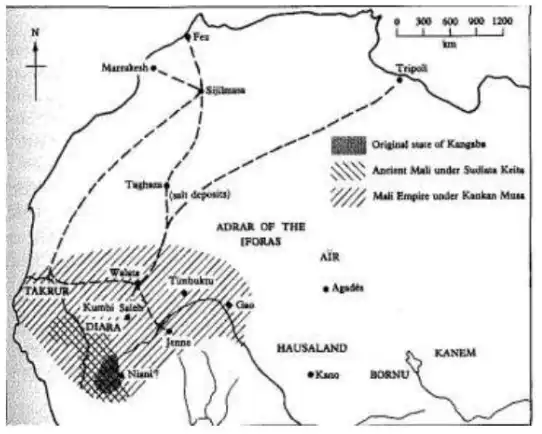
This trade route started at Fez in morocco and passed through Sijimasa, Taghaza, Taoden, Walata, Audaghost, and Timbuktu. The Western route was famous because of the salt work at Taghaza and gold mines of Wangara.
The Central route
This trade route started at Tunis and proceeded to Tuata, taotek, tadmekket, Timbuktu, Gao, kano, and katsina.
The Eastern route
This route originated in Tunisia in Tripoli, Alexandria and Cairo, and proceeded to murzuk, Ghat, Agades,
and Bilma, this trade route was significant due to the salt mine in Bilma.
FACTORS FOR THE GROWTH OF THE TRANS SAHARAN TRADE
i. Political Growth and development
That was evidenced during the 7th century and 16th century cases in point include the Western Sudanic states whose rulers promoted the expansion of the trade, they ensured this by giving a leading hand, security and freedom of movement and also encouraged their people to prepare the goods that were necessary in the trade, examples of these leaders include Askia Mohamed, Mansa Musa, and Tunka Manin,
ii. The conquest of North Africa by the Arabs between 641 and 708
When the Arabs conquered North Africa them being traders naturally, they did introduce their trading system and on top of that they increased the use of camels in North Africa and in the Saharan desert.
iii. Development of production in various regions of the Sudanic zone
As production increased it meant that the supply of commodities to be used in the trade was available as no single community is self-sufficient; this meant that the different societies had to depend upon each other facilitated by the development of production like mining and hand crafts.
iv. The Berbers of the North and the African traders of west Africa trusted each other
These two societies conducted trade without panic of fraud, theft and robbery hence the entire atmosphere of the trading promoted further trade,
v. Its locality and climatic condition facilitated the development of the trans Saharan trade
These two factors facilitated the voluminous production of kola nuts and food stuffs that were badly needed, many parts of Western Sudan never had impassable forests therefore the traders could travel easily with no any setbacks.
vi. Adoption and development of Arabic language in West Africa
Arabic language was adopted as a medium of communication which the merchants used in trade transaction hence with the clear medium of communication the trade accelerated
vii. The introduction and use of camels in 100A.D
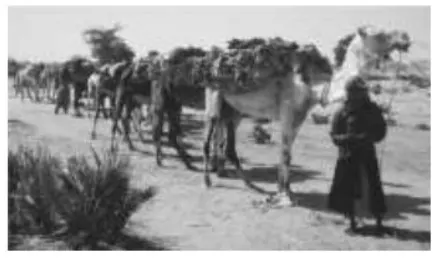
The camels were able to carry more loads than any other animals, the camel can withstand harsher weather than other animals, a camel can stay a very long time without drinking and can still move ahead even with a heavy load on its body. This made the use of Sahara Desert as a route for business between West Africa and their Northern neighbors very successful.
IMPACTS OF THE TRANS SAHARAN TRADE
i. It contributed to the formation of West African states and kingdoms
The profit that were raised from the trade helped in the development of the different states, these were got through the taking over the charge or control over trade routes and every one using that routes had to pay tax or tribute, examples of states developed due to this trade were Ghana empire, Mali empire and Songhai empire.
ii. Spread of Islam in West Africa
The traders were serving two masters at the same time, as they were traders at the same time acted as teachers of Islam a thing that improved literacy in the region.
iii. Emergence and development of towns in West Africa
Due to the trade many areas which previous were once villages turned into towns in what is known as urbanization small villages turned into large towns and cities such as Kumbi Saleh, Gao, Kano, Jenne, Timbuktu, and many other.
iv. The Improvement of political administration
The caravan routes improved political administration of different kingdoms and empires in West Africa through the use and employment of well-educated Muslims traders who had been attracted by the trade, many of the states were also applying Islamic ways of administration in their different areas of jurisdiction.
v. Exploitation of natural resources increased in West Africa
This was due to the influx of many whites in West Africa who then introduced unequal exchange in West Africa.
FACTORS FOR THE COLLAPSE OF THE TRANS-SAHARAN TRADE
i. The germination of suspicion and mistrust among the Arabs, Berbers and Africans
Thus it was unsecure for the merchants to wage trade bartering of commodities amidst the atmosphere of mistrust, fear, and suspicion drastically the rhythm of trade died away.
ii. Death of People and Depopulation
The major towns in North Africa and Western Sudan were affected by the epidemics of plague which claimed some lives of the people, due to these the traders from Europe and Asia fore west the idea of coming to North Africa and this decimated the volume of trade.
iii. Development of Triangular slave trade in the 15th century
Ivory and slaves were quickly and easily exported to Europe through the coast of West Africa hence the volume of goods carried across the Sahara decreased.
CLICK HERE TO GET PDF NOTES