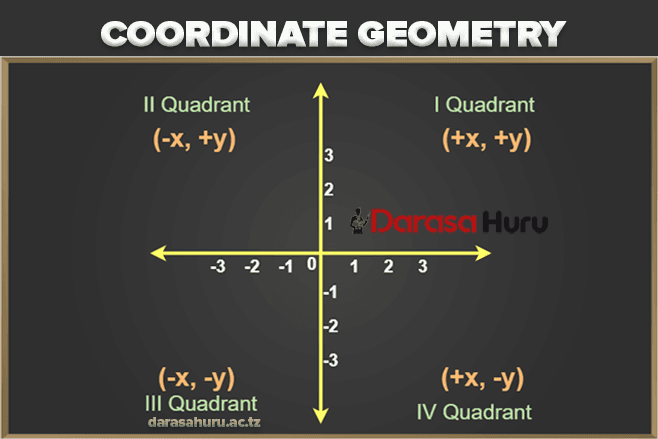
COORDINATE GEOMETRY NOTES I


Exercise
1. Plot the following point. P (2,2), T (-1, -2), L (2, -1)

2. In which quadrants is the?
a. Abscissa positive? I
b. Ordinate negative III
c. Abscissa negative II
d. Ordinate positive I
e. Abscissa negative and ordinate negative? III
EQUATIONS IN A STRAIGHT LINE
Gradient / slope

Equation
A (3,2) N (x,y) m=1
Gradient = 
1 = 
y – 2 = x – 3
y =x – 3 + 2
y=x – 1
Consider two points P (x, y) and (X2, Y2) are given and lie on the same line.
If there exists point N (x, y) which lies on PQ, where X1 ≠ X2 the N lies on the same line If and Only if the slope of PN if the same as the slope of PQ. 
Slope PQ =
P(x ,y) and Q ( X2, Y2)
Slope of PQ (M) = 
Slope at PN =
P(X ,Y) and N ( X, Y)
M = 
Exercise
1. A straight line is drawn through (2, 4) and (-2, 2) . Draw a graph to find where it intersects.
a. The y- axis
b. The x-axis
Solution:

(a) (0 , 3)
(b) (-6, 0)

Equation of line
Choose the points (2, 4)

Will intersect in point (-6, 3)
2. In figure below, find the coordinates of the following points; A,P and L

A (3, 1), P (0,0) , L(-2,-2)
3. Find the gradient of the straight line joining each of the following pairs of points.
a. (1,6) and (5,7)
b. (3,2) and (7,-3)
c. (-3,4 ) and (8,1)
Solution:

4. Find the equation of the line of 2 which passes through the point (3,5)Solution;
M = 2
M = 
2= 
2X – 6 = Y – 5
2X – 6 + 5 = Y
Y=2X – 1
5. For each of the following conditions, find the equations of the line.
a. Passing through points (4,7) having gradient of 3.
b. Passing through point (4,7) and (3,4)
c. Passing through A (4,-3) whose slope is 2/5 of the slope of the line joining A (4,-3) to B (9,7)
Solution
a). 3 = Y-7
X-4
3X-12= Y-7
Y=3X-5
b). M= 7-4
4-3
M=3
3= 
3X – 9 = Y – 4
Y =3X – 5
c). M=  = 2
= 2
 x 2=
x 2= 
= 
4X – 16 – 15 = 5Y
Y= 
6. Verify that the points (-2,2) and ( -6,0) lie on the line joining points A (-4,1) and B (2,4).
Solution
M =  =
= 
M= 
Also
M = 
M=

7. Find the equations of the following straight lines in the form of ax + by + c = 0
a. The line joining the points ( 2,4) and (-3,1)
M=  =
= 
= 
5y – 20 = 3x-6
5y = 3x + 14
3x – 5y + 14 = 0
b. The line through (3,1) with gradient 
Solution:
M=
M = 
= 
-3x + 9 -5y + 5 = 0
-3x – 5y + 14 = 0
(c) = The line through (3,-4) and which has the same slope as the line 5x-2y =3
5x-2y = 3
5x – 3 = +2y

2y + 8 = 5x + -15- 8
2y +8 -8 = 5x-15-8
2y = 5x-23
0= 5x-2y-23
. : 5x – 2y -23 = 0
8. Determine the value of K in order the line whose equation is Kx – y + 5 passes through that point (3,5)
Solution:
Kx – y+5=0
Kx-5+5=0
3K=0
K=0
9. What must be the value of T to allow the line represented by the equation 3X-Ty=16 to pass through the point (5,-4)
Solution
3x-Ty=16
3(5) – Tx-4=16
15 + 4T=16
4T = 1
T = 
10. Find the equation of a line with a slope  having the same Y-intercept as the line
2x – 5y + 20 = 0
Solution:
y = mx +c
5y=  + 20
+ 20
y=  + 4
+ 4
y – intercept x = 0
y = 4
points (0 , 4)
y = m(x – x1) + y1
y =  (x – 0) + 4
y =  + 4
+ 4
11. Determine the value of m and c so that the line Y = mx + c will pass through the points (-1, 4) and (3, 5).
Solution:
M =  =
= 
M =
= 
x – 3 = 4y – 20
x + 17= 4y
y =  +
+ 
c =
Therefore gradient (M) = and c =
EQUATION OF A STRAIGHT LINE
Slope of PQ (M) = 
Y-Y1 = M(X-X1)
Y= MX – MX1+ Y1
Y = MX + C
Example
(3, 5) slope = 2
Y – 5 = 2(X-3)
Y= 2x – 6 + 5
Mid point of a straight line

Similarities;

 =
=  =
= 
= 1
Take;
PC = PQ
QD QR
 = 1
= 1
X-X1 = X2– X
2X= X1 + X2
X = 
 =
= 
QR
 = 1
= 1
2Y = Y2 + Y1
Y= 
Mid point (x, y) = 
EXERCISE
1. Find the coordinates of the mid points joining each of the following pairs.
a. (7,1) and (3,5)
Midpoint = 
= 
= (5, 3)
b. ( 0,0 ) and (12, 3)
Mid point = 
= (6, 1.5)
DISTANCE BETWEEN TWO POINTS
PQ2= PC 2 + BC2
PQ2 = (X-X1)2 + (Y- Y1)2
 =
= 
EXERCISE
1. If the line from (-4, Y1) to (X2, -3) is bisected at (1,-1) .find the values of Y1 and X2
Solution
1= (-4 + X2)/2
2
2 = -4 + X2
X2 = 6
-1 = Y -3
2
-2 = Y1 + -3
Y1 = 1
2. The mid point of a line segment is ( -2,5) and one end point is (1,7) . Find the other end point.
Solution:
Mid point = 
= 
-2 = 
-4 = 1 + X2
X2 = -5
5 = 
10 = 7 + Y2
Y2 = 3
The other points is (-5 , 3)
3. The mid points of the sides of a triangle are ( 2 , 0) and (4, -3 ½ ) and
(6 , ½) .Find the vertices of the triangle if one of them is (4,3) .
Solution
i. Mid point = (2,0)
2 = 4 + X2
2
4 = 4+ X2
X2 = 0
0 = 3+ Y2
2
Y2 = -3
ii. 4 = 4+ X2
2
X2= 8-4
X2= 4
-3.5 = 3 + Y2
2
Y2 = -7-3
Y2 = -10.
iii. 6 = 4+ X2
2
12 = 4 + x2
X2 = 8
0.5 = 3 + Y2
2
1= 3 + y2
Y2 = –2
:. The vertices of the triangle are (0 , -3), (4 , 10) and (8 , -2)
4. Three vertices of a parallelogram ABCD are A (-1,3) ,B(2,7) and C (5,-7). Find the coordinates of vertex D using the principle that the diagonals dissect each other.
Solution:

Mid point H (x, y) = (5-1 ) , (-7+3)
2 2
= (2,-2)
(2,-2) = 2+ X, 7+Y
2 2
4 = 2+ X
X = 2
-4 = 7 + Y
Y= -11
D= ( 2,-11)
EXERCISE
1.Find the distance between the line segments joining each of the following pairs of points.
a. (1,3) and (4,7)
Solution
D = 
D = 
D = 
D = 
D= 
D = 5
b. (1,2) and (5,2)
Solution;
D =
D = 
D = 
D = 
D = 4
2.Find the distance of the following point from the origin.
(-15, 8) (0, 0)
Solution
D =
D = 
D = 
D = 
D= 
D = 17
3. P, Q, R are the points (5,-3) (-6,1) (1,8) respectively . Show that triangle PQR is isosceles

QP =
QP = 
QP = 
QP = 
QP= 
PR =
PR = 
PR = 
PR = 
PR=
Therefore triangle PQR is isosceles
PARALLEL LINES
Two lines are parallel if they have the same slope.
Example
1. Find whether AB is parallel to PQ in the following case.
a. A( 4,3) , B (8,4) P ( 7,1) Q ( 6,5)
Solution
Slope of AB = Change in Y
Change in X
=  =
=
Slope of PQ=  = -4
= -4
Therefore AB and PQ are not parallel line
2. Find the equation of the line through the point ( 6,2) and parallel to the line
X +3Y – 13=0
Solution
X+3Y -13 =0
3Y = -X+13
Y= -X/3 + 13/3
Slope = -1/3
Equation of a straight line
Y – Y1= M (X-X1)
Y – 2 = -1/3 (x-6)
Y = -x/3 + 4
3. Show that A (-3, 1), B (1,2) , C( 0,-1) and D ( -4,-2) are vertices of a parallelograms.

Slope AB =  =
=
Slope CD =  =
= 
PERPENDICULAR LINES
Two lines are perpendicular if they intersect at right angle. Suppose that two lines L1 and L2 are perpendicular with slopes M1 and M2 as shown below.

Choose Point P(x1,y1) , P2(x2, y2) P3(x3, y3), R and Q
Also ∝, β and  are the Greek letters Alpha, beta and gamma respectively representing the degree measures of the triangles as indicated. Then

If two non-vectorlines are perpendicular with slopes M1 and M2,then

Two lines are perpendicular if they intersect at right angles.
If two non vertical lines are perpendicular with slopes M1 and M 2, then
M1 x M2 = 1
Example
1. Find the equation of the line through P (-2 , 5) and perpendicular to the line
6X – 7Y = 4
Solution
y = mx + c
From the equation we get
Y = (  )X –
)X – 
M1 =
M1 x M2 = -1
( ) M2= -1
M2= – 
Equation M = – (-2, 5)

2. Find the equation of the line through the point (6,2) and perpendicular to the line joining P ( 3,-1) and Q ( -2 ,1)
Solution:
Slope of P and Q = 1- -1 = –
-2-3
M1 x M 2 = -1
M2= -1 x -5/2 = 5/2
Equation M = 5/2 (6,2)

3. Find the equation of a line perpendicular to the equation 3X- 11Y -4 = 0
And passing through (- 3, 8)
Solution:
3X – 11Y – 4 =0
Y =mx + c
-11y = -3X +4
Y= 3/11 X – 4/11
M = 3/11
M2 = – 11/3
Equation M = –  ( -3,8)

4. Show that A (-3 , 2) , B ( 5 , 6) and C (7 , 2) are vertices of a right angled triangle.
Solution

Slope of AB x slop of BC = -1
Hence AB is perpendicular to BC
5. Determine which two sides of the following triangles ABC contain a right angle. A(3,2) , B ( 5,-4) , C ( 1, -2)
Solution
Slope AB = -4 – 2 = -6 = -3
5-3 2
Slope BC = -2 + 4 = 2 = – 1 = 1
1-5 -4 2 2
Slope AC = -2-2 = -4 = 2
1-3 -2
Slope of AB x slope of AC = -1
-(1/2) x 2 = -1
Therefore AB is perpendicular to AC
COORDINATE GEOMETRY NOTES II
Equation of a Line
The General Equation of a Straight Line
Derive the general equation of a straight line
COORDINATES OF A POINT
•The coordinates of a points – are the values of x and y enclosed by the brackets which are used to describe the position of point in a line in the plane.
The plane is called xy-plane and it has two axis.
- Horizontal axis known as axis and
- Vertical axis known as axis
Consider the xy-plane below
The coordinates of points A, B, C ,D and E are A(2, 3), B(4, 4), C(-3, -1), D(2, -4) and E(1, 0).
Definition

Example 1
Find the gradient of the lines joining

Example 2
(a) The line joining (2, -3) and (k, 5) has a gradient -2. Find k


Exercise 1
1. Find the gradientof the line which passes through the following points ;
- (3,6) and (-2,8)
- (0,6) and (99,-12)
- (4,5)and (5,4)
2. A line passes through (3, a) and (4, -2), what is the value of a if the slope of the line is 4?
3. The gradient of the linewhich goes through (4,3) and (-5,k) is 2. Find the value of k.
FINDING THE EQUATION OF A STRAIGHT LINE
The equation of a straight line can be determined if one of the following is given:-

Example 3
Find the equation of the line with the following
- Gradient 2 and intercept
- Gradient and passing through the point
- Passing through the points and
Solution


EQUATION OF A STRAIGHT LINE IN DIFFERENT FORMS
The equation of a line can be expressed in two forms

Example 4
Find the gradient of the following lines


INTERCEPTS

Therefore

Example 5
Find the y-intercept of the following lines

Example 6
Find the x and y-intercept of the following lines


Exercise 2
Attempt the following Questions.
- Find the y-intercept of the line 3x+2y = 18 .
- What is the x-intercept of the line passing through (3,3) and (-4,9)?
- Calculate the slope of the line given by the equation x-3y= 9
- Find the equation of the straight line with a slope -4 and passing through the point (0,0).
- Find the equation of the straight line with y-intercept 5 and passing through the point (-4,8).
GRAPHS OF STRAIGHT LINES
The graph of straight line can be drawn by using the following methods;
- By using intercepts
- By using the table of values
Example 7
Sketch the graph of Y = 2X – 1


SOLVING SIMULTANEOUS EQUATION BY GRAPHICAL METHOD
- Use the intercepts to plot the straight lines of the simultaneous equations
- The point where the two lines cross each other is the solution to the simultaneous equations
Example 8
Solve the following simultaneous equations by graphical method

Exercise 3
1. Draw the line 4x-2y=7 and 3x+y=7 on the same axis and hence determine their intersection point
2. Find the solutionfor each pair the following simultaneous equations by graphical method;
- y-x = 3 and 2x+y = 9
- 3x- 4y=-1 and x+y = 2
- x = 8 and 2x-3y = 10
Midpoint of a Line Segment
The Coordinates of the Midpoint of a Line Segment
Determine the coordinates of the midpoint of a line segment
Let S be a point with coordinates (x1,y1), T with coordinates (x2,y2) and M with coordinates (x,y) where M is the mid-point of ST. Consider the figure below:

Considering the angles of the triangles SMC and TMD, the triangles SMC and TMD are similar since their equiangular

Example 9
Find the coordinates of the mid-point joining the points (-2,8) and (-4,-2)
Solution

Therefore the coordinates of the midpoint of the line joining the points (-2,8) and (-4, -2) is (-3,3).
Distance Between Two Points on a Plane
The Distance Between Two Points on a Plane
Calculate the distance between two points on a plane
Consider two points, A(x1,y1) and B(x2,y2) as shown in the figure below:

The distance between A and B in terms of x1, y1,x2, and y2can be found as follows:Join AB and draw doted lines as shown in the figure above.
Then, AC = x2– x1and BC = y2– y1
Since the triangle ABC is a right angled, then by applying Pythagoras theorem to the triangle ABC we obtain

Therefore the distance is 13 units.
Coordinate Geometry
Parallel and Perpendicular Lines
Gradients in order to Determine the Conditions for any Two Lines to be Parallel
Compute gradients in order to determine the conditions for any two lines to be parallel
The two lines which never meet when produced infinitely are called parallel lines. See figure below:

The two parallel lines must have the same slope. That is, if M1is the slope for L1and M2is the slope for L2thenM1= M2
Gradients in order to Determine the Conditions for any Two Lines to be Perpendicular
Compute gradients in order to determine the conditions for any two lines to be perpendicular
When two straight lines intersect at right angle, we say that the lines are perpendicular lines. See an illustration below.

Consider the points P1(x1,y1), P2(x2,y2), P3(x3,y3), R(x1,y2) and Q(x3,y2) and the anglesα,β,γ(alpha, beta and gamma respectively).
- α+β = 90 (complementary angles)
- α+γ= 90 (complementary angles)
- β = γ (alternate interior angles)
Therefore the triangle P2QP3is similar to triangle P1RP2.

Generally two perpendicular lines L1and L2with slopes M1and M2respectively the product of their slopes is equal to negative one. That is M1M2= -1.
Example 10
Show that A(-3,1), B(1,2), C(0,-1) and D(-4,-2) are vertices of a parallelogram.
Solution
Let us find the slope of the lines AB, DC, AD and BC

We see that each two opposite sides of the parallelogram have equal slope. This means that the two opposite sides are parallel to each other, which is the distinctive feature of the parallelogram. Therefore the given vertices are the vertices of a parallelogram.
Problems on Parallel and Perpendicular Lines
Solve problems on parallel and perpendicular lines
Example 11
Show that A(-3,2), B(5,6) and C(7,2) are vertices of a right angled triangle.
Solution
Right angled triangle has two sides that are perpendicular, they form 90°.We know that the slope of the line is given by: slope = change in y/change in x
Now,

Since the slope of AB and BC are negative reciprocals, then the triangle ABC is a right-angled triangle at B.
CLICK HERE TO GET PDF NOTES