CHAPTER 2 SINGING AND MUSICAL INSTRUMENTS – ARTS AND SPORTS STD 5
Musical dynamics
Musical dynamics involve changes in the level of the volume during singing or playing a musical instrument
These changes involve increasing or decreasing the volume. It is important for a singer or an instrumentalist to know when to increase the volume and when to decrease it.
This helps to convey a message and make the emotion of the song clearer. Often, lowering the volume is one of the ways of achieving a soft or gentle sound.
Music dynamics help a listener to understand and feel the emotions expressed through the song.
There are terms and signs used to represent dynamics in a song.
These terms and signs include
1. Piano(p)
This directs to sing or play an instrument softly. It is often used when singing or playing an instrument in a calm manner.
2. Mezzo-piano(mp)
This directs to sing or play an instrument at a moderately soft but with gentleness. It is used when singing or playing an instrument in a calm manner with slight emphasis.
3. Pianissimo (pp)
This directs to sing or play an instrument very softly. It is used when singing or playing an instrument in a state of great calmness or with an exceptionally gentle expression.
4. Forte (f)
This directs to sing or play an instrument loudly. It is often used when singing or playing an instrument in situations of excitement or great emphasis.
5. Mezzo-forte(mf)
This directs to sing or play an instrument moderately loud. It is used when singing or playing an instrument in situations that require moderate emphasis.
6. Fortissimo(ff)
This directs to sing or play an instrument at a very loud and powerful volume. It is used when singing or playing an instrument in situations that require a strong impact or intensity
7. Crescendo (cresc)
This directs to sing or play an instrument, gradually increasing volume. It is used when singing or playing an instrument with greater emphasis on voice. Crescendo is represented using this symbol
8. Decrescendo (decresc.) or diminuendo (dim)
This directs to sing or play an instrument, gradually decreasing the volume. It is used when singing or playing an instrument in a situation that requires a gradual reduction in voice intensity or excitement. Decrescendo is represented using this symbol =-
IMPORTANCE OF DYNAMICS IN MUSIC
1. Enhance the beauty and appeal of the song
Vocal variations in intensity between soft and loud make the song more exciting.
2. Effectively convey the message and emotions of the song.
Vocal rising and falling in a song create an emotion and help listeners understand the song thoroughly.
3. Add variety and avoid monotonous singing
Variation in vocal intensity makes the singing lively and interesting.
VOICE BALANCING
Voice balancing involves maintaining equal volume in singing. It is crucial in singing by involving multiple voices at the same time to achieve a harmonious blend
The key factors to ensure voice balancing in singing include
1. Singing a song while listening to other voices. Each singer should listen to the voices of others and sing in balance
2. No voice should overlap with another without arrangement
3. All voices should be well – balanced and heard clearly without overlapping
4. Practice proper breathing techniques and vocal control to improve singing and voice balance
Solfa singing
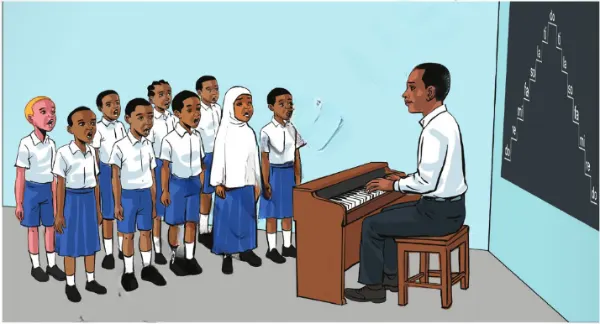
This is a method of singing using specific syllables that represent musical pitches instead of the actual lyrics of a song. These syllables are known as solfa. They are : do, re, mi, fa, so, la, ti. This method makes it easier to learn accurate note singing and helps improve the ability to read and write music

Pupils singing solfa
MUSICAL NOTES
Musical notes are symbols used to represent duration in written music; Musical notes indicate the duration for which a particular note should be sung or played accurately.
In music, there are different types of notes such as whole notes, half notes and quarter notes.
Normally, a whole note lasts four beats, a half note lasts two beats and quarter note lasts one beat.
These musical notes differ in length, so in singing a major scale using solfa, we choose the type of note
Which is used as a tempo. Table number 1 shows whole note, half note and quarter note along with their corresponding beats

A major scale is series of eight notes arranged in order. These notes are do re mi fa so la ti do’. These eight notes are called an octave.
The eight note is a repetition of the first note, but in a higher pitch. The eight note is marked with an apostrophe (‘) to distinguish it from the low do. Figure 2 shows the major scale in ascending order

Major scale in a ascending order
When the arrangement of notes starts from high to low, the solfa syllables are do’ti la so fa mi re do. Figure 3 shows the major scale in descending order

Major scale in descending order
Moreover, these notes can be sung in ascending and descending order as shown in figure below

Major scale in ascending and descending order
MUSICAL INSTRUMENTS IN SOLFA SINGING
Musical instruments play a major role in helping to understand the voice, note arrangement, and musical relationship in practice. In accompanying solfa singing, instruments such as the piano, hand piano, xylophone and guitar are used as a guide to producing the actual pitch of the notes. Also, instruments such as drums and bells are used to set the rhythm. Musical instruments also help to increase the excitement in the participation in singing
HINTS TO CONSIDER IN SOLFA SINGING ACCOMPANIED BY MUSICAL INSTRUMENTS
The use of musical instruments in accompanying solfa singing should follow techniques that enable a person to understand voice, note arrangement, and the singing process.
Important things to consider include
1. Start with simple instruments
It is good to start with simple instruments that are found in your environment before moving on to more complex instruments. So, you can use claps, stamping, drums and bells to guide the beats of the solfa singing.
2. Instruments should not overpower the singers’ voices but should be a guide
Arrange musical instruments according to their function in a way that will not interfere with the singers’ voices.
3. Directly involved in practical learning by playing the musical instrument
So, swap roles to gain experience, for example, one group can sing while the other accompanies the instrument.
4. Correcting solfa singing mistakes using the instrument
A musical instrument, such as a piano, helps to correct mistakes in solfa singing by providing the correct pitch. The correct note can be played on the instrument while a singer listens and later sings it.
5. Increase creativity in accompanying solfa singing
It is good to use instruments that stimulate the learning environment, such as drums. Also, various styles of playing instruments, such as playing slowly and then gradually increasing the speed, can be used.
Exercise ON SINGING AND MUSICAL INSTRUMENTS
1. Mention at least three advantages of learning to sing by using solfa
2. Why is it important for a singer to balance their voices when singing together?
3. Explain how musical instruments help in learning solfa singing